
Closing Time: The hottest AI lab is paying surge prices
TechCrunch reports that Anthropic’s revenue jumped to $17 billion last quarter, but it had to buy $5 billion of computing power on short notice at premium prices, and its margins got worse as a result.

Good afternoon. Today’s AI news came down to one question: who is paying for all the computing power, and how much. Here is what mattered.
Anthropic’s revenue jumped to $17 billion last quarter, but it had to buy $5 billion of computing power on short notice at premium prices, and its margins got worse as a result, TechCrunch reports.
Google agreed to stand behind Anthropic’s $19 billion of leases at a TeraWulf data center campus in Kentucky, promising to pay the rent and take over the leases if Anthropic ever defaults, according to Reuters.
AMD’s data center sales nearly doubled to a record $8.5 billion as its newest AI chips began shipping to customers including Anthropic, Meta, Microsoft and OpenAI, CNBC reports.
Oracle scrapped a roughly $7 billion deal to lease about 100,000 advanced AI chips to China’s Tencent after U.S. officials raised concerns, Bloomberg reports, citing the Financial Times.
Datadog shares sank even though the company beat forecasts, because its largest customer, an unnamed AI company, is cutting back how much it uses the service, Quartz reports.
The Wire
The latest headlines from our live AI news feed.
Sam Altman says his 'terrible' RAM-in-PCs comments were taken out of context
The Verge
TeraWulf gets credit backstop from Google for Anthropic data-center project
Reuters
Voters pass data center bans and restrictions in at least 29 jurisdictions as AI backlash grows
The Washington Post
Oracle cancels $7 billion Tencent AI chip lease under Trump administration pressure
Financial Times
The hottest AI lab is paying surge prices
Anthropic is growing at a pace few companies have ever seen. Revenue reached $17 billion in the third quarter, up from $11.5 billion just three months earlier, according to the updated IPO filing the company released this week. But the more it grew, the more it had to pay for the computers that run Claude, and its margins moved the wrong way, TechCrunch reports.
The problem is a familiar one to anyone who has booked a ride at rush hour. Demand rose so fast that Anthropic could not wait for the cheaper capacity it had locked in under long-term contracts. It bought $5 billion of computing power on short-term deals, which the filing says costs significantly more, and computing costs climbed to 58% of revenue from 48% the quarter before.
Put another way, every dollar Anthropic spent on computing brought in about $1.72 of revenue last quarter, down from just over $2 the quarter before. That pushed the company to an operating loss of $567 million after a profit in the spring. The filing also lists about $895 billion of future spending commitments, nearly all of it for computing and data centers, and warns that short-term purchases will keep squeezing margins for now.
The companies selling the picks and shovels are cashing in. AMD said its data center business brought in a record $8.5 billion, up 97% from a year earlier, and that Anthropic, Meta, Microsoft, OpenAI and Oracle are already running workloads on its new rack-sized Helios systems. The chipmaker expects about $17 billion of revenue this quarter, CNBC reports.
Paying for the buildings is its own puzzle, and Google stepped in today. Under deals disclosed Wednesday, Google will back Anthropic’s 20-year leases for about 401 megawatts of capacity at TeraWulf’s campus in Hawesville, Kentucky. If Anthropic misses a payment or becomes insolvent, Google can pay the rent and take over the leases. The backstop ends once Anthropic holds investment-grade credit ratings for three months, Reuters reports.
That guarantee matters because lenders are being asked to fund enormous projects for a company that is still losing money on an operating basis. A promise from Google, one of Anthropic’s biggest investors, makes it easier for a former bitcoin miner like TeraWulf to borrow what it needs to build.
The bigger picture is that AI demand is not the problem right now. Supply is. The labs with the fastest-growing products are paying whatever it takes to keep up, and investors will have to decide whether that premium is a growing pain or a permanent cost of competing at the top.
Elsewhere in AI today
Washington is deciding who gets the chips. Oracle cancelled a five-year lease that would have given Tencent access to about 100,000 advanced AI chips in Oracle data centers across Southeast Asia, after U.S. officials raised concerns, the Financial Times reported. Officials in Tencent’s home province of Guangdong also urged the company to back Chinese-made chips, Bloomberg reports.
Not every AI customer is spending more. Datadog reported revenue of $1.20 billion, up 35%, and beat Wall Street’s profit forecast, but its outlook assumes its largest customer, an AI company it did not name, cuts usage down to the minimum it has committed to. The company said growth outside that customer sped up again, Quartz reports.
Canva is restructuring. The Australian design platform said changes affecting 1,271 people, about 22% of its global workforce, will include layoffs and requests to relocate to central hubs. Chief executive Melanie Perkins called it “without doubt the hardest moment” in the company’s 13-year history. Canva did not mention AI, but the cuts come as software makers race to compete with cheaper AI tools, The Guardian reports.
Japan wants an early look at software flaws. Tokyo plans to ask U.S. AI developers and other overseas tech companies to share serious vulnerabilities before they become public, so government agencies and critical infrastructure operators can patch them first. It is part of an emergency cybersecurity package Prime Minister Sanae Takaichi ordered after a wave of attacks on Japanese companies, Nikkei Asia reports.
Markets
It was a split day for AI stocks. The broad market rallied, as the Dow rose 3.0%, the S&P 500 rose 1.6% and the Nasdaq rose 1.4%. But the Philadelphia semiconductor index fell 3.1%, and only 30 of the 86 AI and tech stocks we track were higher.
The Biggest winners table is led by the largest tech platforms. AppLovin jumped 10.7% ahead of its earnings report after the closing bell, and Shopify climbed 7.3%. Microsoft gained 6.7%, Amazon rose 6.1% and Qualcomm added 5.3%.
Datadog tops the Biggest losers table after sinking 14.4% on its weaker outlook. Most of the rest of the list builds and powers AI data centers. Power producer Vistra dropped 13.9% after Texas election results rattled investors in the AI power trade and KeyBanc downgraded the stock. Cooling and power equipment maker Vertiv fell 12.9%, electrical equipment maker Eaton lost 9.9% and AI cloud provider CoreWeave slid 9.9%.
Biggest winners
| Ticker | Name | Price | Day |
|---|---|---|---|
| APP | AppLovin | 271.75 | +10.69% |
| SHOP | Shopify | 153.03 | +7.34% |
| MSFT | Microsoft | 555.80 | +6.68% |
| AMZN | Amazon | 266.03 | +6.12% |
| QCOM | Qualcomm | 173.19 | +5.33% |
Biggest losers
| Ticker | Name | Price | Day |
|---|---|---|---|
| DDOG | Datadog | 188.72 | -14.42% |
| VST | Vistra | 120.22 | -13.88% |
| VRT | Vertiv | 205.54 | -12.89% |
| ETN | Eaton | 352.78 | -9.94% |
| CRWV | CoreWeave | 48.42 | -9.90% |
Prices are from Wednesday’s U.S. trading session, November 4, 2026, versus Tuesday’s close.
Aigentic Exclusive
FEATURED DEEP DIVE
AI’s Next Building Boom Has to Get Past the Voters
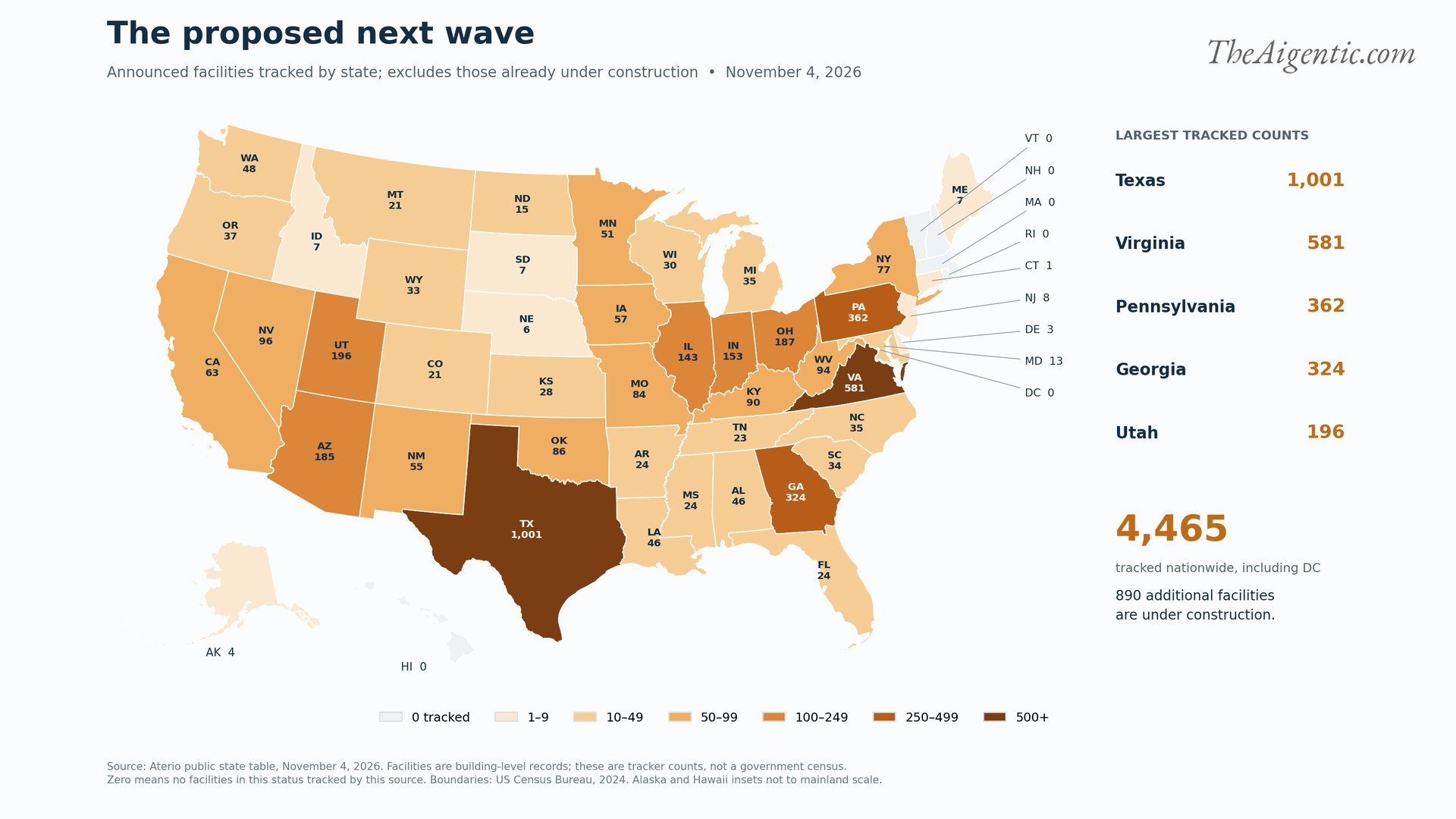
Nearly 79% of voters in Sunbury, Ohio, backed a charter amendment blocking large data centers, while statewide results showed only a weak link (a correlation of about 0.18) between announced facilities and shifts in governor vote margins. Texas leads the nation with 1,001 announced facilities, and Gina Hinojosa, reported winner of the governor’s race there, campaigned for a moratorium. We explain why local consent, utility cost allocation and enforceable commitments will shape the next AI buildout, and you can download our free report, Data centers and the 2026 election (PDF).
FEATURED TOOL
Local votes are deciding where AI gets built. Enter your town or ZIP to see announced and operating data centers in your area.
Watch
Matthew Berman — MIT Researchers Discover AI Can Rewrite Its Own Weights
Matthew Berman walks through a new MIT paper on what the researchers call weight space programming, where a frontier model reads the raw numbers inside another AI model and edits them directly.
In one test, the model studied a small neural network that steers a car over a ramp, worked out why it kept failing, and rewrote about 3.5% of its weights so the car succeeded in all 1,024 attempts. Berman explains why that could help researchers finally see inside AI systems that have long been black boxes.
It also raises the question hanging over the industry this week: if a model can improve another model this way, how long before it can improve itself?
Watch it for a clear, jargon-light explanation of a paper a lot of people will be talking about.
AI News & Strategy Daily with Nate B Jones — Elon’s AI Agent Has a Massive Cost Problem
On AI News & Strategy Daily, Nate B Jones starts with Elon Musk’s admission that xAI’s Grok Bot agent costs too much to serve for the revenue it brings in.
The twist is that xAI’s own write-ups show the same agent finding 43 unused software seats and saving the company more than $14,000. Jones argues both things can be true, because an agent’s value depends entirely on the work you hand it.
It pairs well with today’s lead. Computing power is getting more expensive, so the agents worth paying for will be the ones aimed at work that truly matters.
Watch it if you are trying to decide whether your AI tools are earning their keep.
Matt Wolfe — The Definitive Guide To Editing Video With Claude
Matt Wolfe shows how he now uses Claude to edit his short-form videos, from pulling a script out of raw footage to cutting in B-roll and assembling a finished clip.
He says several of his AI-edited shorts have passed a million views, and he walks step by step through setting up the workflow, including the snags he hit along the way. He notes the same approach works with OpenAI’s Codex.
Watch it if you make video and want to hand off the most tedious part of the job.
Peter Yang — My Mom Has Cancer Again. Here’s How I’m Using AI to Fight It
Peter Yang shares a personal one: his mother has cancer for the fourth time, and he explains how he is using AI as her caregiver.
He built a free tool that keeps a one-page brief of her diagnosis, next steps and questions for doctors, and he uses AI to organize medical records, research standard treatment guidelines and prepare for second opinions. His biggest lesson is that AI helped most with the paperwork, not the medicine.
Watch it if you are helping a loved one through a serious illness.
My First Million — AI proof businesses worth building in 2027
On My First Million, Shaan Puri and Sam Parr make the case that some of the safest businesses in an AI world are not AI businesses at all.
Their favorite examples are paid peer groups and communities, like the auto dealer groups where owners pay thousands of dollars a year to compare their books line by line with peers from other regions. The point is that trust and relationships are hard for software to replace.
Watch it if you want business ideas that do not depend on keeping up with the next model release.