
AI’s Next Building Boom Has to Get Past the Voters
The next wave of data centers will depend on whether developers can win local acceptance, deliver credible benefits and pay the infrastructure costs their projects create.
In Sunbury, Ohio, the vote was 2,809 to 763. Nearly 79% of voters backed a charter amendment prohibiting construction of data centers with an aggregate monthly demand or peak electrical load above 25 megawatts. The preliminary returns included all six precincts; the measure’s language set a specific limit on what could be built.
For companies planning the next generation of AI infrastructure, that result raises a question that money alone cannot settle: will the communities hosting these facilities agree to the bargain?
Find data centers near you
Enter your town or ZIP code in our data center lookup to see the closest existing and proposed data centers, along with phone numbers and contact links for your U.S. representative and senators.
A developer can promise investment and construction work. Residents still have to judge whether the lasting benefits justify the demands on electricity, water and land. Their answer can determine whether an announced campus becomes an operating business.
Sunbury provides direct evidence of opposition to a particular kind of development. Statewide elections require more careful interpretation. Our accompanying report found a weak relationship between announced data center counts and the change in Democratic gubernatorial vote margins from 2022 to 2026: a correlation of approximately 0.18 across 31 comparable states. The calculation is preliminary and does not control for population, incumbency or the broader political environment.
That result does not establish that data centers drove statewide outcomes. It also cannot tell us how strongly a proposed project affected voters in the immediate neighborhood. Local ballot measures answer a narrower question much more directly.
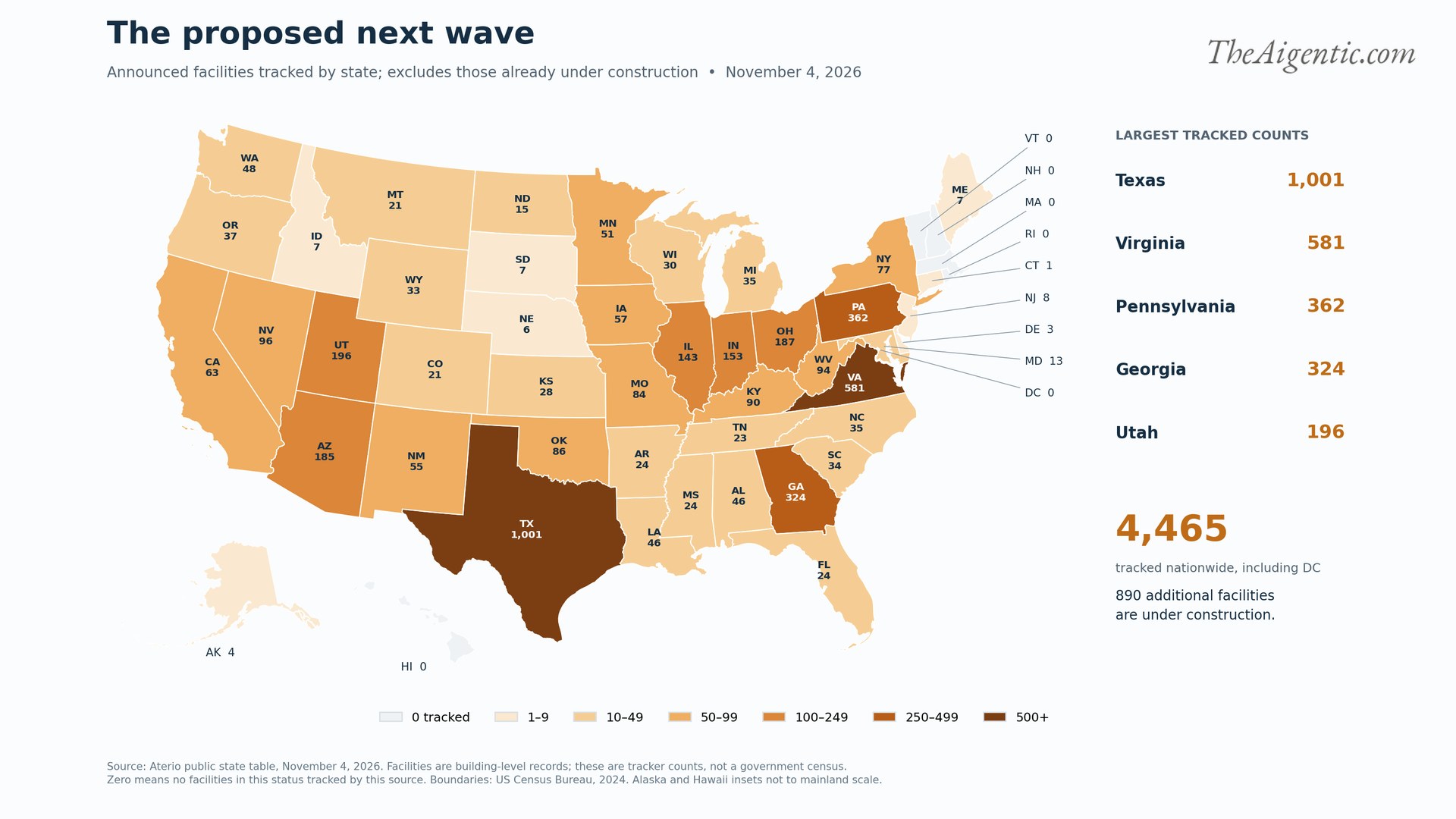
The geography helps explain why the issue now matters nationally. In Aterio’s November 4 snapshot, Virginia leads with 353 operational facilities, followed by Texas with 246 and California with 171. Texas dominates the announced pipeline, with 1,001 facilities, plus another 184 under construction.
| State | Operational | Under construction | Announced |
|---|---|---|---|
| Texas | 246 | 184 | 1,001 |
| Virginia | 353 | 140 | 581 |
| Pennsylvania | 41 | 23 | 362 |
| Georgia | 76 | 64 | 324 |
| Utah | 31 | 9 | 196 |
The five largest announced pipelines in Aterio’s November 4, 2026 snapshot. Counts cover tracked data center facilities, including uses beyond AI. Announcements are not guaranteed completions; buildings differ greatly in power demand.
Texas’s decisions therefore reach beyond its own borders. Republican Governor Greg Abbott had already halted new Texas Commission on Environmental Quality data center permits in September. Gina Hinojosa, the Democrat reported to have won Tuesday’s governor’s race, campaigned for a moratorium until lawmakers establish protections and give communities more control.
The dispute crosses party lines. The practical questions are how long approvals remain suspended, what conditions replace the pause and which projects still need the affected permits. A campaign position does not by itself determine the fate of every development in a state.
Timing makes the distinction consequential. SemiAnalysis’s November 1 outlook estimates that roughly three-quarters of the 33.8 gigawatts due in its top 20 states in 2027 is already under construction. Its separate nationwide forecast calls for 62.2 gigawatts of net additions in 2028, most of which has not begun construction. These are commercial forecasts with different geographic scopes, not completed capacity or a like-for-like growth comparison.
Our reading is that the later pipeline offers policymakers more opportunity to change the terms before developers make their largest commitments. Projects still awaiting permits or utility agreements could face delays or higher costs. The effect will depend on each project’s approvals and schedule; an announcement alone cannot tell us which capacity is at risk.
The benefits deserve the same scrutiny as the costs. Virginia’s Joint Legislative Audit and Review Commission estimated in 2024 that the industry contributed $9.1 billion annually to the state’s GDP, with most economic benefits arising during construction. Industry representatives told the commission that a typical 250,000-square-foot facility might employ about 50 full-time workers, roughly half contractors, while peak construction could put approximately 1,500 people on site.
Construction work is a real benefit. It should be presented separately from permanent employment, with clear expectations about how much work will go to local residents. A large investment announcement is not a substitute for those details.
JLARC also found substantial local tax revenue, while noting that reduced tax rates on computer equipment diminish what communities collect. The relevant bargain is the revenue left after incentives and public obligations, rather than the headline value of a campus. Towns should be able to see the assumptions behind that calculation, including equipment depreciation, promised staffing and who pays for new infrastructure.
Electricity costs are especially sensitive to how utilities are regulated. A working paper published through MIT’s Center for Energy and Environmental Policy Research, revised in October, links data center entry from 2010 through 2024 to utility outcomes. It estimates an average 2.1% increase in residential retail electricity rates after entry. Effects vary by utility ownership and market structure, and price effects are smaller where utilization improves.
That estimate is not a prediction that every household near a new campus will receive the same increase. It shows why the local utility arrangement matters. Additional demand can help spread existing costs, but serving it can also require expensive new infrastructure. Whether households benefit or pay more depends on the system and the rules for recovering those costs.
There are already enforceable terms to examine. Under AEP Ohio’s approved data center tariff, the initial contract lasts eight years plus a ramp-up period of up to four years, with minimum demand charges and financial security requirements. Its service process requires reimbursement of buildout costs when a customer cancels, or delays more than 12 months, before the target energization date. Ohio’s consumer advocate reports that industry groups appealed the tariff.
The principle is straightforward: if a utility invests to serve a project, the customer should remain financially responsible for agreed costs even if its plans change. Such contracts can address specific risks; they cannot guarantee that all regional electricity prices remain unchanged or that every resident will support the development.
Water and neighborhood impacts also require site-specific evidence. JLARC found that cooling design, computing density and facility size produce widely differing water needs. It also documented problems with persistent noise near homes. A statewide average cannot tell a town what a proposed campus will do to its water supply or how it will sound at night.
A credible approval process could test a small set of commitments before construction begins:
| Concern | Commitment to examine |
|---|---|
| Electricity costs | Regulator-approved cost allocation, binding payment obligations and financial guarantees for project-related infrastructure. |
| Jobs and taxes | Separate construction and permanent jobs; disclose incentives and net fiscal projections; require repayment where legally agreed targets are missed. |
| Water and noise | Publish site-specific water budgets and drought plans; set measurable noise limits, monitoring duties and consequences for violations. |
| Local accountability | Make material commitments public before approval and identify the authority responsible for enforcing each one. |
These are terms worth testing, not evidence that a particular package will win a vote. Some communities may reject a project even after its developer agrees to pay more. Others may accept industrial development that brings dependable revenue and protects existing residents. Developers also need a clear route to approval, so they can evaluate the cost of meeting the rules before committing capital.
Sunbury’s vote makes the challenge tangible. AI companies can describe why they need more computing capacity. To build it, they must also show why a particular community should want to host it—and make the promises that matter enforceable.
Free research brief
Download Data centers and the 2026 election (PDF), our free report with maps of current facilities and announced buildouts, state rankings, election comparisons and source notes. Election returns remain preliminary; project data and forecasts are snapshots as of November 4, 2026.
Near you: Look up the closest existing and proposed data centers by town or ZIP code, and get contact details for your members of Congress.