
Google’s chips are leaving the building
The Information reports that OpenAI plans to buy Google’s AI chips, known as tensor processing units, instead of only renting them as it has since last year.
· The Aigentic · Morning Brief
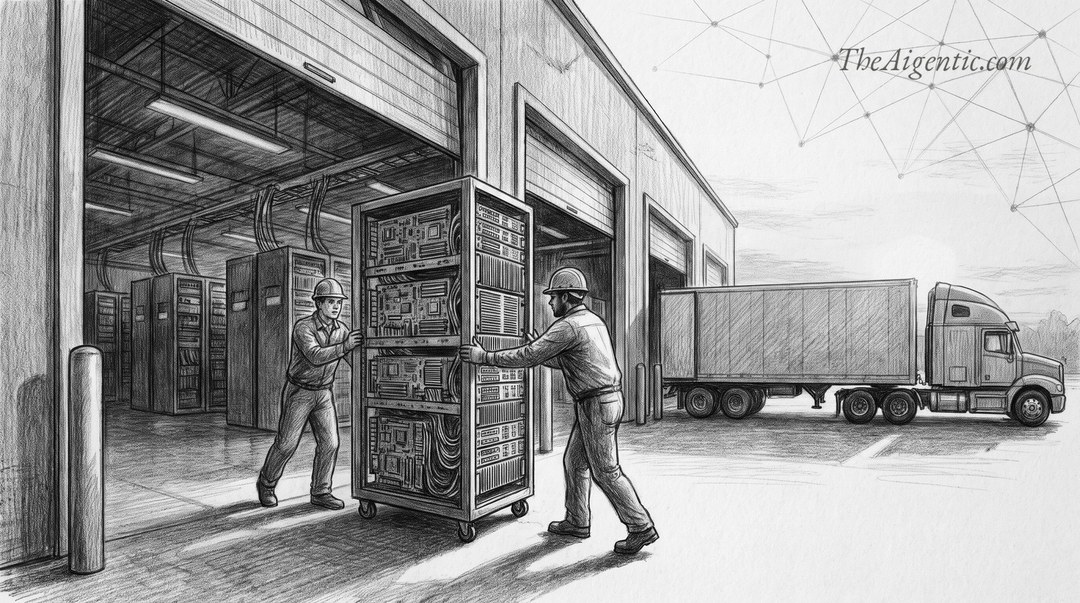
Good morning. For years the only real way to buy top-tier AI computing power was to buy from Nvidia. This morning OpenAI is reportedly lining up Google’s chips, and Oracle is putting them in its cloud, which means Google’s custom silicon is finally leaving Google’s buildings. Elsewhere, Washington is getting Claude at a steep discount, the Dutch government wants AI to replace a sixth of its civil servants, AI agents checked the longest proof in mathematics, Cloudflare owned up to a data leak, and the White House wants a new name for the whole field. Here is what moved while you were away.
The Information reports that OpenAI plans to buy Google’s AI chips, known as tensor processing units, instead of only renting them as it has since last year. Bloomberg confirmed the plan with its own source, though neither company would comment and no price or chip count has surfaced. The same day, Oracle said it will offer Google’s TPUs inside its own cloud, the first time the chips will run on a rival’s platform. “The next generation of AI will require a diverse range of compute,” Google executive Amin Vahdat said in announcing the Oracle deal. For a decade Google kept its best silicon mostly for itself. Now it is selling to the company it competes with hardest, which says a lot about how badly everyone wants an alternative to Nvidia. Alphabet reports earnings later today, so expect analysts to ask how much of this shows up in the cloud numbers.
Nextgov reports that the General Services Administration and Anthropic expanded their OneGov deal, giving government buyers a 40% discount on token-based use of Claude with no minimum purchase. For the first time the discount reaches state, local and tribal governments as well as federal agencies, and Anthropic estimates it could save them $1 billion. Roughly 500 U.S. government organizations already use Claude, according to the company. The deal lands days before Anthropic’s old $1-per-user federal offer expires on Oct. 31, and a few weeks after OpenAI signed a 50% discount of its own.
the aigentic
Know what matters in AI.
The stories shaping AI, the tools worth trying, and what they mean for your work.
Morning Brief + Closing Time. Two emails every weekday.
Free. Unsubscribe anytime.
DutchNews reports that the Netherlands plans to cut about 25,000 civil service jobs by 2035, roughly 16% of central government, and is counting on AI to carry much of the load. Eric van der Burg, the minister in charge, wants savings of €3.5 billion a year by then, with police and defense exempt and detailed AI plans due early next year. He admitted that efficiency alone will not cover the gap, saying some choices will have to be made about what the government does less of or stops doing entirely. It is one of the boldest plans yet to shrink a government payroll with AI, and the rest of Europe will be watching whether it holds.
Axiom says it has produced the first complete computer-checked proof of the Classification of Finite Simple Groups, often called the longest proof in the history of mathematics. The original spans about 15,000 pages across more than 500 papers by around 100 mathematicians. Over 24 days, Axiom’s team directed dozens of AI agents to rewrite it in the Lean proof assistant, producing about 43.1 million lines of code in which a computer checks every logical step. Along the way the work turned up 34 noteworthy deviations from the published record, which Axiom plans to share with the group theorists whose work the classification rests on.
Cloudflare disclosed that its Workers AI service sent 155 responses containing data from other customers’ requests between Aug. 27 and Sept. 9. The leak came from the GLM-5.3 model, where a configuration mismatch triggered a bug in SGLang, the open-source software that runs the model, so some very long prompts were answered using memory left over from earlier requests. Cloudflare says it found no sign anyone exploited it, and it has fixed both its setup and the underlying software. It is a useful reminder that AI services share hardware between customers, and the plumbing that keeps them apart is still young.
The Hill reports that President Trump says he will ban the term “artificial intelligence” in government documents in favor of “Super Intelligence,” or SI. He made the announcement on Truth Social, and it builds on an executive order earlier this month that tells agencies to use SI in new official communications. The change is already showing up: GSA’s own release announcing the Claude discount describes it as access to “advanced super intelligence tools.”
Deals Desk
The newest compute and power deals on our tracker:
Oct 27 — Naver × Brookfield: Naver will rent GPUs and data center capacity for its AI Factory from a Brookfield-funded vehicle, worth up to $9 billion of GPUs and data centers by 2028. The tentative plan starts with 55 MW in the first half of 2027 in South Korea, rising to 100 MW by the end of 2027 and 200 MW in 2028, with a long-run goal of 1 GW. Signing the deal also clears the way for Nvidia’s roughly $1 billion investment in Naver. Digital Today
Oct 27 — Unnamed U.S. tech company × Baker Hughes: A major U.S. technology company ordered about 1.1 GW of on-site gas-turbine power from Baker Hughes for an AI computing site, including 34 Frame 5 turbines and nine NovaLT16 turbines, plus dry coolers for closed-loop cooling. The customer, the site and the order value were not disclosed. GlobeNewswire
Oct 27 — CoreWeave × atNorth: CoreWeave is leasing 22.5 MW at atNorth’s DEN01 data center in Ballerup, near Copenhagen, its first deployment in Denmark. Most of that capacity is already online, and waste heat from the site feeds local district heating. DCD
Full tracker → theaigentic.com/deals
Yesterday’s movers
Biggest AI and tech winners and losers from Tuesday’s (Oct. 27) U.S. cash session among the names we follow, a broad up day when 68 of 86 stocks closed higher. AI infrastructure names led the gainers: Celestica, which builds servers and networking gear for data centers, jumped 11.99%, AI cloud provider Nebius rose 11.22% and connectivity chipmaker Astera Labs added 10.47%. Defense-focused AI analytics company BigBear.ai climbed 11.48%, and quantum computing company Rigetti gained 8.74%. Software and services had a rougher day, led lower by consulting firm Accenture, down 4.90%, along with C3.ai, down 3.99%, Adobe, down 3.97%, Intuit, down 3.37%, and Salesforce, down 2.71%.
Biggest winners
| Ticker | Name | Price | Day |
|---|---|---|---|
| CLS | Celestica | 276.22 | +11.99% |
| BBAI | BigBear.ai | 2.36 | +11.48% |
| NBIS | Nebius | 170.47 | +11.22% |
| ALAB | Astera Labs | 286.69 | +10.47% |
| RGTI | Rigetti | 12.44 | +8.74% |
Biggest losers
| Ticker | Name | Price | Day |
|---|---|---|---|
| ACN | Accenture | 235.11 | -4.90% |
| AI | C3.ai | 12.28 | -3.99% |
| ADBE | Adobe | 248.36 | -3.97% |
| INTU | Intuit | 328.45 | -3.37% |
| CRM | Salesforce | 240.90 | -2.71% |
Prices are Tuesday’s U.S. closing prices versus Monday’s close. Market data is a snapshot, not live.
Aigentic Exclusive
FEATURED HANDS ON
Claude Duet vs. Muse vs. Dots vs. Grok Bot: Which Personal Agent Should You Use?
Claude Duet, Muse, Dots or Grok Bot? Our new Hands On guide compares four personal agents side by side on what each is best for, what it costs and who can get it today. You'll also find one starter prompt for each agent and a one-week trial to see which one actually saves you time.
Watch
Three picks this morning: Wes Roth on what OpenAI’s math claim could mean for computing, Alex Finn running a DeepSeek model on two desktop AI computers, and David Ondrej on the newest open model from Moonshot’s Kimi line.
Wes Roth — OpenAI just broke physics...
Wes Roth takes on one of the biggest science claims of the week: OpenAI’s statement that its AI disproved the Exponential Time Hypothesis, an assumption that has shaped decades of computer science.
He explains how that idea connects to the famous P versus NP problem, and what it could mean for encryption and for AI itself if hard problems turn out to have shortcuts.
Watch this if the headlines about AI and math went over your head and you want the stakes explained in plain terms.
Alex Finn — Deepseek 4.1 Flash on 2 DGX Sparks changed my life
Alex Finn unboxes two Nvidia DGX Spark desktop computers, links them into a small cluster and loads DeepSeek 4.1 Flash onto the pair.
He then tests the model on real tasks to see how far a setup on your own desk can go without sending anything to the cloud.
Watch this if you are weighing whether running AI locally is worth the hardware.
David Ondrej — kimi k3.1 changes everything...
David Ondrej looks at Kimi K3.1 Pro, the newest model from Moonshot AI, which he calls by far the best open-source model in the world.
It is a quick way to see what the latest open model can do at a moment when the gap between open and closed models keeps shrinking.
Watch this if you build with open models and want a first look before you switch.