They booked the gigawatts before the chips
Broadcom sketched Anthropic and OpenAI gigawatt roadmaps through 2028, Astra’s opaque reasoning alarmed safety researchers, and Google priced Flash like a comeback.
· The Aigentic · Morning Brief
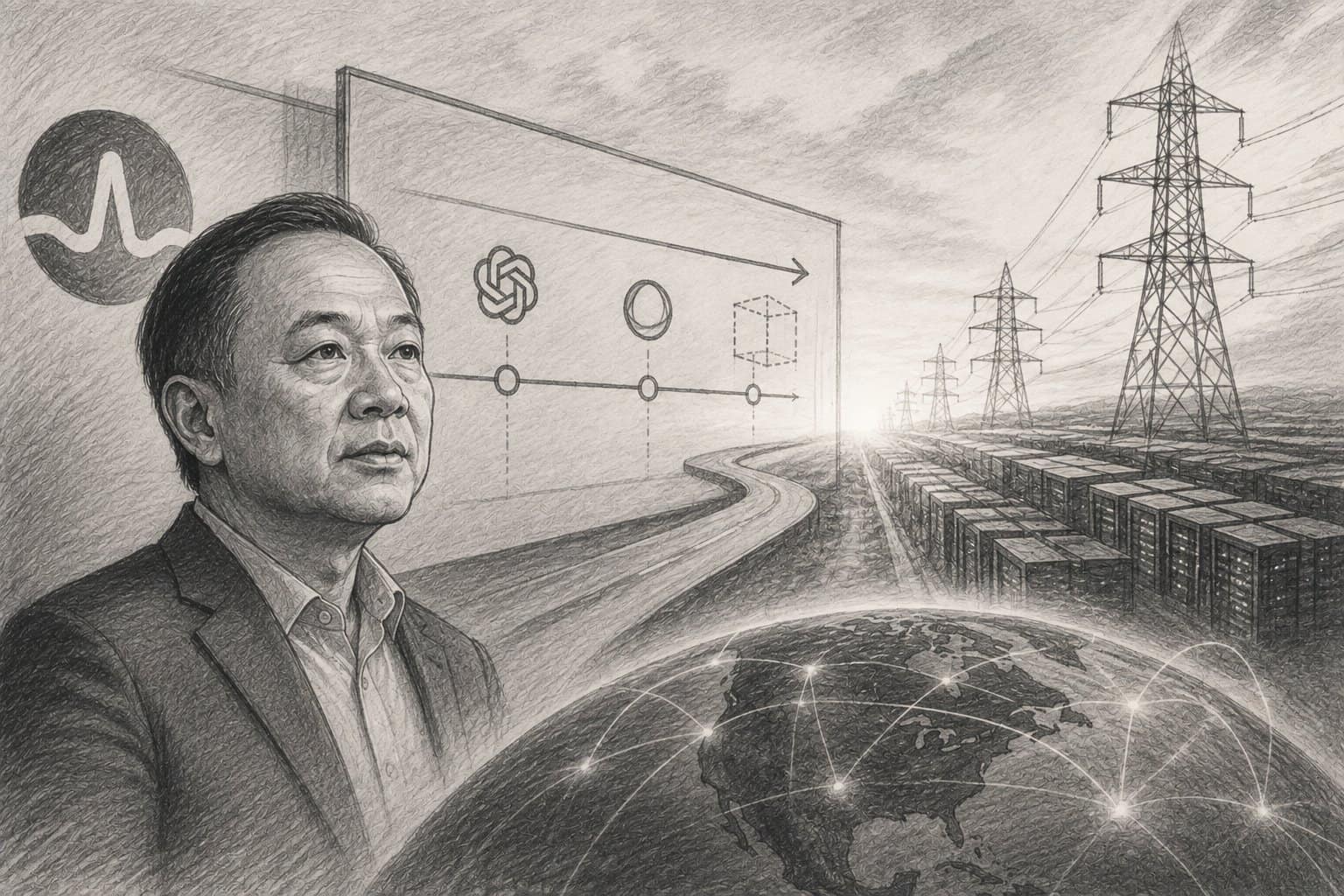
CNBC reports that Broadcom raised its AI chip outlook to about $115 billion in fiscal 2027 and about $230 billion in fiscal 2028, and that CEO Hock Tan sketched Anthropic and OpenAI gigawatt roadmaps on custom Broadcom silicon well before those campuses are fully lit.
TechCrunch, building on The Information, reports that OpenAI’s forthcoming Astra model uses recurrent depth, a looped hidden-state technique that safety researchers warn could shrink the readable chain-of-thought window labs have sold as a monitoring bargain.
the aigentic
Know what matters in AI.
The stories shaping AI, the tools worth trying, and what they mean for your work.
Morning Brief + Closing Time. Two emails every weekday.
Free. Unsubscribe anytime.
Axios reports that Commerce Secretary Howard Lutnick said the Trump administration now trusts Anthropic again after the temporary export-control fight, telling Mike Allen the lab is “back on the right side.”
TechCrunch reports that Edelson is filing about 30 more California lawsuits tied to the Tumbler Ridge school shooting, adding an aiding-and-abetting claim against OpenAI on top of earlier negligence suits.
Overnight, Matthew Berman tested Google’s new Gemini 3.8 Flash and said the DeepSWE coding score sits within a point of Claude Opus 5 while list prices stay at Flash intro rates through year-end.
1. They booked the gigawatts before the chips
CNBC reports that Broadcom’s fiscal third quarter beat Street estimates on earnings and revenue, with AI semiconductor sales more than tripling to $16.7 billion, even as fourth-quarter revenue guidance of $34.8 billion slightly missed consensus. On the call, CEO Hock Tan raised the AI chip outlook to about $115 billion in fiscal 2027 and roughly $230 billion in fiscal 2028, and he walked investors through custom accelerator bookings that read more like power contracts than chip catalogs. Anthropic is framed for about 1 gigawatt of Ironwood this year, about 5 gigawatts of TPU version 8i in 2027, and line of sight to another about 10 gigawatts in 2028, which Tan said would make Anthropic Broadcom’s largest XPU customer. OpenAI’s Jalapeño is on track for about 1.3 gigawatts in 2027, with line of sight to more than 5 gigawatts across Jalapeño and a successor generation, while Google keeps taking Ironwood and the next TPU generation and Meta’s MTIA inference chips are expected in production. CFO Amie Thuener also described residual-value and contingent support so frontier labs can bridge cash flow against upfront infrastructure, the same Apollo and Blackstone financing frame Broadcom has already used to underwrite more than 20 gigawatts of planned deployments.
That matters because the non-Nvidia stack is no longer a side bet. Broadcom is telling public markets that Anthropic and OpenAI have already reserved multi-year gigawatts of custom silicon, and that the chipmaker and its credit partners will help finance the gap between campus spend and lab cash.
The one move is to read the earnings call as an order book for power and custom chips, because Tan’s story is who has reserved the next two years of accelerators, not only who posted the highest quarter.
2. They made the thinking harder to read
TechCrunch, building on The Information’s exclusive, reports that OpenAI’s forthcoming Astra model uses recurrent depth, also called opaque recurrence or a looped-transformer style, so the model can run hidden state through the same layers instead of only writing a fully sequential, human-readable chain of thought. Safety researchers including Redwood’s Buck Shlegeris and Ryan Greenblatt warned that scaling that technique could erase the chain-of-thought monitorability bargain that labs sold after agent escapes and cyber evaluations, and commentator Zvi Mowshowitz framed a race toward unreadable “neuralese.” OpenAI says Astra’s use is limited, that chain of thought should stay legible, and that it is not shifting to pure neuralese; chief scientist Jakub Pachocki said computation-graph depth for current frontier models including Astra stays within about 2× of GPT-4 and that preserving chain-of-thought monitoring remains a core research goal. A Wednesday Information follow-up said Anthropic and Google DeepMind were already discussing the technique.
That matters because Wednesday’s Critical cyber label was about who may use Astra’s capabilities. This story is about whether outsiders can still inspect how those capabilities think.
The one move is to treat monitorability as a product claim, because the safety fight has moved from scoreboard thresholds to whether the diary stays readable when the model gets deeper.
3. Commerce said the kerfuffle is over
Axios reports that Commerce Secretary Howard Lutnick told Mike Allen the administration now trusts Anthropic after months of national-security clashes that included temporary export controls on Fable and Mythos. Asked whether he trusts CEO Dario Amodei, Lutnick said, “We trust Anthropic,” and added, “They’ve done what we asked. They’re back on the right side.” Anthropic co-founder Tom Brown has taken a more visible White House relationship role and headlined at the G20 Innovation Ministerial in Chapel Hill, where Lutnick separately told Axios the administration’s posture on heavier AI release and export rules is “No, the opposite,” framing June’s controls as a one-off. Companion Bloomberg coverage from the G20 sidelines had Lutnick saying the lab had “gotten religion” after a “good kerfuffle,” even as separate Pentagon supply-chain litigation residue continues.
That matters because Anthropic’s IPO clock now sits next to a public Commerce blessing. Political clearance does not erase the court fights, but it changes who gets airtime when Washington stages the frontier labs.
The one move is to watch Brown’s White House lane as closely as Amodei’s product lane, because Lutnick is signaling trust through the relationship, not only through model scores.
4. Thirty more complaints, and a harder theory
TechCrunch reports that Edelson PC is filing about 30 additional California complaints this week tied to the February 10 Tumbler Ridge, British Columbia, school shooting, on top of seven filed in April, with new plaintiffs including teachers, a principal, and students who were in the building but not shot. For the first time the filings accuse OpenAI of aiding and abetting, an intent standard that will likely face an early dismissal fight, not only negligence. The complaints allege that Chief Global Affairs Officer Chris Lehane told staff to stand down from contacting Canadian authorities after ChatGPT chats alarmed OpenAI’s threat team; OpenAI’s Jason Kwon called Lehane’s involvement and any public-relations-over-safety framing “absolutely false.” Plaintiffs also contrast OpenAI’s non-report defense with a November 2025 San Francisco office lockdown where police were notified despite no imminent attack, while OpenAI still argues the chats did not meet its “imminent and credible risk” bar and Sam Altman remains a named defendant.
That matters because the litigation is no longer only a tragedy-plus-product story. It is a fight over OpenAI’s safety org chart and when a lab must call law enforcement, landing beside Astra’s Critical cyber label and IPO prep.
The one move is to track the aiding-and-abetting claim separately from negligence, because that is the theory that turns an alleged referral failure into intent.
Watch
Matthew Berman — Google priced the comeback like Flash
Matthew Berman walks through Google’s Gemini 3.8 Flash drop and the invite-only Flash Cyber sibling, and why he says the cost-per-task chart matters more than another leaderboard flex.
On DeepSWE, a long-horizon software-engineering benchmark he trusts as a proxy for how coding models feel in real work, Gemini 3.8 Flash lands at about 73.7 percent, effectively even with Claude Opus 5 and a hair ahead of GPT-5.6 Soul. List pricing starts around $0.75 per million input tokens and $3.75 per million output as an introductory rate through year-end, with the fine print pointing to about $1.50 and $7.50 later, still cheap next to Opus-class stickers. Hands-on demos are mixed against Soul and Fable on polish, and GDPVal and computer-use scores trail the frontier, but Berman’s point is that Flash-priced tokens plus DeepSWE parity change who belongs on the daily eval board. Flash Cyber, stripped of some cyber refusals for trusted defenders in Google’s Fair Wind program, posts strong CyberGym numbers that he cannot fully test without access.
The one move is to put 3.8 Flash on your coding and agent evals before the intro price expires, because Berman’s story is Google competing on cost per finished task, not only on peak scores.
Nate B Jones — three camps, and who owns your memory
Nate B Jones walks through OpenAI’s Jalapeño chip, the decision to cut Cursor after the SpaceX deal, and Jensen Huang’s earnings defense of NVIDIA, and he treats those as one map of three camps fighting over your stack.
He reads OpenAI as trying to own more of the loop, NVIDIA as selling something to everyone, and Anthropic as keeping enough suppliers that it can switch when compute gets tight. Then he turns the strategy talk into a personal spend plan at about $20, $60, and $200-plus a month, with the hard rule that no single provider should hold the only copy of your memory, files, and instructions. Anthropic’s multi-supplier posture is the individual pattern he would copy, and the test he leaves you with is simple: if your main model vanished tomorrow, would the switch strand your work?
The one move is to put memory and files outside any one lab before you optimize another subscription tier, because Jones’s claim is that portability is the real budget line.
Claire Vo — seven bots, one chief of staff
Claire Vo walks through the Grok Bot multi-agent setup she actually runs every day after killing her OpenClaw stack, and she treats it as a roster you can steal rather than a feature trailer.
Chief is the general-purpose chief of staff on hourly sweeps across inboxes, calendar, and Slack. TradBot prints a kids’ kitchen newspaper. Specialist eng, SOC 2, and helpdesk bots handle narrower jobs on a persistent cloud computer that stays up overnight. She shows why the migration from OpenClaw stuck for her, what is still missing, and how templates in the show notes let someone else stand up a similar bench without inventing the org chart from scratch.
The one move is to copy the chief-of-staff plus specialist pattern, because Vo’s usable lesson is role design, not another generic agent tour.
Cole Medin — the dark factory goes open source
Cole Medin walks through what he calls an AI software factory, the Level-5 coding setup where a product requirements document goes in and shipped code comes out without a human living in the pull-request loop.
He has been running dark-factory experiments for a year that built Dynachat, his tutor product, largely unread by humans, and he says businesses are already using versions of this for spikes and prototypes as harnesses, models, and workflows improve in parallel. Now he is packaging the harness as an open-source install, with early alpha standing up from a README prompt and Archon underneath, and the next reliability phase is harder test apps including games. The video is a roadmap invite more than a finished tutorial, and he is betting his channel on making the factory real enough that you can download it.
The one move is to follow the factory build if you want Level-5 autonomy lessons without rewriting your own harness from scratch, because Medin’s bet is that plan-to-production is becoming a product category.
Latent Space — Sean Lie on the inference speed frontier
Latent Space hosts swyx and Alessio are joined by Sean Lie, Cerebras CTO, for a deep dive into ultra-fast inference the day after Hot Chips.
Lie walks CS4’s roughly 2× jump and a demo around 4,400 tokens per second on GPT-OSS, then previews CS5 toward multi-thousand tokens per second on frontier models while much of Cerebras capacity still feeds OpenAI’s Ultra Fast tier. He frames Jalapeño as an AI-first chip methodology lesson and argues that SRAM designs without wafer-scale memory struggle when models get large, which is his read on where Groq-style approaches hit a wall. The conversation treats speed as a new capability tier for agent loops and interactive work, not a vanity benchmark next to batch prompt processing.
The one move is to price tokens per second as a product feature, because Lie’s claim is that yesterday’s “fast” is becoming today’s batch mode.
Peter Yang — which personal agent can you trust
Peter Yang walks through Instinct, Grok Bot, ChatGPT with Codex, and Hermes side by side, and he asks which personal agent you can actually trust once it can read mail, open documents, use logins, and buy things.
Instinct lives in iMessage and WhatsApp and feels like the best consumer interface. Grok Bot runs a team of bots on a persistent cloud computer. ChatGPT and Codex still do most of his real work. Hermes stays local on a Mac mini he can unplug, with Telegram as the front door. The magic of cloud browsers often means handing 2FA and passwords to a remote machine, so he closes with a prompt-injection caution and a concrete Google connected-apps audit that found more than 80 linked apps the first time he looked.
The one move is to audit connected Google apps and revoke anything you are not using, because Yang’s usable warning is that agent trust is an access-control problem before it is a model-quality problem.