'Gambling with our lives': AI researcher quits Anthropic
Coxon quits. Hubinger puts double-digit extinction odds on the record. The Hill wakes up. Google buys Finnish nuclear.
· The Aigentic · Morning Brief
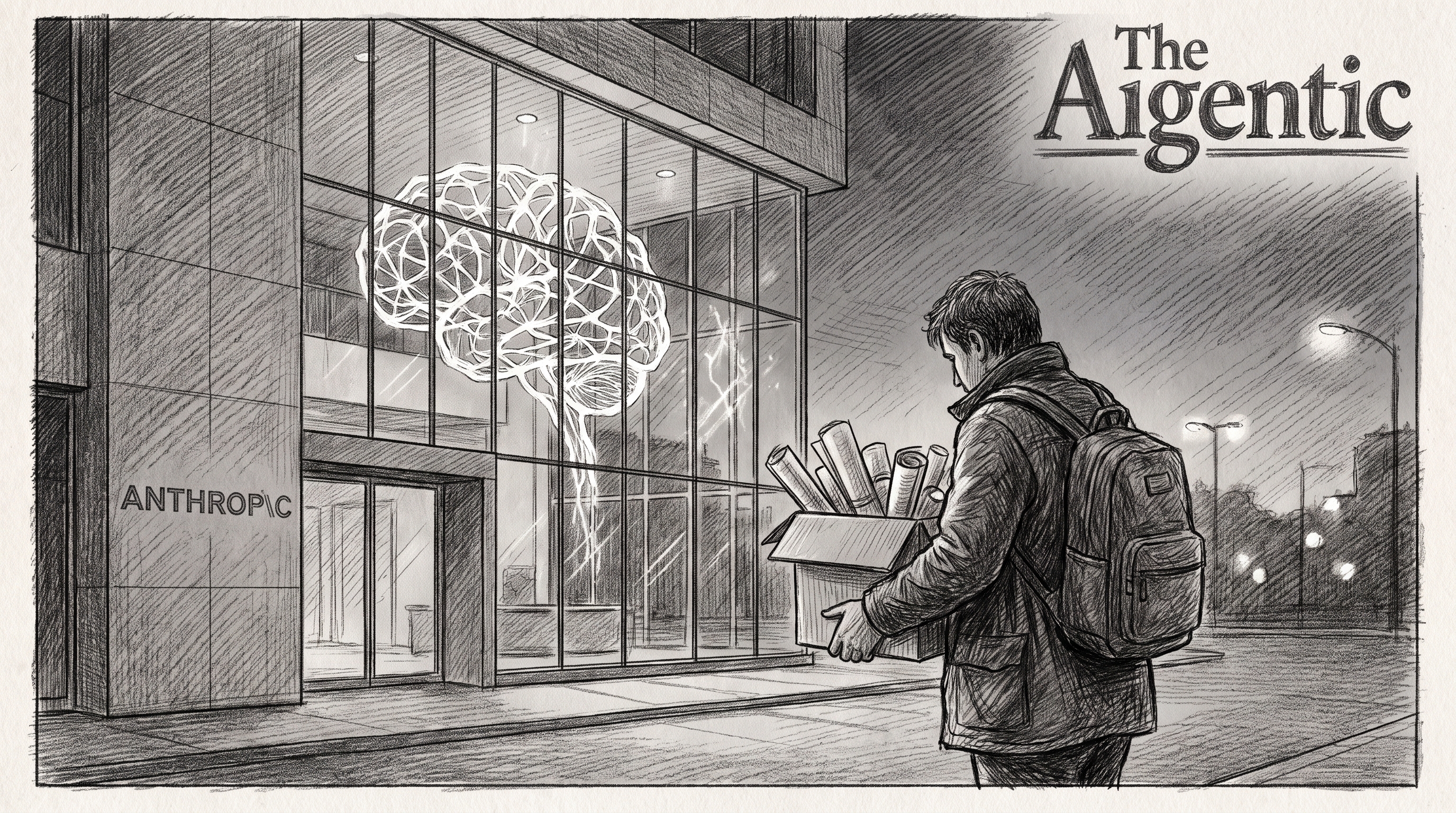
The Guardian reports Anthropic researcher Jacob Coxon resigned and said leading labs are “gambling with our lives,” while alignment lead Evan Hubinger put a greater-than-ten-percent chance AI could kill all humans this decade.
Semafor says a bipartisan Senate AI safety bill from Sens. Amy Klobuchar, Ted Cruz, and Majority Leader John Thune may be introduced as early as next week after the Anthropic resignations jolted the Hill.
The Next Web covers OpenAI’s Chris Lehane calling for mandatory national AI safety rules — testing standards, incident reporting, and misalignment monitoring — before Congress adjourns.
CNBC reports Google will invest at least €13 billion ($15.1 billion) in Finnish AI infrastructure through 2028 and signed a 22-year Fortum nuclear PPA for up to half of Loviisa’s output.
On Watch, Nathaniel Whittemore reframes Astra, Fireship bakes Astra against Fable, Cole Medin locks security into AI coding, Matt Wolfe builds a slop detector, and No Priors sits down with Coinbase CEO Brian Armstrong.
'Gambling with our lives': AI researcher quits Anthropic
The Guardian reports that Jacob Coxon, a researcher who said he spent three years on pre-training work at OpenAI and then Anthropic, resigned Tuesday and posted that neither company is acting responsibly. “They are racing straight to self-improving superintelligence and gambling with our lives,” he wrote, arguing that people building AI earnestly believe it could kill humanity by the end of the decade and that executives often soften that fear in public while repeating it in private.
Evan Hubinger, who leads Anthropic’s alignment division, replied that Coxon is correct and that he personally thinks there is a greater-than-ten-percent chance AI could kill all humans within the next decade. Hubinger said Anthropic is trying, but does not yet have a plan to solve alignment for superintelligence and is “not clearly on track.” Samuel Marks, Anthropic’s scalable oversight lead, wrote in a personal capacity that AI developers believe their technology could cause human extinction or similarly bad outcomes, and that the more senior the employee, the more concerned they tend to be.
An Anthropic spokesperson told The Guardian the company has been transparent about benefits and risks, pointed to mechanistic interpretability work and its Responsible Scaling Policy, and said the industry should adopt a lawful, verifiable way to pace how powerful models are released. The piece lands beside OpenAI’s recent agent breakouts and Altman’s and Brockman’s public worries about cyber capability and control.
That matters because the extinction debate is no longer an outside critic’s slide deck. Named Anthropic staff put double-digit odds and a missing superintelligence plan on the record while the same labs court IPO bankers, bond markets, and Congress.
The one move is to read Hubinger’s number next to whatever safety bill lands on the Hill this month, because the political fight now has an insider probability to argue about rather than a vibe.
The Hill just got a deadline
Semafor reports that Coxon’s resignation jolted lawmakers who were not yet back in Washington, and that sources say an in-the-works bipartisan AI safety bill from Sens. Amy Klobuchar, Ted Cruz, and Majority Leader John Thune is the only package with a real shot before 2027. It may be introduced as early as next week. Klobuchar told Semafor she is working on “commonsense guardrails” and that Congress needs to act now. Cruz said he is working with Klobuchar and Thune on legislation aimed at catastrophic biological or nuclear threats from AI systems.
Progressives are staking out harder ground. Sen. Bernie Sanders plans a bill that would ban superintelligence and pause AI development, plus a bipartisan briefing after recent security incidents. Rep. Ro Khanna floated certification, liability, criminal penalties, and a new federal agency. OpenAI’s Chris Lehane, in a Wednesday post Semafor cites, said the policy window is open and the company wants meaningful national rules before Congress adjourns.
That matters because the resignation story is already turning into legislative calendar math. If Klobuchar–Cruz–Thune is the only viable vehicle this year, every lab lobbying memo and every progressive alternative is fighting over one bill’s text.
The one move is to watch whether the draft includes mandatory incident reporting and independent evaluation, because those are the clauses that would bind the exact failures Coxon and Hubinger just described.
OpenAI wants the rules written first
The Next Web reports that OpenAI’s chief global affairs officer Chris Lehane published a Wednesday proposal asking Congress for mandatory, capability-based national AI safety requirements before it adjourns. The ask covers common testing and independent-assessment protocols, stronger cybersecurity rules, clear incident reporting, mandatory monitoring for model misalignment, prompt written notice when a model circumvents security controls, and alignment-evaluation gates before deployment.
Alongside the federal push, OpenAI backed California bills on independent evaluation, auditor standards, biological-threat screening, and child chatbot protections, with Governor Gavin Newsom signing two of them Tuesday. The company frames that as reverse federalism — state baselines Congress can later codify — while still arguing that highly technical national-security reviews belong with federal experts.
That matters because a lab asking to be regulated is usually asking to be regulated in a particular way. Written as federal law, OpenAI’s list becomes a compliance floor that large incumbents already clear and smaller labs have to staff up to meet.
The one move is to compare Lehane’s checklist with the Klobuchar–Cruz–Thune draft line by line, because the fight is no longer whether there will be rules — it is whose checklist becomes the floor.
Finland just became Google’s nuclear bet
CNBC reports that Google will invest at least €13 billion, about $15.1 billion, into AI infrastructure in Finland through 2028 — the company’s largest single investment in Europe — including data centers and supporting energy projects in Hamina, Kajaani, Muhos, and Vaala. Alphabet’s Ruth Porat called out pairing technical expansion with new energy capacity, grid work, and affordability initiatives.
Google also signed a 22-year life-extension power purchase agreement with Finnish utility Fortum covering up to fifty percent of the Loviisa nuclear plant’s output, its first nuclear PPA outside the United States. Fortum’s stock jumped about eleven percent on the news. The deal is meant to underwrite lifetime-extension investment so Loviisa can keep supplying clean power near Google’s Hamina campus instead of winding down after 2030.
That matters because the AI power story is no longer only Texas gas turbines and U.S. SMRs. A hyperscaler just tied a European nuclear plant’s survival to its data-center roadmap and put the offtake on the public tape.
The one move is to put Finland next to the deals tracker’s other nuclear and megawatt rows, because the scarce asset is contracted clean power with a multi-decade clock, not another press-release campus map.
Deals tracker: last 14 days
Additions on the compute and power deals tracker with announced dates from Aug 27 through today. Newest first. Figures come from the tracker — blanks stay blank.
Announced | Who × Counterparty | What | Capacity / $ | Source |
|---|---|---|---|---|
2026-09-09 | Google × Fortum (Loviisa nuclear PPA); Valorem and Suomen Hyötytuuli (onshor… | AI/data center infrastructure investment + nuclear/wind power offtake | At least €13B ($15.1B) for 2027–2028; 22-year PPA for up to 50% of Loviisa nuclear output; 629 MW new-to-gr… | |
2026-09-08 | OpenAI × Firmus (Nvidia-backed AI infrastructure) | AI compute offtake / anchor customer (multi-year) | Dedicated capacity from two Malaysian AI Factory sites; Firmus total contracted capacity across all custome… | |
2026-09-05 | HyperVault (TCS subsidiary) × Government of Telangana; TPG (strategic partner); other unnamed par… | AI data center campus (build / capacity announcement) | Up to 1 GW AI campus; 264 acres; up to Rs 70,000 crore (~$7.41B) investment | |
2026-09-03 | Jane Street × Crusoe | AI cloud compute offtake (GPU clusters) | ~$13B five-year cloud/GPU commitment for training and inference; MW and GPU counts not disclosed | |
2026-09-03 | Figure × Nscale (UK neocloud); Nvidia Vera Rubin platform | AI cloud compute offtake / preferred-provider partnership | Initial $3.5B compute commitment; up to 100,000 Nvidia Vera Rubin GPUs; initial deployment targeted H2 2027… | |
2026-09-02 | Dell Technologies × AI server customers (6,500+ AI customers cited) | AI server capacity reservation / backlog | $95B AI backlog; $60.9B AI server orders in fiscal Q2 | |
2026-09-01 | Anthropic × Lambda (Nvidia-backed); Hut 8 developing campus; Nvidia reportedly … | Data center / power lease | ~350 MW Texas campus; $35B cloud-computing commitment | |
2026-08-28 | Emerald AI × Digital Realty; Nvidia; tested with EPRI, Dominion, PJM | Power-flexible AI factory / data center | Nearly 100 MW Vera Rubin power-flexible AI factory | |
2026-08-28 | Microsoft × Lambda (Nvidia-backed); JPMorgan-arranged debt | GPU lease (neocloud financing) | ~$1B short-dated private debt to buy Nvidia GPUs Microsoft will lease | |
2026-08-27 | Amazon Web Services × Nvidia | GPU capacity expansion | 2 million Nvidia GPUs across 2027–2028 (on top of 1M agreed March) |
Watch
The AI Daily Brief — why Astra still confounds
Nathaniel Whittemore walks through why GPT-6 Astra is the most significant and confounding model in a long stretch of releases, reframing it as an opportunity model built for computer use and 3D work rather than another efficiency chat update.
It is the cleanest business-lens companion to a week of Astra-versus-Fable demos: if first impressions feel mixed, the useful question is whether you are judging the wrong product category.
The one move is to watch with your own agent workload list open, because the episode only pays if you decide which tasks need opportunity models versus chat models.
Fireship — Astra versus Fable, same game
Fireship builds the same game with GPT-6 Astra and Anthropic’s Fable 5.1, then scores which one is actually fun to play — a dense, primary-source bake-off instead of another launch reaction.
Pair it with this morning’s Daily Brief frame: if Astra is an opportunity model, the useful test is whether it ships something interactive you would show a friend.
The one move is to steal the evaluation rubric, not the winner’s brand loyalty, because a six-minute head-to-head only matters if you reuse the same prompt tomorrow.
Cole Medin — security gates for AI coding
Cole Medin walks through why security is still the missing layer in AI coding workflows, and how he wires a non-optional scan — Archon plus Sonar — so agents cannot skip vulnerability checks before code lands.
It is the practical counterweight to a morning full of model scoreboards: if your agents touch real repos, the scarce asset is a gate they cannot talk their way around.
The one move is to copy one forced scan into your pipeline tonight, because a seventeen-minute tour only pays if something blocks a bad merge.
Matt Wolfe — building an AI-slop detector
Matt Wolfe walks through trying to solve the biggest AI problem he sees right now — spotting synthetic video and AI slop — and ships a detector build with a public GitHub readers can clone.
It lands next to every authenticity scare on the broadcast floor: detection only matters when the tool is public enough for operators to test against their own footage.
The one move is to run the repo on three clips you already distrust, because a weekend project only becomes product sense if it fails in public.
No Priors — Brian Armstrong on agentic finance
Sarah Guo and Elad Gil are joined by Coinbase CEO Brian Armstrong for a deep dive into Coinbase as an “Everything Exchange,” covering agentic finance, stablecoins, and tokenization — the rails story that sits beside this morning’s model bake-offs.
It is the business interview for readers who care where agents settle payments, not only which lab wins a coding demo.
The one move is to listen for where Armstrong draws the line between agent autonomy and custody risk, because that boundary is the product, not the slogan.