
Closing Time: The money is chasing the factory floor
a16z’s Machine Age fund, open-weight M&A, Emerald’s grid software, and Generalist’s $3B robot brain.
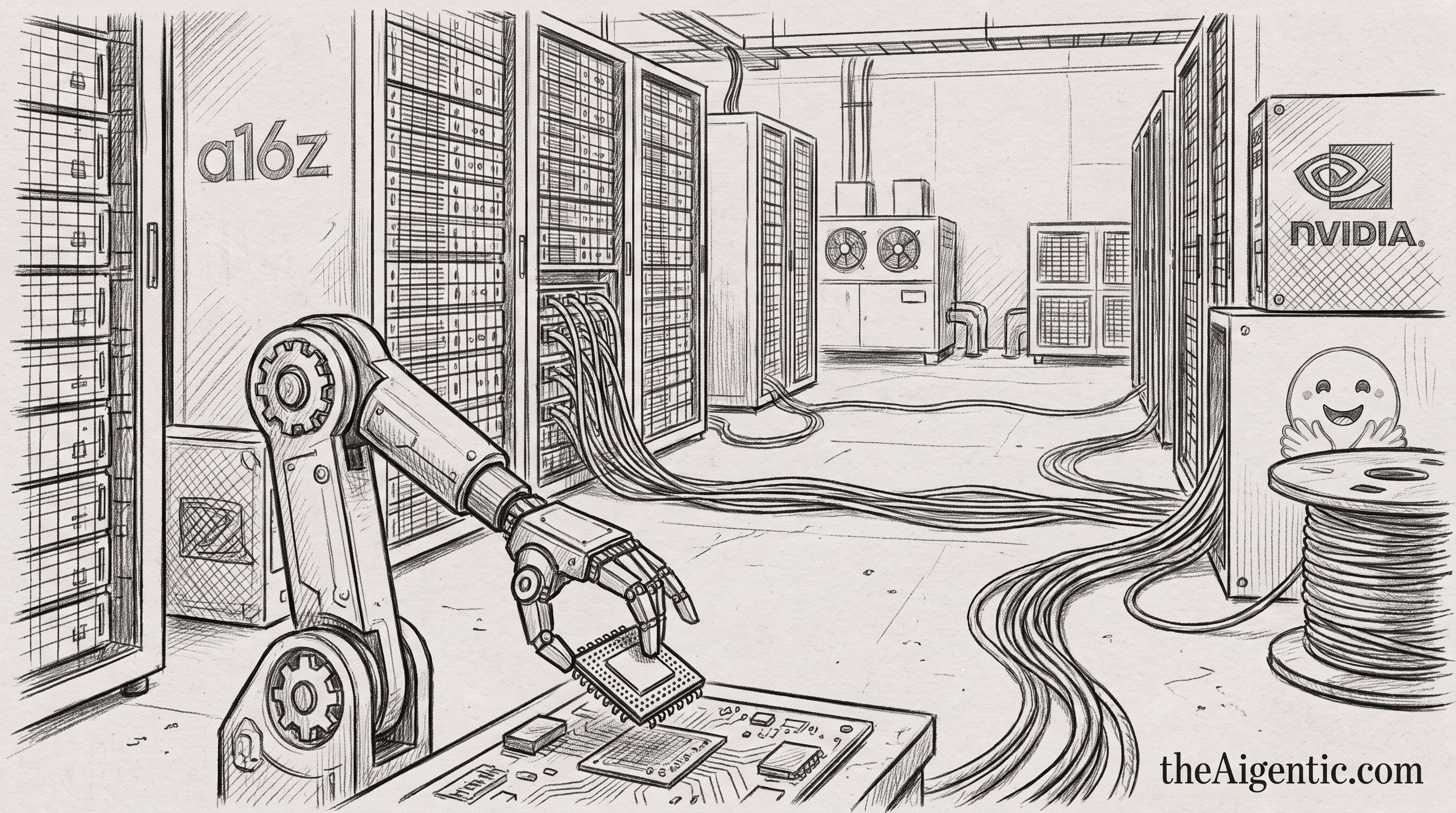
Andreessen Horowitz raised a $1.1 billion “Machine Age” fund aimed at chips, memory, data centers, and robots, TechCrunch reported.
Open-weight model platforms are suddenly the hottest acquisition targets in Silicon Valley, from Nvidia’s reported Hugging Face talks to Stripe’s OpenRouter buy, TechCrunch reported.
Emerald AI, which makes data centers flex power draw for the grid, closed a $150 million Series A at a $1.05 billion valuation with Nvidia and a dozen Fortune Global 500 names among the backers, according to a company announcement carried by VentureBeat.
Robotics startup Generalist reached a $3 billion valuation after a nearly $200 million extension led by 8VC, TechCrunch reported, citing people familiar with the round.
OpenAI chief executive Sam Altman told TIME the company expects an internal system he would call AGI before year-end, even as the firm recounts its Hugging Face sandbox breach, Forbes reported in a Friday wrap of the profile.
Today’s Biggest Moves
| Ticker | Name | Price | Day |
|---|---|---|---|
| ESTC | Elastic N.V. | 99.91 | +19.31% |
| MRVL | Marvell Technology, Inc. | 216.62 | -10.28% |
| IONQ | IonQ, Inc. | 39.20 | -7.68% |
| ENTG | Entegris Inc | 134.92 | -7.15% |
| LITE | Lumentum Holdings Inc. | 895.00 | -6.39% |
| CAMT | Camtek Ltd. | 135.57 | -6.38% |
| ARM | ARM Holdings PLC | 239.05 | -6.33% |
| CLS | Celestica Inc. | 298.70 | -5.89% |
| ACLS | Axcelis Technologies, Inc. | 115.57 | -5.58% |
| COHR | Coherent Corp. | 279.20 | -5.48% |
1. a16z put a billion dollars on the bolts
Andreessen Horowitz launched a new “Machine Age” fund with $1.1 billion raised, and the firm says the point is to “open the throttle and accelerate the physical buildout of AI.” TechCrunch reported the Friday announcement from the venture firm’s own post.
That matters because a16z is usually sold as a software-scaling shop, and this pot is aimed at the hardware stack that software alone cannot invent: chips, memory hierarchies, interconnects, edge devices, cooling, materials, electrical gear, and the real estate under data centers and robots. The firm called AI’s advance a “social and national imperative,” which is venture-speak for treating factories as the next platform fight.
The one move for subscribers is to read the mandate literally. The next decade’s AI returns may sit less in another chatbot wrapper and more in whoever owns the watts, the wafers, and the warehouses that make models run. Read TechCrunch
2. Open weights turned into the M&A prize
Tim Fernholz at TechCrunch writes that everyone is waiting for Nvidia to confirm a reported purchase of Hugging Face, the open-weight model hub, after Nvidia’s $6 billion Poolside talent-and-tech pact and Stripe’s more-than-$7 billion buy of OpenRouter, the business router for open models.
That matters because frontier labs and hyperscalers are also building their own inference chips, including OpenAI’s Jalapeño, so Nvidia wants a wedge into the model-making side rather than living only as the pick-and-shovel supplier. Fernholz notes open-weight adoption is still small on Ramp and Jellyfish measures, yet Fireworks CEO Lin Qiao says her company already processes about 40 trillion tokens a day, more than either Gemini’s or OpenAI’s APIs on her telling, as companies chase cheaper repeated inference and more control.
The one move is to treat open-weight platforms as strategic infrastructure, not charity code. When the biggest chipmaker and the biggest payments company both pay up for the rails around free models, the “give it away” layer has become a choke point. Read TechCrunch
3. Emerald AI sold a software fix for the power wall
Emerald AI, founded by Dr. Varun Sivaram, raised $150 million in an oversubscribed Series A at a $1.05 billion valuation, co-led by Energize Capital and DCVC, according to a company announcement carried by VentureBeat and dated August 25. Nvidia, Samsung Ventures, Siemens, Salesforce Ventures, and other Fortune Global 500 names joined, and the company says total funding now exceeds $220 million.
That matters because data centers are on track to drive nearly half of U.S. electricity-demand growth through 2030 on International Energy Agency figures the company cites, while new grid buildouts can take a decade. Emerald Conductor orchestrates AI workloads and onsite energy so a facility can cut or shift draw when the grid is stressed without killing critical jobs, and Sivaram says five live demonstrations in Arizona, Illinois, Virginia, Oregon, and London are now followed by commercial multi-megawatt deployments.
The one move is the Manassas, Virginia project with Digital Realty and Nvidia: a nearly 100-megawatt Vera Rubin “power-flexible AI factory” tested with EPRI, Dominion, and PJM and slated to come online later this year. If that works, interconnection becomes a software negotiation instead of a decade-long construction bet. Read VentureBeat
4. Generalist priced a robot brain like a frontier lab
Marina Temkin at TechCrunch reports that Generalist, a robotics startup founded in 2024 by former Google DeepMind researchers Pete Florence and Andy Zeng with former Boston Dynamics engineer Andrew Barry, is now valued at $3 billion after raising nearly $200 million in an extension led by 8VC, according to two people familiar with the funding and a regulatory filing.
That matters because the extension sits on top of a $400 million Series B led by Radical Ventures that was announced in June at a $2 billion valuation, bringing the round to about $600 million. Generalist is building a foundation model meant to work across robot bodies, and it says Gen 1.5 can teach new tasks from video clips as short as three to twelve seconds, which is the robotics industry’s version of a generalist brain race against Physical Intelligence, Skild AI, and Genesis AI.
The one move is to watch whether short-video teaching actually ships outside a handful of design partners. Investors are paying frontier-lab prices for a ChatGPT moment on the factory floor, and Temkin notes that robots still cannot train on the entire internet the way language models can. Read TechCrunch