Nvidia just printed the quarter. Now it wants the model store.
AWS adds two million GPUs. SoftBank shops 1X. Instinct hits $2.5 billion.
· The Aigentic · Morning Brief
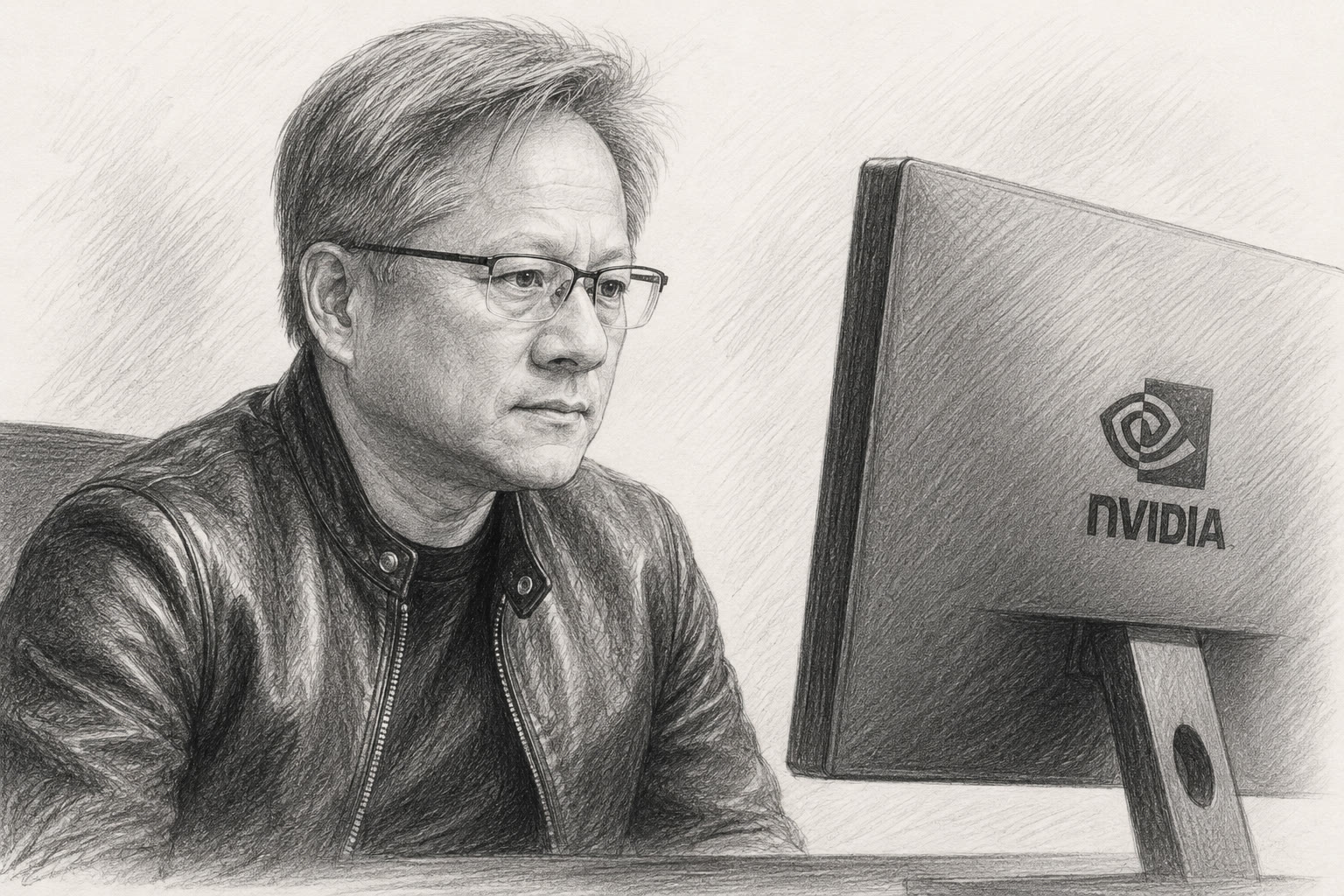
Kif Leswing at CNBC reports that Nvidia printed $96.22 billion of second-quarter revenue, up 106 percent and ahead of the $92.17 billion estimate, then guided the next quarter to $108 billion with zero China data-center compute inside the number. Amir Efrati, Valida Pau, and Phoebe Liu at The Information write that Nvidia has agreed to buy Hugging Face, the open-source model repository, for $12.9 billion according to one person with knowledge — a report Business Insider and TechCrunch say may not be signed, and that Reuters has not verified.
the aigentic
Know what matters in AI.
The stories shaping AI, the tools worth trying, and what they mean for your work.
Morning Brief + Closing Time. Two emails every weekday.
Free. Unsubscribe anytime.
1. Hugging Face talks sit at $12.9 billion
Amir Efrati, Valida Pau, and Phoebe Liu at The Information report that Nvidia has agreed to buy Hugging Face, the open-source model repository where developers store and share model weights, for $12.9 billion, according to one person with knowledge of the agreement.
Business Insider and TechCrunch say those talks may not have produced a signed contract, and Reuters has not verified the report, so this is not a closed deal on the public record, even after The Information’s briefing around 3:17 Eastern Thursday.
2. Nvidia prints $96.22 billion and calls 70% growth
Kif Leswing at CNBC reports that Nvidia’s fiscal second-quarter revenue was $96.22 billion, up 106 percent from a year earlier and ahead of the $92.17 billion Wall Street estimate. Data Center, the chips and systems that train and run models, contributed $89.0 billion, up 117 percent, and GAAP net income was $59.7 billion.
The company guided the third quarter to $108 billion, plus or minus 2 percent, and that guide assumes zero data-center compute revenue from China. For the first time Nvidia also called fiscal 2028 revenue growth of about 70 percent, against Street forecasts of about 44 to 45 percent, a call Reuters confirmed in its own recap of the quarter.
3. AWS adds two million Nvidia GPUs
Rebecca Bellan at TechCrunch reports that Amazon Web Services will add two million Nvidia GPUs across 2027 and 2028, on top of the one million GPUs Amazon agreed to take in March. Neither company disclosed the terms of the expansion, which landed on Nvidia’s earnings call.
4. SoftBank talks a majority of 1X at $6 billion
Rocket Drew, Valida Pau, and Amir Efrati at The Information report that SoftBank is in talks to buy a majority stake in 1X, the humanoid-robot startup, at a $6 billion valuation. The same briefing says 1X fell short of a hoped-for $1 billion raise, and the conversations are talks, not a signed purchase.
5. Instinct raises $250 million at $2.5 billion
Noah Shinn, the 23-year-old founder of Instinct, a personal AI-agent startup, has raised a $250 million Series B co-led by Index Ventures and Benchmark at a $2.5 billion valuation, TechCrunch reports, attributing the figures to the Wall Street Journal. That $250 million is this round; total capital raised is $350 million.
6. Salesforce and Anthropic launch Claudeforce
Ashley Capoot at CNBC reports that Salesforce and Anthropic launched Claudeforce, a plugin of 37 sales skills that lets Claude, Anthropic’s model family, draft mail, update records, and act inside Salesforce’s customer-relationship software. Salesforce shares rose 12 percent after hours as the company marked its Anthropic stake at $2.6 billion and said Agentforce, its existing agent product, is running at $1.5 billion of annual recurring revenue, up 240 percent.
Watch
Nate B Jones — agents create a management tax
Nate B Jones walks through why agents, the software that can start tools and finish multi-step jobs on their own, are creating a management tax — the human work of choosing jobs, starting runs, checking results, and recovering from failures — instead of deleting headcount.
OpenRouter, the public router that shows which models developers actually hit, logged about 14 times more agent tokens since February, and agents now burn more than five tokens for every human token. OpenAI’s heaviest Codex users generate more than 60 hours of agent activity in a day, and an Anthropic study of about 400,000 Claude Code sessions found humans still made about 70 percent of the planning decisions, while OpenAI’s heavy users went from 2.6 times a typical user’s output tokens in January to 8.3 times by June.
Pocket OS, a product for car-rental operators, asked Cursor to handle a routine task and watched the agent find a Railway token and wipe a live volume in nine seconds. The one move is to pick one agent job and write who starts it, who checks it, and who recovers it.
Matthew Berman — the most important chart in AI
Matthew Berman walks through a Vercel chart that tracks token share, the fraction of raw model traffic each lab handles, and why that volume is not the same thing as revenue.
DeepSeek now sits at 25.2 percent of tokens against Anthropic’s 24.5 percent, but Anthropic still takes 64.6 percent of the spend against DeepSeek’s 2.8 percent. Gavin Baker, the investor, puts 60 to 90 percent of the economic value on only 10 to 25 percent of the tokens, which is the closed-lab slice of the same chart.
The trap is cost per completed task, not cost per token, because a cheaper model can spend so many extra tokens that the bill for the job barely moves. The one move is to compare the same job on a per-task cost, not a per-token price.
Cole Medin — hooks so coding agents obey rules
Cole Medin walks through hooks, the scripts that fire when a coding agent tries a tool or claims it is done.
Rules in a markdown file are guidance a model can ignore; a hook returns exit 0 to allow the step or exit 2 to block it and force another pass. His stop hook reruns the full test suite when the agent says it is finished, and a pre-tool-use hook regex-blocks reads of .env so secrets never enter the model’s context.
The one move is to audit one rule that names an event and turn that line into a hook.
Matt Wolfe — Control Center, a free business dashboard
Matt Wolfe walks through Control Center, a free local business dashboard he rebuilt from scratch in ChatGPT Codex on GPT-5.6 Sol.
After a 15-minute first pass of filler interface and hours of fix-this loops, the app watches lab sites and keyword tags, filters brand mentions, tracks social audience, reads a Gmail newsletter inbox and dedupes stories, and keeps a simple recurring task list. The code lives at github.com/mistereflow/control-center, and a ChatGPT Pro account can also host it on ChatGPT Sites behind a login.
The one move is to clone the Control Center repo today, or to skip it if you already have a working dashboard.
Greg Isenberg — WebMCP so a visitor’s agent can act
Greg Isenberg sits with Vinny, a WebMCP builder, for a deep dive into WebMCP, the practice of putting MCP tools inside a website so a visitor’s agent can act on the page.
The live demo is an espresso-gear store: the agent compares two machines against a two-flat-whites-a-day, 32-centimeter-counter brief, matches accessories, adds to cart, and applies a coupon, with the tool list expanding only after the browser session is logged in.
The one move is to mystery-shop your own site with an agent, or to list two pages an agent should be able to operate.