
Is Anthropic's Growth Already Slowing? The Bear Case the S-1 Leaves Out
Q3 revenue reportedly hit $16.8 billion. Slower growth and weaker revenue per dollar of compute are why it may still disappoint IPO investors.

Q3 revenue reportedly reached $16.8 billion. Slower growth and weaker revenue per dollar of compute explain why that may still disappoint IPO investors.
On the reported third-quarter numbers, Anthropic’s growth has slowed sharply. The harder question is whether that reflects a company growing into its size or customers becoming less willing to pay a premium for intelligence.
The October 26 S-1’s detailed financial statements stop at June. It includes some September operating metrics and explicitly warns that growth will slow, but it does not yet supply a complete Q3 financial picture. That missing quarter is central to the IPO debate. [1]
Reuters reported $16.8 billion in Q3 revenue, up approximately 45% from Q2. Bloomberg reported positive free cash flow and adjusted profitability. Those are substantial achievements. Yet the pace of growth has fallen, and the relationship between revenue and compute expense has weakened. [2, 3, 5]
Our October 26 examination of the filing focused on the accounts, financing and obligations. This follow-up examines what the newer numbers change: how much confidence investors should place in the continuation of the first-half boom. [4]
Revenue is rising while growth slows
The quarterly sequence makes the disagreement easier to understand. Q1 and Q2 are from the filed accounts; Q3 is the figure reported from Anthropic’s October investor presentation. [1, 2]
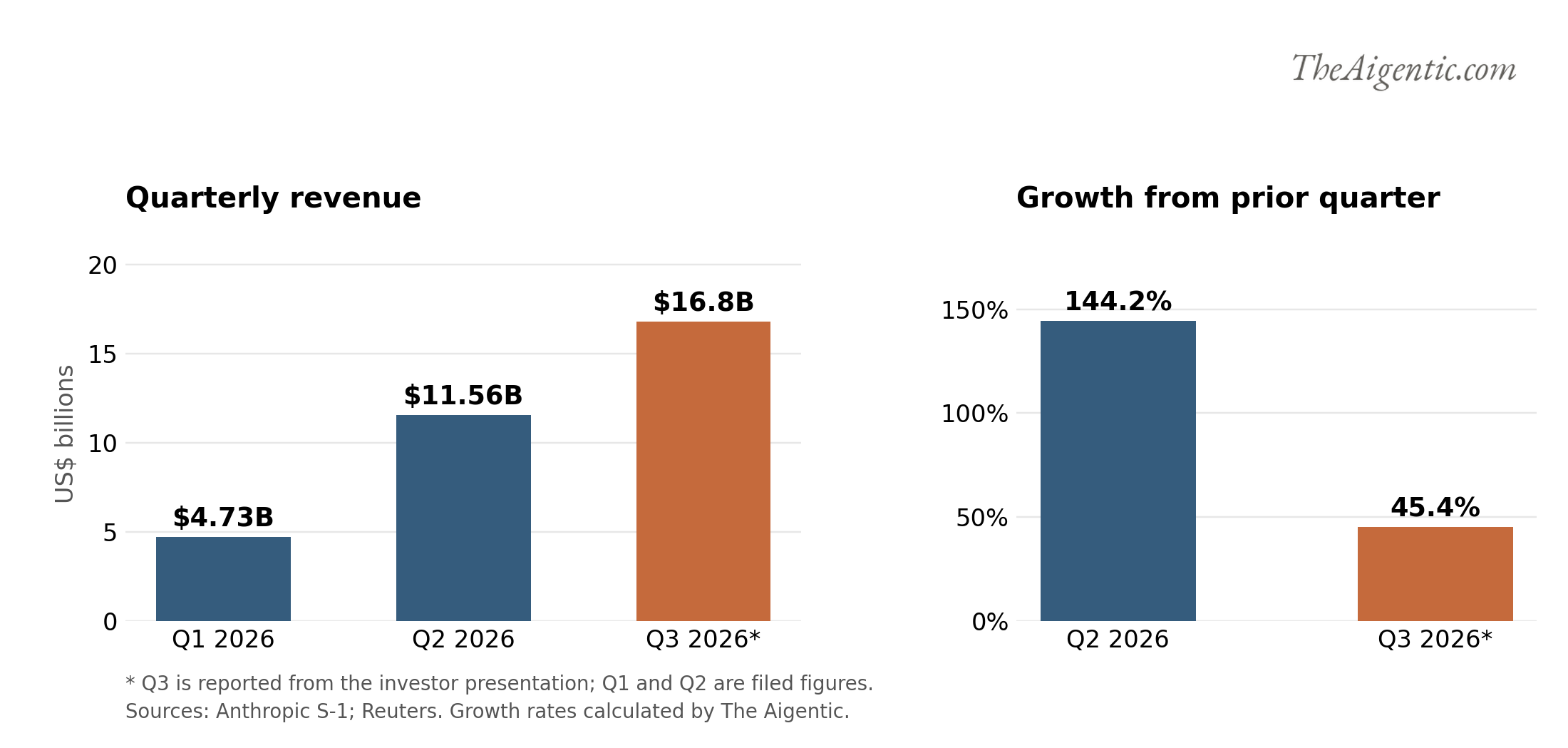
Using those figures, revenue increased by about $6.82 billion between Q1 and Q2, then by $5.25 billion between Q2 and Q3. The latest quarter therefore added fewer revenue dollars as well as growing more slowly in percentage terms. These are our calculations, with Q3 subject to the precision of the reported number.
A larger denominator naturally makes percentage growth harder to sustain. The smaller dollar increase gives skeptics something more substantial to examine. Still, one quarter cannot distinguish durable demand weakness from capacity constraints, release timing or a pause after unusually rapid customer expansion.
For valuation, the relevant question is how far expectations had run ahead. A company can deliver exceptional results and disappoint investors who priced in even more exceptional ones.
The compute ratio sharpens the bear case
Steve Eisman’s October 28 appearance on Prof G Markets focused on revenue relative to compute and infrastructure expense. As reported by Benzinga, the ratio fell from $2.08 of revenue per dollar of compute in Q2 to $1.70 in Q3. The Financial Times had also reported the $1.70 figure from the investor event. [5, 6]
That is an approximately 18% decline in the ratio. Inverting it makes the economics more tangible: compute represented about 48 cents of each revenue dollar at the earlier ratio, versus approximately 59 cents at the later one. On a hypothetical $100 of revenue, roughly $11 more would go to compute before considering other expenses.
This ratio is not gross margin. Anthropic’s compute category includes research, model development, serving customer workloads and internal usage. A ratio spanning that whole category answers a different question from the margin on delivering services to customers. [1]
A falling ratio can reflect weaker realized pricing, a more expensive workload mix or new capacity arriving before it produces enough revenue. Extra research spending could also depress the current ratio while supporting future products. These explanations have very different implications, and the two headline numbers do not separate them.
Eisman attributes the change partly to the fading of “tokenmaxing”: companies pushing employees to use AI intensively before bringing spending under tighter control. He also points to competition from cheaper Chinese models. That is a plausible explanation to investigate, rather than an established causal finding. [5]
Chinese competition creates a credible pricing risk
There is concrete evidence of lower-priced competition during the quarter. DeepSeek’s official changelog dates its V4.1 Flash release and associated API price reduction to September 10. Its October 17 update then promised better performance, shorter outputs and faster completion without changing API pricing. [7]
The timing matters. DeepSeek’s October update and Kimi’s October 23 rollout of K3.1 Pro in Kimi Code came after Q3 ended. They strengthen the competitive challenge ahead, but cannot themselves explain revenue already earned between July and September. [7, 8]
The commercial threat does not require customers to abandon Claude. A business could retain Anthropic for difficult work while routing routine tasks to a cheaper provider. Its AI usage could rise while the share of its budget going to Anthropic falls. Buyers could also use credible alternatives to negotiate discounts.
Consider a hypothetical supplier whose realized price drops 25% while usage rises 30%. Revenue would fall 2.5%, because 0.75 multiplied by 1.30 equals 0.975. More activity alone cannot protect revenue; the result depends on how quickly demand responds to lower prices.
Anthropic could offset that pressure through lower costs, stronger products or workloads where reliability commands a premium. The bear case is that customers capture a growing share of the efficiency gains while the provider still has to fund the next model.
The bull case has financial substance
Bloomberg’s account of the investor presentation included an 85% gross margin, an adjusted operating margin above 11% and positive free cash flow. These are reported investor-day figures, rather than a complete Q3 reconciliation in the initial S-1. If sustained, they would support a business with meaningful capacity to finance its expansion. [3]
Positive free cash flow deserves weight. It indicates that the business may already be generating cash after the capital expenditures included in that measure. Investors still need the actual amount and a bridge showing customer prepayments, vendor payment timing, capital spending and lease obligations. A positive quarter does not establish how much cash will remain after future infrastructure payments.
The bullish economic argument is that cheaper intelligence makes more work worth automating. A customer might reduce spending on one task and expand into several others. Anthropic could grow with that demand if its products remain the most effective way to get useful work done.
Nate B. Jones’s October 28 discussion centers on the distinction between acquiring a customer and becoming important to that customer. That is a useful way to assess the opportunity: initial adoption offers much less protection than dependable use in recurring work. [9]
For a business, the cheapest model per token need not deliver the cheapest completed task. Integration, review time and the cost of mistakes also matter. Anthropic’s premium can survive cheaper rivals if customers consistently recover that premium through better outcomes. That proposition needs evidence from mature customer cohorts and actual spending.
There is also a company-specific complication. The filing estimates that customers later identified as violating its policies or terms generated 5%–7% of revenue in the first nine months. Enforcement increased in August and September. Removing such activity could affect growth independently of ordinary customer demand; the filing does not quantify the Q3 impact. [1]
A lower valuation still demands a great deal
Reuters reported on October 15 that some existing and prospective investors were discussing a valuation around $1.5 trillion, versus roughly $2 trillion previously expected. That is a 25% reduction in the valuation under discussion. It was a report about investor expectations before the public S-1, not a completed IPO repricing. [2]
Annualizing the reported $16.8 billion quarter produces $67.2 billion. Against that simple revenue yardstick, a $1.5 trillion equity valuation is approximately 22.3 times revenue; $2 trillion is about 29.8 times. This is a sensitivity calculation, not a revenue forecast, contracted annual recurring revenue or an enterprise-value multiple. It does not adjust for cash, debt-like instruments or dilution.
A second illustration shows the cash-generation burden. At a hypothetical $1.5 trillion equity value, $30 billion in annual free cash flow would represent a 2% yield. That is not an earnings estimate. It shows why investors must underwrite years of expansion and eventual cash generation even after lowering their valuation expectations.
The company’s October 26 announcement said the offering’s share count and price range had not been determined. Until terms are set, the valuation debate remains a negotiation over assumptions. [12]
November 12 changes the disclosure timetable
The SEC generally requires initial registration statements to contain a balance sheet no more than 134 days old, with a holiday extension. For June 30 financials, the 134th day is November 11, Veterans Day. Deloitte’s 2026 IPO calendar therefore identifies November 12 as the last usable date before an update is required. [10, 11]
If the registration statement is to be declared effective after that cutoff, updated September financial statements would generally be required. November 12 is a financial-statement freshness deadline, not a scheduled earnings announcement or a guaranteed listing date. [10, 11]
Eisman alleges that excluding full Q3 figures from the initial filing was deliberate. The publication schedule alone does not establish a motive. Anthropic had already presented headline Q3 results to prospective investors, according to Reuters. The substantive issue is whether everyone can evaluate the complete quarter before the offering is priced. [2, 5]
The next filing needs to explain the change
Five disclosures would do the most to separate a temporary slowdown from deteriorating economics:
Quarterly revenue and the dollar increase, using consistent recognition policies and separating broad customer demand from enforcement-related changes.
Realized pricing and product mix, so investors can distinguish rising usage from the revenue earned on that usage.
Compute spending and utilization, including how much new capacity and research activity contributed to the weaker ratio.
A cash-flow reconciliation showing how much cash generation survives working-capital changes and infrastructure payments.
Spending by mature customer cohorts, showing whether deployments continue expanding after their initial surge.
Our assessment is that the reported Q3 figures establish deceleration and justify closer scrutiny of compute economics. They do not yet establish the cause or prove that Anthropic’s growth advantage is disappearing.
The bear case becomes stronger if lower realized prices and weaker customer expansion persist while compute expense keeps climbing. The bull case becomes stronger if customer spending broadens, new capacity earns its keep and cash generation survives the next investment cycle. The next filing needs to show which pattern is emerging. At the valuations being discussed, the difference matters enormously.
Sources and calculation notes
Reporting checked October 29, 2026. Quarterly growth, incremental revenue, compute-ratio conversions and valuation illustrations are The Aigentic’s calculations. Q3 figures are attributed to reporting on the investor presentation and may be refined in subsequent filings. Hypothetical examples are not forecasts.
Anthropic, PBC — Form S-1, October 26, 2026. Quarterly results; compute definition; growth risks; policy-enforcement disclosure.
Reuters — Investors temper Anthropic IPO valuation expectations, October 15, 2026. Syndicated by MarketScreener; Q3 revenue and investor valuation discussions.
Bloomberg — Anthropic Revenue Hits $16.8 Billion in Quarter Before IPO, October 15, 2026. Reported free cash flow, gross margin and adjusted operating margin.
The Aigentic — Inside Anthropic’s IPO Filing, October 26, 2026. Our earlier examination of the initial filing.
Benzinga — Steve Eisman Says Anthropic Left Q3 Figures Out of IPO Filing, October 28, 2026. Account of Eisman’s Prof G Markets interview; his interpretation is attributed.
Financial Times — Anthropic tells investors quarterly revenue up nearly 50% to $16.8bn ahead of IPO. Reporting on the October investor presentation and revenue per dollar of compute.
DeepSeek — Official API change log. September 10 price reduction and October 17 model update.
Kimi — Kimi Code release notes. October 23 rollout of K3.1 Pro in Kimi Code.
Nate B. Jones — Anthropic IPO S-1: Customer Growth, Margins, and Compute Meta, October 28, 2026. Customer adoption and recurring deployment.
SEC — Financial Reporting Manual, Topic 1. Sections 1220.1, 1220.2 and 1220.12: age requirements and holiday extension.
Deloitte — IPO Roadmap, section 2.4.3, Age of Financial Statements. 2026 calendar confirms November 12 as the last usable date for June financials.
Anthropic — Public S-1 announcement, October 26, 2026. Offering terms remained undetermined.