
Inside Anthropic's IPO Filing
Extraordinary growth, a misleading loss headline, and the price of building frontier AI

The IPO that turns the AI debate into a financial test
Anthropic’s public offering will force a more demanding conversation about artificial intelligence. The question is no longer simply whether Claude can write useful code or help a business automate work. It is whether the company behind it can convert extraordinary demand into durable returns while financing an enormous computing footprint.
Anthropic filed its public Form S-1 on October 26, 2026, proposing to list Class A shares on Nasdaq under the symbol ANT. The initial filing leaves the offering price and number of shares blank. A final IPO valuation, amount raised, and trading date are therefore not established by this document. 1 2
The filing supports a strong commercial case: revenue is surging, existing customers are expanding, and operating economics have improved sharply. It also exposes a difficult investment proposition: demand is largely usage-based, long-term infrastructure commitments are substantial, and outside shareholders will have limited influence. A successful AI business and an attractive stock purchase are separate judgments.
What the financial statements actually show
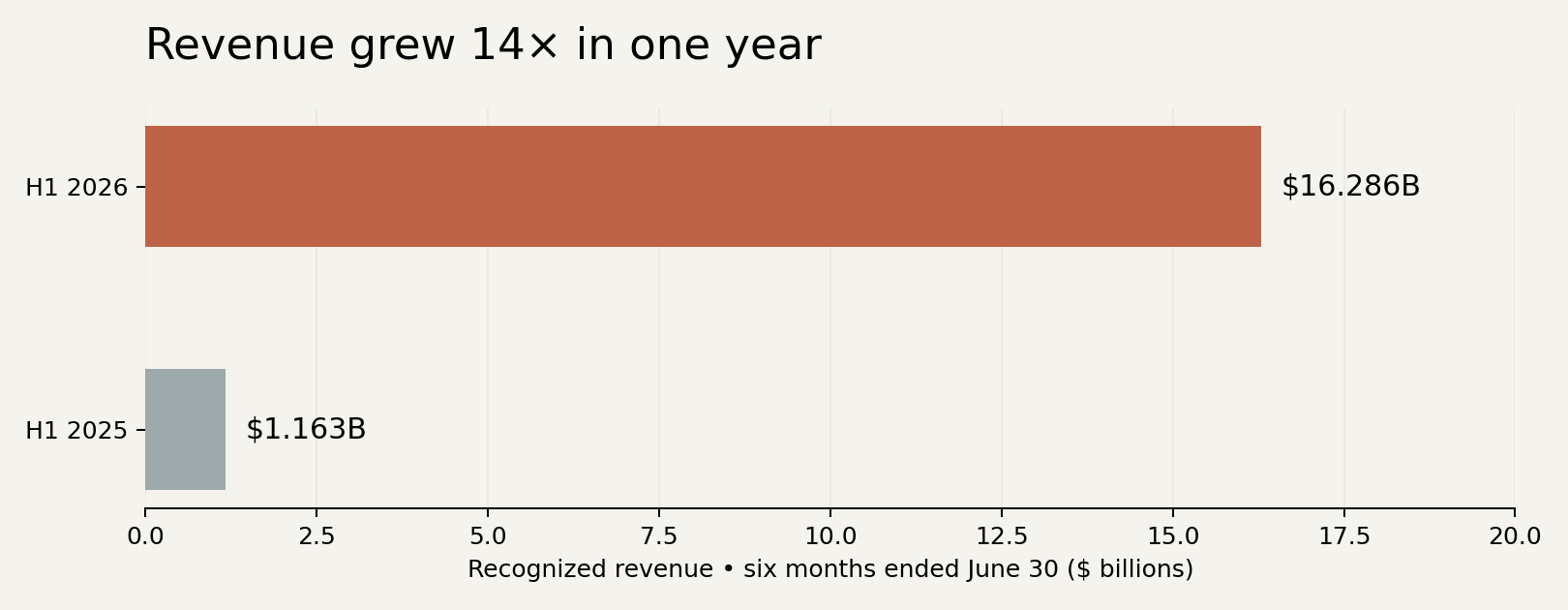
The cleanest comparison is the same six-month period in consecutive years. Anthropic recognized $16.286 billion in revenue in the first half of 2026, compared with $1.163 billion a year earlier—an increase of 1,300%, or about fourteenfold. Full-year 2025 revenue was $4.585 billion. The first half of 2026 alone exceeded that annual total more than three times over. 1
More consequential than growth alone is the movement in operating losses. The first-half operating loss narrowed from $2.135 billion to $693 million even as revenue expanded. That translates to an operating margin of approximately negative 4.3%, versus negative 183.6% a year earlier. Compute and infrastructure expenses rose from $2.334 billion to $8.945 billion, but declined from roughly 201% of revenue to 55%. Those percentages are calculations from the filing, not gross margins.
This is meaningful operating leverage. It does not establish that future model generations will have the same economics. New capacity, research requirements, and product pricing can change the relationship between revenue and expense. The filing’s figures for the six months ended June 30 are unaudited; the annual financial statements cover a different reporting scope.
The $80.7 billion loss: a headline that needs a bridge
Anthropic reported a first-half net loss of $80.748 billion. Treating that figure as cash burned running Claude would materially misdescribe the accounts.
The income statement includes a $72.388 billion loss from changes in the fair value of convertible notes, derivative liabilities, and simple agreements for future equity. Anthropic says these changes were primarily driven by the rising value of outstanding convertible promissory notes as its enterprise valuation increased. A higher valuation can therefore produce a larger accounting loss before the instruments convert. 1
There is another material line: $8.757 billion of other expense, net. The filing attributes the change primarily to initial fair-value recognition and subsequent fair-value changes in assets and liabilities under note purchase agreements. Simply subtracting the $72.388 billion charge from the net loss does not reveal an operating loss or a cash-burn figure.
The bridge is straightforward: a $693 million operating loss, plus $1.111 billion of interest income, less $72.388 billion of financing-instrument fair-value losses and $8.757 billion of other net expense, followed by $21 million of tax expense, produces the reported $80.748 billion net loss.
These charges matter to understanding financing complexity and shareholder economics. They also need to be distinguished from cash payments. The operating statement, cash-flow statement, and capital structure each answer a different question.
Cash flow is stronger—but financing still dominates the balance sheet
The first-half cash-flow statement shows $3.929 billion of cash provided by operating activities. Purchases of property and equipment were $482 million. Subtracting the latter produces a simple operating-cash-flow-less-capex figure of approximately $3.447 billion. That is an editorial calculation, rather than a claim that all future infrastructure obligations are funded. 1
Operating cash flow benefited from improved results after noncash adjustments and from working-capital timing, including vendor payments and customer receipts. Investors should examine how much persists when those timing effects normalize.
Anthropic also reported $112.4 billion in cash and cash equivalents and $19.3 billion in short-term investments at June 30. That is considerable financial capacity. But the cash-flow statement recorded $110.774 billion of net financing inflows during the half-year. The balance sheet reflects enormous external funding as well as commercial progress.
Net investing outflows of $17.181 billion should not be described entirely as infrastructure spending: purchases and maturities of short-term investments account for much of that activity. Confusing investment purchases with operating consumption would exaggerate cash burn.
The business is increasingly embedded in enterprise work
Anthropic’s most compelling evidence of product adoption is the depth of customer spending. As of September 30, it reported more than 11,900 customers generating at least $100,000 in trailing-twelve-month revenue, more than 1,900 generating at least $1 million, and approximately 250 generating at least $10 million. These thresholds are nested, not separate groups to add together. 1
The company also reported approximately 900% net revenue retention. Under its definition, revenue from qualified existing customers in the current three-month period is divided by their revenue in the corresponding period a year earlier. Customers need at least $1 of base-period revenue; Claude Pro and Max subscribers are excluded.
That indicates enormous expansion within the measured customer cohort. It does not mean 900% of customers stayed, and it does not establish a repeatable long-term growth rate. Early deployments can expand from a very small base. The useful follow-up is whether successive cohorts keep expanding after their initial rollout.
The revenue model amplifies both opportunity and uncertainty. In the first half, about $13.1 billion, or 80% of revenue, was consumption-based. Subscription revenue contributed about $3.2 billion, or 20%. More tasks can create more spending, but customers can also optimize workloads, select cheaper models, or reduce usage. Revenue tied to consumption is not equivalent to a fixed annual subscription commitment.
The infrastructure bill is the central strategic risk
As of June 30, Anthropic disclosed approximately $265.6 billion of future fixed or minimum guaranteed commitments under hosting and computing arrangements, with terms ranging from one to twenty years. It also disclosed agreements without fixed or minimum dollar commitments, whose payments depend on deployed capacity, timing, and pricing and were not yet determinable. 1
The $265.6 billion is neither an immediate cash bill nor a complete estimate of every future compute expense. Broader figures in reporting about earlier drafts should not be substituted for this dated, specifically defined disclosure. Later agreements, leases, contingent obligations, and subsequent events require separate treatment.
The underlying challenge is matching long-lived supply commitments with demand that can change quickly. Too little compute can prevent Anthropic from serving customers. Too much capacity, or capacity secured at unattractive prices, can compress returns if usage growth or pricing disappoints.
Efficiency helps only if Anthropic captures enough of its benefits. Lower costs can improve margins; competitive price cuts can pass those savings to customers. The investment thesis requires both growing demand and a durable share of the economic value created by better models.
Cloud distribution creates reach and dependency
Cloud marketplaces accounted for approximately 48% of first-half 2026 revenue, compared with 47% in 2025. Anthropic also said its top five customers represented approximately 25% of revenue in the first nine months of 2026. Several large customers can reduce spending or have contracts expiring in the near term. 1
Cloud partners can simultaneously supply compute, distribute Claude, invest in Anthropic, and compete with it. Their reach can accelerate enterprise adoption, while their overlapping roles complicate bargaining power and expose Anthropic to changes in access, commercial terms, and customer billing.
The accounting presentation also deserves attention. Anthropic recognizes marketplace revenue gross when it concludes it is the principal in the transaction, while partner fees appear in sales, marketing, and partnerships expenses. Comparisons with another AI lab need consistent treatment of channel fees and research costs. Revenue rankings or gross-margin headlines alone can obscure different underlying economics.
Public shareholders buy economic exposure with limited control
Anthropic’s governance is unusually important to the evaluation. Its Long-Term Benefit Trust generally has the power, through Class T stock, to elect a majority of the authorized board. A single Class F share held by an entity initially owned by the seven co-founders will carry 50.1% of voting power on matters submitted to stockholders generally, including directors outside the Class T group. Class A shares have one vote each. 1
The trust’s board-election rights and the founders’ general voting power are distinct mechanisms. Together, they leave public investors with limited ability to redirect strategy. The company’s public-benefit purpose also means investors should evaluate decisions through a broader mandate than near-term shareholder returns alone.
The company has contributed shares representing 5% of its fully diluted share count, on the filing’s specified June 30 conversion assumptions, to its wholly owned Public Benefit Fund. Its board also approved a discretionary framework for further issuances of up to 2% at specified 50% share-price appreciation milestones. That is separate from co-founders’ pledges involving their personal equity. Investors should examine potential dilution and how the framework operates.
This structure can protect long-term research and safety commitments from short-term market pressure. It also asks outside investors to accept decisions they may have little power to reverse. Both implications belong in the valuation.
What would justify the valuation?
The initial S-1 does not establish the final IPO valuation. Rather than present a reported target as a settled price, consider two illustrative equity values: $1 trillion and $1.5 trillion.
Annualizing first-half recognized revenue yields $32.572 billion. Those hypothetical equity values would equal approximately 30.7 and 46.1 times that annualized revenue, respectively. This is a sensitivity exercise, not a forecast or enterprise-value calculation. It does not adjust for cash, debt-like instruments, conversion terms, or dilution, and annualizing a fast-growing half-year can understate subsequent revenue.
Still, the exercise makes the burden of proof visible. A high revenue multiple requires confidence that rapid growth will persist and ultimately translate into substantial cash generation. A strong company can produce weak shareholder returns if the purchase price already assumes exceptional success.
The bull case is that Claude becomes a durable layer of enterprise infrastructure, customer expansion continues, and efficiency lets revenue outgrow the full cost of maintaining model leadership. The bear case is that model competition reduces pricing power while supply commitments and research spending remain demanding. Neither case is resolved by a single impressive growth period.
What The Aigentic will watch next
The most useful next disclosures are the offering terms and fully diluted share count; subsequent quarterly financial statements; customer expansion as cohorts mature; cash flow after working-capital effects; and the timing, flexibility, and financing of compute obligations. Gross profit should be evaluated alongside the recurring research and channel expenses required to sustain the business.
Legal and safety risks also deserve economic treatment. The 2025 accounts include a $1.5 billion Bartz settlement expense. Separately, the risk factors discuss misuse, misalignment, cyber threats, and potential liabilities. A disclosed risk is not proof that an event will occur, but these exposures affect potential costs and the durability of customer trust. 1
The filing offers substantial evidence that frontier AI has become a serious enterprise business. The investment question is whether Anthropic can retain enough value from that business to reward shareholders after compute, research, financing, dilution, and risk. Until the price and updated financial picture are available, commercial optimism deserves to remain separate from a verdict on the stock.
Sources
Analysis of the initial public S-1. Sections reviewed include the prospectus summary, risk factors, governance, MD&A, consolidated financial statements, and related notes. Historical annual figures and unaudited interim figures are identified separately. September customer metrics and concentration disclosures have different measurement windows from the June financial statements.
- Anthropic, PBC. Form S-1 Registration Statement. Filed October 26, 2026. Sections cited: prospectus summary; Summary Consolidated Financial and Other Data; Risk Factors; Our Governance Structure and Its Goals; MD&A, including Liquidity; Business; Description of Capital Stock; consolidated statements of operations and cash flows; notes on Concentrations and Commitments and Contingencies.
- Anthropic. Anthropic files S-1 with the SEC for proposed initial public offering. October 26, 2026.
Calculations are The Aigentic’s analysis using disclosed figures. Hypothetical valuations are illustrative and are not offering terms, price targets, or investment recommendations. This article evaluates the initial filing; amendments may change the picture.