
China's Open Models Just Caught the Frontier. Who Pays for That?
Kimi closes the coding gap. DeepSeek drives down the price. Who keeps the value?

Kimi is closing the gap on agentic coding. DeepSeek is driving down the price of useful intelligence. Together, they sharpen the question facing frontier labs: how much of AI’s value will they keep?
The most consequential number in the latest Chinese model releases may be 0.7.
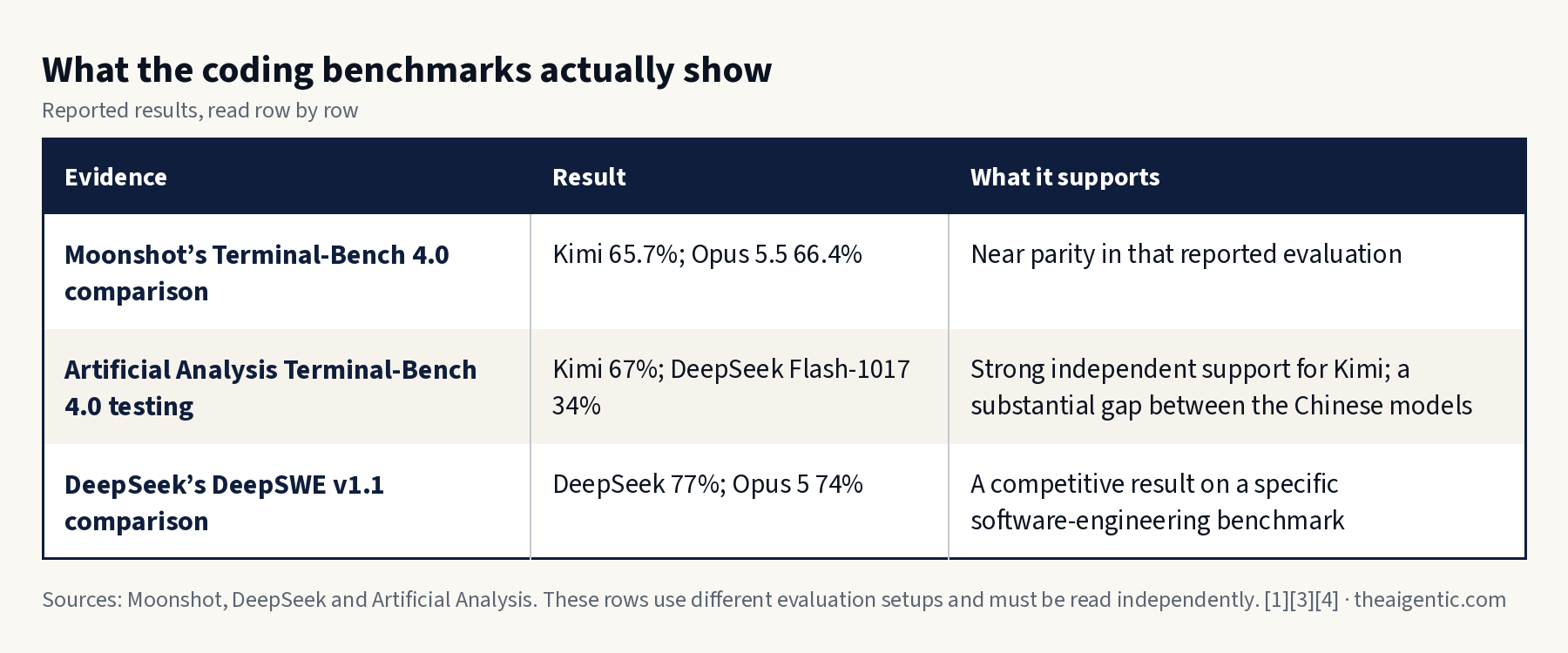
That is the percentage-point gap between Kimi K3.1 Pro and Claude Opus 5.5 on Terminal-Bench 4.0 in Moonshot’s published comparison: 65.7% against 66.4%. For a developer choosing a coding agent, a gap that small invites a practical question. How much extra is the premium model worth?
But the claim that China’s open models have “caught the frontier” needs a more precise reading. Kimi’s result is a strong showing on a particular agentic coding test. DeepSeek V4.1 Flash-1017 offers a different proposition: capable automation at exceptionally low token prices. The two models do not occupy the same competitive position, and Kimi’s full weights are still scheduled for release by November 4. [1]
The distinction matters because this story reaches beyond a leaderboard. As Anthropic prepares for a reported November IPO, investors are being asked to value the future profits of a business whose underlying product keeps getting cheaper to reproduce—or good enough to replace.
Our October 16 deep dive examined how open models could expand AI adoption while reducing profit per unit of work. These releases make that tension more concrete. They also show why benchmark proximity, customer savings and financial damage are three separate claims.
What actually caught up
Moonshot’s headline comparison is compelling. Terminal-Bench evaluates agents working through tasks in a terminal, where success depends on executing steps and passing tests rather than producing a persuasive answer. Its published scores put Kimi within 0.7 percentage points of Opus 5.5. [1]
Independent evidence supports Kimi’s strength in this area. Artificial Analysis reported a 67% Terminal-Bench 4.0 result at launch, the highest among models it tested. That is a separate evaluation from Moonshot’s table; the figures should not be spliced together into one ranking. [2]
DeepSeek’s position is different. Its own release table reports 42.3% on Terminal-Bench 4.0 against 51.8% for the model labeled Opus 5—a 9.5-point gap, involving an older Claude comparator. On DeepSWE v1.1, however, DeepSeek reports 77% against 74% for that Opus model. The release specifies different agent frameworks for the two tests. [3]
| Evidence | Result | What it supports |
|---|---|---|
| Moonshot’s Terminal-Bench 4.0 comparison | Kimi 65.7%; Opus 5.5 66.4% | Near parity in that reported evaluation |
| Artificial Analysis Terminal-Bench 4.0 testing | Kimi 67%; DeepSeek Flash-1017 34% | Strong independent support for Kimi; a substantial gap between the Chinese models |
| DeepSeek’s DeepSWE v1.1 comparison | DeepSeek 77%; Opus 5 74% | A competitive result on a specific software-engineering benchmark |
Tap to enlarge.
Sources: Moonshot, DeepSeek and Artificial Analysis. These rows use different evaluation setups and must be read independently. [1][3][4]
An agent’s score reflects more than its underlying model. The surrounding software determines how it reads files, calls tools, handles failures and uses its available time. Reasoning settings and fallback behavior can also affect the outcome. Small differences are difficult to interpret without repeated runs and comparable conditions.
The defensible conclusion is that Kimi has become a serious competitor in terminal coding, while DeepSeek offers strong results in selected tasks at a much lower price. Neither finding establishes universal equivalence with Claude.
Yesterday’s benchmark update complicates the story
On October 27, Artificial Analysis introduced version 5 of its Intelligence Index. The harder suite changed the picture considerably.
Kimi scored 46, compared with 58 for the leading Opus 5.5 configuration. DeepSeek Flash-1017 scored 32. Kimi continued to lead Terminal-Bench 4.0, but the wider suite exposed larger deficits in other demanding tasks. [5]
This is an unusually useful reminder of what a benchmark measures. A model can approach a leader on an established coding test while remaining well behind across a broader collection of problems. An aggregate index can also obscure a capability that matters greatly to a particular customer.
For a company automating terminal-based engineering work, Kimi’s strength may be more relevant than its overall rank. For a research team handling unfamiliar scientific problems, that same rank may be a poor guide.
The commercial threat therefore does not require open models to win every test. It requires them to become credible substitutes for enough paid work.
The price gap is real—and uneven
The two Chinese releases also tell different pricing stories.
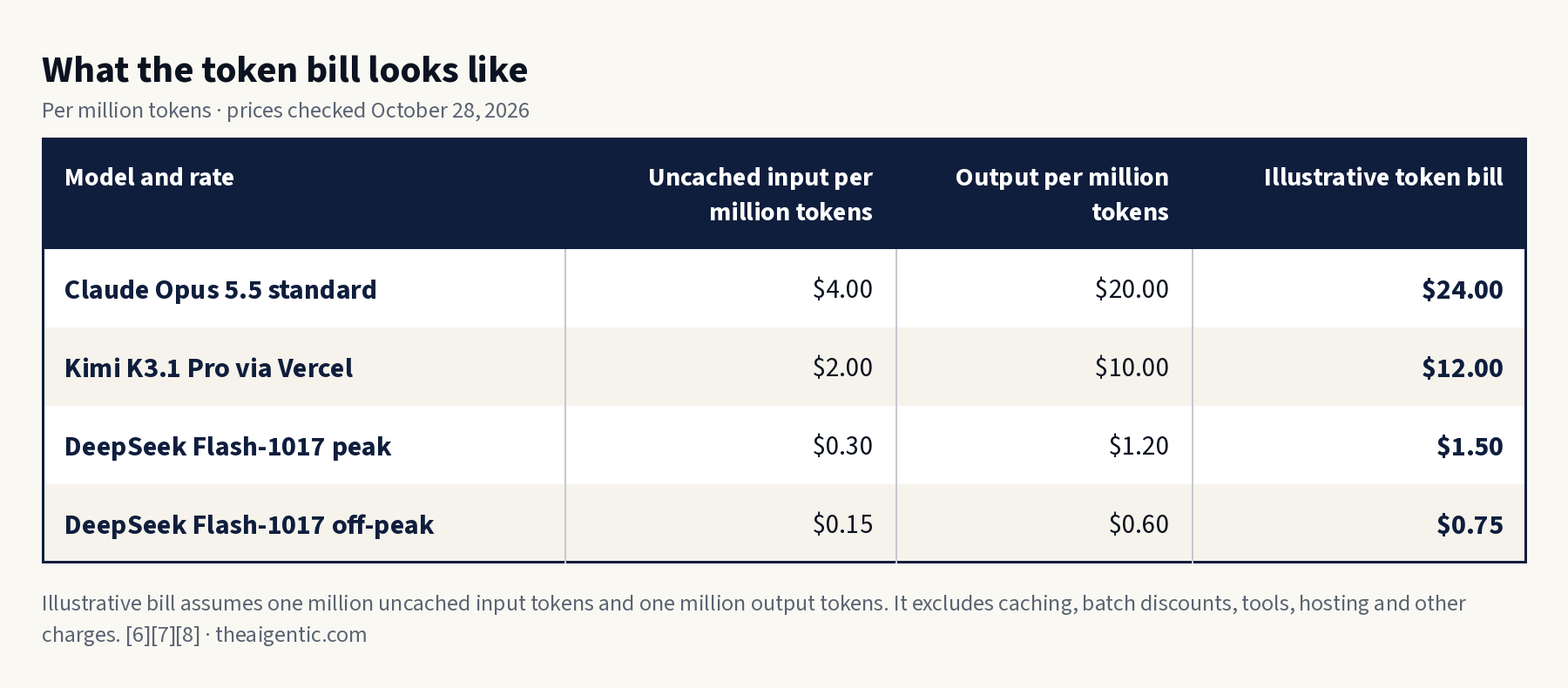
DeepSeek lists Flash-1017 at peak rates of $0.30 per million uncached input tokens and $1.20 per million output tokens. Off-peak rates are half those amounts. Anthropic lists Opus 5.5 at $4 and $20 respectively. Kimi K3.1 Pro is listed through Vercel AI Gateway at $2 and $10. [6][7][8]
| Model and rate | Uncached input per million tokens | Output per million tokens | Illustrative token bill |
|---|---|---|---|
| Claude Opus 5.5 standard | $4.00 | $20.00 | $24.00 |
| Kimi K3.1 Pro via Vercel | $2.00 | $10.00 | $12.00 |
| DeepSeek Flash-1017 peak | $0.30 | $1.20 | $1.50 |
| DeepSeek Flash-1017 off-peak | $0.15 | $0.60 | $0.75 |
Tap to enlarge.
Illustrative bill assumes one million uncached input tokens and one million output tokens. It excludes caching, batch discounts, tools, hosting and other charges. Prices checked October 28. [6][7][8]
At identical token volumes, Kimi costs half as much as Opus in this comparison. DeepSeek’s peak bill is one-sixteenth as large; its off-peak bill is one-thirty-second.
Those are token-price calculations, not measured savings on equivalent completed jobs. A cheaper model may generate more reasoning tokens, retry more often or require additional human review. Conversely, it may be sufficiently fast and accurate that the savings survive those extra costs.
For coding agents, the economically useful measure is the cost of an accepted change: model usage, execution, retries and review, divided by work that passes the customer’s quality requirements. A cheap attempt that creates an expensive defect can erase its apparent advantage. A cheap model that reliably clears routine work can be valuable even if it struggles with the hardest tasks.
How the models get there
DeepSeek’s architecture helps explain why its pricing deserves attention. The company describes V4.1 Flash as a 552-billion-parameter mixture-of-experts model, with an asymmetric design activating roughly 8 billion parameters for input processing and 16 billion for output generation. It also reports substantial reductions in the memory and storage required for its attention cache. [9]
Mixture-of-experts systems use only part of the model for each token. That can reduce computation relative to activating the full parameter count. Cache efficiency matters because agents repeatedly revisit large amounts of context: repository files, instructions, tool results and earlier steps.
Moonshot describes K3.1 Pro as a post-trained version of K3, using substantially more post-training compute and reinforcement learning across many domains. Its account emphasizes improvements to training infrastructure, environments and rollout scheduling. [1]
The approaches illustrate two routes to better economics: reduce the resources needed to serve useful intelligence, and improve the work a model can complete with those resources.
Neither a low API price nor an architecture description reveals a company’s fully loaded economics. Published rates do not disclose training amortization, hardware utilization or gross margin. It would be premature to conclude that DeepSeek has proved frontier development is cheap, or that its competitors’ infrastructure spending is unnecessary.
Open weights change who can compete
“Open” also requires a date and a definition.
DeepSeek Flash-1017 has published weights under an MIT license. Moonshot says Kimi K3.1 Pro’s full weights will be released by November 4. As of October 28, the promised release is part of Kimi’s competitive story, rather than a completed deployment option. [1][3]
Available weights allow other operators to host and optimize a model, subject to its license. They can create alternatives to the originating laboratory’s API and give customers more control over deployment.
That does not make inference free. Large models still require hardware, engineering, monitoring and sufficient utilization. For many buyers, a managed endpoint will remain more economical than operating their own installation.
The strategic change is that competition can extend beyond the lab that trained the model. Once weights are available, improvements in hosting and inference can be commercialized by additional suppliers. Customers gain options; model developers face more pressure to explain their premium.
DeepSeek is already winning traffic
OpenRouter supplies evidence that low-cost models are attracting substantial use. Its rankings, with data through October 27, list DeepSeek Flash-1017 first at 37.3 trillion tokens in the displayed weekly ranking, ahead of Opus 5.5 at 8.07 trillion. [10]
That is meaningful distribution evidence. It is not a measure of global AI market share or revenue leadership.
OpenRouter counts activity passing through its platform, and token totals are affected by context length, output verbosity and workload composition. They do not establish the number of customers or the amount those customers spend.
Still, the result challenges the idea that Chinese models are merely impressive demonstrations. Developers are routing real workloads through them. The next question is how much of that use replaces premium inference, and how much consists of work that would never have been economical at premium prices.
Both can occur simultaneously.
Who pays for cheaper intelligence?
Start with customers. Lower prices can let software companies keep more of their revenue, offer more generous products or automate tasks that previously failed a cost-benefit test.
Then consider application providers. A company that can evaluate tasks and route them intelligently may gain bargaining power over model suppliers. It could reserve a premium model for difficult planning or final review while assigning cheaper models to routine implementation and repeated attempts.
That is a plausible operating strategy, not a universal recipe. Routing creates its own engineering and evaluation costs. But it changes the purchasing question from “Which model is best?” to “Where does the better model earn its price?”
Closed labs may face that pressure first in work where quality is easy to test and switching is relatively straightforward. If buyers can verify an answer or run a test suite, a cheaper substitute has a clearer path into production.
Premium providers retain several possible advantages: superior performance on difficult tasks, reliable service, strong developer tools, enterprise relationships and products that reduce the customer’s total workload. Those advantages can justify higher prices. They must increasingly be demonstrated in outcomes.
Cheaper inference could also increase total demand enough to sustain growing revenue across multiple providers. But growing revenue and attractive returns on capital are different outcomes. More AI usage does not by itself establish who will capture the profits.
Anthropic’s IPO makes the question tangible
Reuters reported on October 22 that Anthropic was pressing ahead with a mid-November IPO, while emphasizing that the timetable remained subject to change. [11]
The valuation debate predates these latest releases. Reuters’s October 15 reporting described some investors discussing roughly $1.5 trillion, below earlier expectations of about $2 trillion, after financial disclosures that included third-quarter revenue of $16.8 billion and adjusted profitability. Those discussions were not a final offering price. [12]
Kimi and DeepSeek cannot explain a valuation reassessment that came before their latest releases. They do, however, sharpen the questions investors should ask about future margins.
How much revenue depends on tasks for which cheaper models are becoming adequate? How quickly will efficiency gains reduce serving costs? Will customers retain those savings through lower prices, or will the lab retain them as margin? How much value belongs to Claude’s capabilities, and how much to the products and relationships built around them?
A public listing would give investors a market price for one major frontier lab. It would not resolve the economics of the frontier itself.
China’s latest models make the competitive challenge clearer. Kimi shows that a challenger can approach a flagship on a commercially relevant coding test. DeepSeek shows how aggressively useful intelligence can be priced and distributed.
The decisive question is how often customers still need the premium model—and whether the premium they pay is enough to finance the next frontier.