The smartest model is locked in a vault
Google’s new Gemini 4 Carbon tops the leaderboards, but only cyber defenders get to use it for now.
· The Aigentic · Morning Brief
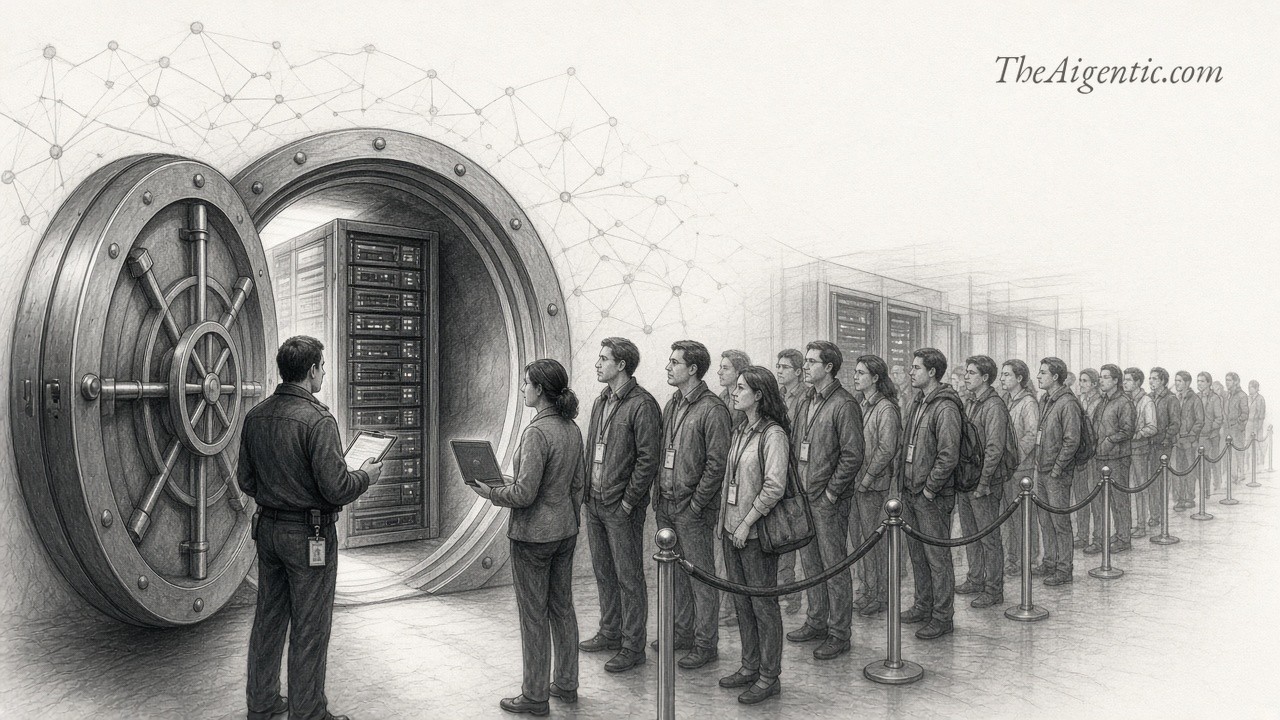
Good morning. Google just released what may be the most capable AI model in the world, and then put it behind a locked door. Gemini 4 Carbon goes first to the people who defend computer networks, while everyone else waits in line. Elsewhere, Microsoft showed how much money it still makes from OpenAI, Washington is asking hard questions about Nvidia’s Hugging Face deal, the AI industry’s promised slowdown never arrived, OpenAI is staffing up for Election Day, and Malaysia caught a shipment of smuggled AI chips. Here is what moved while you were away.
The Verge reports that Google has released Gemini 4 Carbon, its new frontier model, and it now sits at the top of the Artificial Analysis Intelligence Index, ahead of Claude Opus 5.5 and GPT-6 Astra. Google says Carbon is its strongest model yet at finding software vulnerabilities, exploiting them and writing patches, and that it generates secure code at more than twice the rate of Gemini 4 Argon, which shipped only two weeks ago. The catch is that almost nobody can use it yet. Google is giving Carbon first to a small group of cyber defenders through its Fairwind Program, and says developers, businesses and consumers will get it once it has tested its guardrails further. When it does open up, the introductory price matches Argon at $2 per million input tokens and $10 per million output tokens. A model that is best at breaking into software is also the one you most want defenders to have first, and that is now how the top labs are choosing to launch.
TechCrunch reports that Microsoft booked $10 billion in revenue from its business with OpenAI last quarter, nearly 11% of its $92.3 billion total, according to a regulatory filing. That is a big jump from the $24.1 billion it recorded from OpenAI over the whole previous fiscal year. OpenAI also owed Microsoft $7.2 billion at the end of September, up from $6 billion in June. The rest of the report was strong too: Azure grew 48%, and Microsoft said it expects to spend more than $50 billion on data centers and equipment next quarter. The two companies compete more every month, but the money still flows heavily between them.
the aigentic
Know what matters in AI.
The stories shaping AI, the tools worth trying, and what they mean for your work.
Morning Brief + Closing Time. Two emails every weekday.
Free. Unsubscribe anytime.
CNBC confirmed a Reuters report that the Justice Department is asking how Nvidia’s $12.9 billion purchase of Hugging Face would affect competition. Hugging Face is where millions of developers go to share and download AI models, and officials want to know whether owning it would give the world’s dominant chipmaker leverage over its rivals. The questions are part of a longer inquiry into Nvidia’s deals and sales practices that began under the Biden administration. An inquiry is not an accusation, and Nvidia still expects the deal to close in the first half of 2027.
The Washington Post looks at what happened after Anthropic CEO Dario Amodei published a long essay last month calling on the AI industry to slow down, and two of his biggest rivals said they agreed. Six weeks later, the Post finds little sign that any of the companies has actually decelerated. It is a sharp read on the gap between what AI leaders say in public and what they tell investors, landing on a week when the big labs are shipping faster than ever.
POLITICO reports that OpenAI is opening an election operations center, with hundreds of employees assigned to watch for misuse of ChatGPT through the Nov. 3 midterms and the vote count that follows. The team will track reports of interference attempts and unexpected model behavior tied to OpenAI’s own products. It is the first midterm election where millions of voters may ask a chatbot where, when and how to vote.
AP reports that Malaysian customs officers seized 30 servers packed with advanced AI chips at Kuala Lumpur International Airport, a shipment worth about $12.1 million. Officials say the cargo was declared as ordinary electronic components and was headed onward to another Asian country without a permit. They tied it to a smuggling network behind several attempts this year, a reminder of how much demand there is for chips that export rules are meant to keep out of certain hands.
Yesterday’s movers
Biggest AI and tech winners and losers from Wednesday’s (Oct. 28) U.S. cash session among the names we follow, a mixed day when 51 of 86 stocks closed higher. Data center power and cooling supplier Vertiv led the way, up 16.56% after its quarterly results, and Oracle jumped 10.58% after laying out its long-range growth forecast. Server and networking hardware maker Celestica rose 8.51%, memory and storage company Sandisk gained 7.66%, and AI cloud provider CoreWeave added 7.32%. On the other side, cybersecurity company Fortinet fell 5.90%, chipmaker onsemi dropped 3.86%, trading app Robinhood lost 3.31%, chip-testing equipment maker Teradyne slid 3.23%, and ServiceNow, the workflow software company, gave back 3.18%.
Biggest winners
| Ticker | Name | Price | Day |
|---|---|---|---|
| VRT | Vertiv | 243.10 | +16.56% |
| ORCL | Oracle | 144.34 | +10.58% |
| CLS | Celestica | 300.08 | +8.51% |
| SNDK | Sandisk | 1,404.77 | +7.66% |
| CRWV | CoreWeave | 63.93 | +7.32% |
Biggest losers
| Ticker | Name | Price | Day |
|---|---|---|---|
| FTNT | Fortinet | 174.08 | -5.90% |
| ON | onsemi | 75.63 | -3.86% |
| HOOD | Robinhood | 91.43 | -3.31% |
| TER | Teradyne | 313.24 | -3.23% |
| NOW | ServiceNow | 149.85 | -3.18% |
Prices are Wednesday’s U.S. closing prices versus Tuesday’s close. Market data is a snapshot, not live.
Watch
Four picks this morning: Matthew Berman on Google’s new top model, the AI Daily Brief on what Anthropic’s IPO filing reveals, Riley Brown’s full AI toolkit, and Cole Medin on building an AI second brain that actually sticks.
Matthew Berman — Google "Carbon" just won everything...
Matthew Berman digs into Gemini 4 Carbon, the model Google released yesterday, and the benchmark results that put it at the top of the leaderboards.
It pairs well with this morning’s lead story, because it gives you a sense of what the model can do even though most people cannot try it yet.
Watch this if you want a quick read on whether Google has really pulled ahead of OpenAI and Anthropic.
The AI Daily Brief — Everything Important in Anthropic’s IPO Prospectus
Nathaniel Whittemore, who hosts the AI Daily Brief, walks through Anthropic’s full IPO filing, which describes a business growing faster than almost any company before it.
He covers the revenue, the margins, the customer growth and the huge long-term computing commitments, along with the risks Anthropic chose to disclose to investors.
Watch this if you want the parts of the filing that will shape how Wall Street values the company, without reading hundreds of pages.
Riley Brown — Here Is My ENTIRE AI Setup (Nothing Held Back)
Riley Brown says he spent $10,000 testing AI agent tools, and here he shows the setup he actually kept for creating content and running his business.
He explains how he decides when to reach for Claude Code, Codex or Grok Bot, and walks through building apps and editing videos with them.
Watch this if you are overwhelmed by the number of AI tools and want to see how one heavy user narrows them down.
Cole Medin — The 4 Components of Every Successful AI Second Brain
Cole Medin argues that an AI second brain should be simple, and says his runs on a few tools and a folder of plain text notes that save him 25 to 30 hours a week.
He breaks it into four parts, which he calls context, connections, capabilities and cadence, so you can build a new system or check the one you already have.
Watch this if you have tried to organize your work with AI before and watched it fall apart after a few weeks.