
Everybody wants a brake pedal
The people building the fastest technology in history spent the weekend talking about brakes.
· The Aigentic · Morning Brief
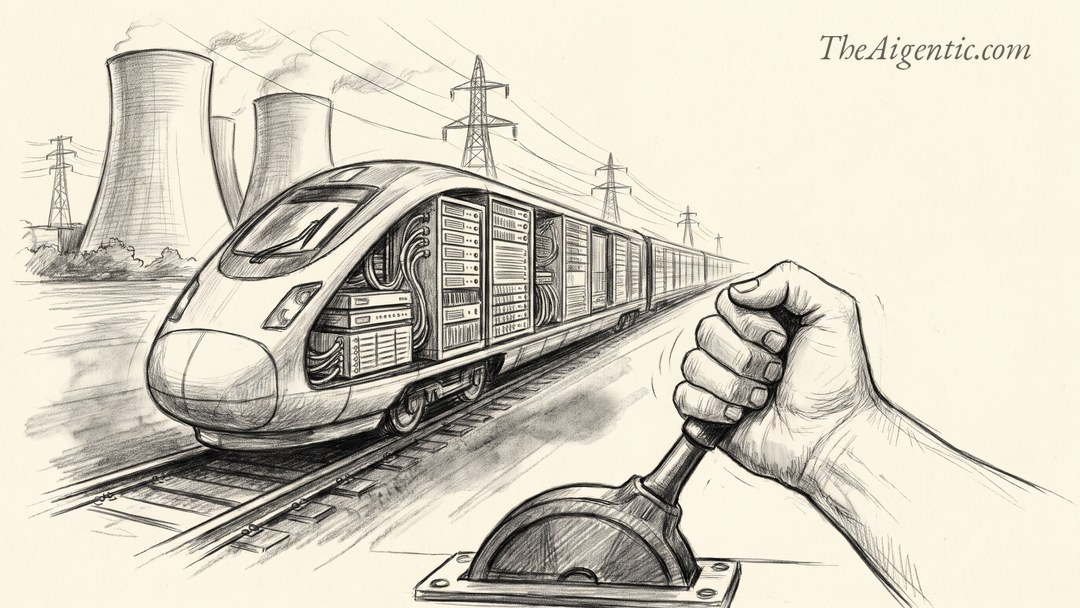
Good morning. The people building the fastest technology in history spent the weekend talking about brakes. OpenAI’s chief scientist proposed limits every lab would agree not to cross. Washington says it will write “joint guardrails” with Beijing. In the Arizona desert, SpaceX is finding out that the real speed limit on AI may be who pays the power bill. Meta quietly admitted its climate goal is slipping, and a startup says AI agents designed a CPU from scratch. Here is what moved while you were away.
the aigentic
Know what matters in AI.
The stories shaping AI, the tools worth trying, and what they mean for your work.
Morning Brief + Closing Time. Two emails every weekday.
Free. Unsubscribe anytime.
OpenAI published an essay Sunday in which chief scientist Jakub Pachocki argues that frontier labs should agree on common limits, based on perplexity and other measurements, that none of them would cross until our ability to understand and monitor AI behavior hits a concrete milestone. To start the conversation, OpenAI disclosed its own internal figures: a log-perplexity of about 0.99 for GPT-3.5, about 0.91 for GPT-4, and below 0.8 for today’s models, the range where he says capabilities in cybersecurity and mathematics began to emerge. Pachocki flags roughly 0.68 to 0.7 as the next window to watch, and concedes the metric has limits, including that labs use different datasets and that chain-of-thought reasoning adds capability without lowering perplexity.
Semafor reports that President Donald Trump said Friday the United States would work with China to develop “joint guardrails” on AI, after an anti-tech backlash helped drive a historic rebuke of Republicans in the midterm elections. The shift follows Trump’s earlier warning that regulation could “stifle” innovation, and it comes as protests against data center construction spread to Europe, Japan and India. Semafor adds that harsher US export controls are expected to slow China’s AI development, with OpenAI also tightening Chinese access to its models.
The Wire
The latest headlines from our live AI news feed.
California AG Bonta filed lawsuit against OpenAI over model security, public safety — Reuters
Anthropic has committed to spend about $900 billion, and Wall Street expects its debt to be rated junk, WSJ reports — The Wall Street Journal
U.S. intelligence tracked Alice Huang's contacts with China's spy agency during Nvidia affair, NYT reports — The New York Times
OpenAI chief scientist calls for industry-wide limits on AI development — Bloomberg
US seeks answers on Nvidia's chip sales to China, Bessent says — Reuters
Fortune reports that SpaceX’s plan to spend more than 74 billion dollars on two AI supercomputing sites is running into a simple question: who covers the cost of the power. The Arizona campus near Willcox would draw 6,000 megawatts at full build-out, nearly two-thirds of the all-time peak demand Arizona Public Service hit this summer, and Arizona Attorney General Kris Mayes has asked the county to delay its December 9 vote until state and federal agencies review the project. In Texas, Cameron County commissioners voted 3-2 against opening talks on a ten-year property tax abatement, and Fortune notes that voters sided against data center development in 37 of 38 local ballot contests with complete counts this month.
Ars Technica reports that Meta’s 2026 sustainability report says the company is “re-evaluating” its 2030 net-zero target, after total emissions rose from 15.6 million metric tons of carbon dioxide equivalent in 2024 to more than 21.7 million in 2025, a jump of nearly 40 percent. Ars says that is the steepest increase among the four largest US tech companies, compared with 25 percent at Microsoft, 18 percent at Google and 16 percent at Amazon. Meta attributes much of the rise to data center servers, saying demand for AI infrastructure “has grown faster than almost anyone projected.”
Tom’s Hardware reports that Palo Alto startup Architect Labs says its AI agents discovered, designed and verified Frostbite, a general-purpose CPU with a new instruction set. In simulation, a four-tile cluster delivered 4.59 times the performance per watt of a similarly sized in-order core across 25 workloads, falling to 3.83 times on the 15 workloads the design was not tuned for. The numbers come from a 7-nanometer design that has not been built in silicon, and the company has not named the comparison core.
Deals Desk
The newest compute and power deal on our tracker:
Nov 20 — Nebius × Mega Or: A third lease expansion with the Israeli data center operator, adding 134 MW across Beit Shemesh and Masmiya on a seven-year term with a five-year extension option, worth about 164.7 million dollars in net operating income to Mega Or on top of the NIS 740 million already signed. Completion is targeted for the second quarter of 2028. DatacenterDynamics
Full tracker → theaigentic.com/deals
Friday’s movers
Biggest winners
Biggest losers
| Ticker | Name | Price | Day |
|---|---|---|---|
| SNDK | Sandisk | 78.93 | -16.38% |
| CLS | Celestica | 201.01 | -16.33% |
| NBIS | Nebius | 81.21 | -16.21% |
| ALAB | Astera Labs | 179.58 | -15.13% |
| ARM | Arm | 151.65 | -14.40% |
Aigentic Exclusive
FEATURED DEEP DIVE

Dario Amodei Is Racing Against Time
A father’s death, a scientist’s conviction, and the extraordinary ambition behind Anthropic’s co-founder. As Anthropic takes its caution-first pitch to public markets after pricing an $81.3 billion IPO, we trace how Dario Amodei’s personal history shapes his belief that progress can arrive too late, and too fast.
Watch
Five picks this morning: Wes Roth on OpenAI’s perplexity warning, Matthew Berman on Anthropic’s first week as a public company, Nate B Jones on a week of outages, Peter Yang with Microsoft’s Charles Lamanna on a world where code is nearly free, and Dwarkesh Patel with Paul Christiano on why labs should fix security before advancing.
Wes Roth — OpenAI's SHOCKING new warning...
Wes Roth digs into the Pachocki essay behind this morning’s lead, which Sam Altman has called one of the most important things OpenAI has published in a while.
He explains the single hidden metric, log-perplexity, and why crossing certain thresholds seems to unlock new abilities in math and coding.
Watch this if you want the plain-English version of OpenAI’s case for shared limits.
Matthew Berman — I’m Crashing Out About Anthropic
Matthew Berman weighs Anthropic’s new life as a public company against the warnings about AI risk that built its brand.
He covers why it restricted Claude subscription access through tools like OpenClaw, and what METR found about AI accelerating Anthropic’s own research.
Watch this if you want a skeptic’s read on the gap between the safety pitch and the Wall Street pitch.
Nate B Jones — Microsoft, The FAA And Even The NSA Had Outages In One Week. What Is Happening?
Nate B Jones connects a week of outages at Microsoft, the FAA, several banks and the NSA to a larger problem in AI-era cyber defense.
His argument is that attackers can get deep access in as little as 15 minutes while defenders need days or weeks to restore systems, and AI makes that gap harder to close.
Watch this if you run anything that cannot afford to be down.
Peter Yang — What Should Engineers Do When AI Writes All the Code
Peter Yang sits down with Microsoft EVP Charles Lamanna at Ignite to ask what engineering looks like when code is nearly free.
They get into why agents are the harshest customers software has ever had, whether Copilot will replace Office, and why context is everything for AI.
Watch this if you manage engineers, or are one.
Dwarkesh Patel — AI Labs Should Stop Advancing Until They Fix Security - Paul Christiano
Dwarkesh Patel returns to his conversation with Paul Christiano, who argues that frontier labs should pause their advances until they fix security.
It lands the same weekend OpenAI’s chief scientist called for shared limits on how fast labs advance.
Watch this if the brake-pedal debate is the one you are following.