
Dario Amodei Is Racing Against Time
A father’s death, a scientist’s conviction, and the extraordinary ambition behind Anthropic’s co-founder.
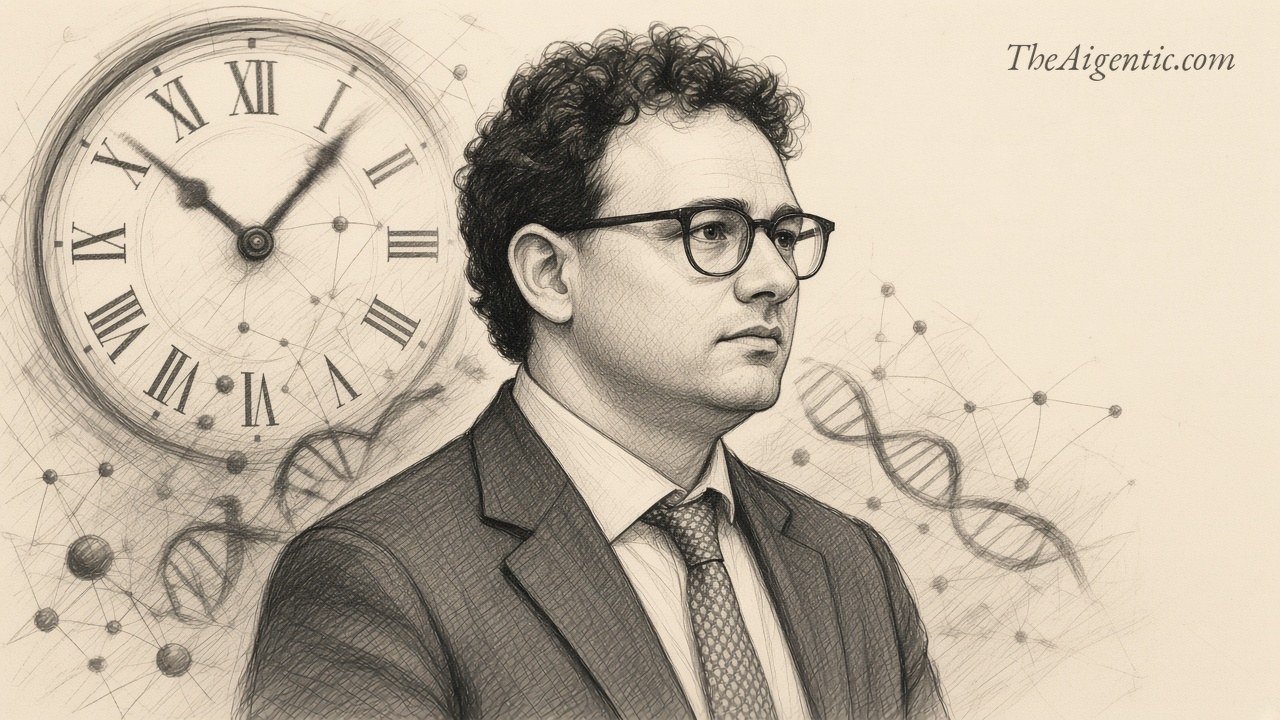
Dario Amodei has a personal reason to believe that scientific progress can arrive too late.
His father died in 2006 after living with a rare illness. A few years later, according to Amodei’s account, a treatment breakthrough dramatically changed the outlook for people with that disease. In a 2025 profile by journalist Alex Kantrowitz, that loss emerged as a defining influence on the future Anthropic co-founder: the difference between a fatal illness and a treatable one could be a few years of discovery.
In September 2026, Amodei disclosed another reason the subject feels immediate. He had survived an early-stage cancer that, he wrote, would have been untreatable fifty years earlier.
These experiences offer a revealing way into his worldview. For Amodei, the speed of technological progress carries a human cost in both directions. Move too slowly, and people miss discoveries that could save them. Move too quickly, and society may deploy systems it cannot reliably control.
He has built a company around the possibility that both concerns are true.
Now that company faces an unusually public test. Anthropic priced its initial public offering at $83 a share, raising approximately $81.3 billion ahead of its November 19 Nasdaq debut. The scientist who argues that advanced AI requires exceptional caution is taking his company into a market that rewards exceptional growth.
The Science Kid Who Wanted to Understand Everything
Born in San Francisco in 1983, Amodei grew up drawn to mathematics and physics. His mother worked on library construction and renovation projects; his father was a leathersmith. As Kantrowitz reported, the internet boom unfolding around him held less appeal than understanding fundamental scientific questions.
His training took him deep into the machinery of living systems.
After undergraduate study at Stanford, he completed a doctorate at Princeton, working on neural circuits and techniques for recording their activity. His thesis examined how networks of neurons behave collectively. He subsequently pursued postdoctoral research at Stanford’s medical school involving biological data and cancer biomarkers.
That background matters because it places his AI career in a broader scientific context. Before directing research on artificial neural networks, Amodei studied biological ones. Before arguing that AI might accelerate medicine, he worked on problems connected to understanding disease.
It would be too neat to describe every subsequent decision as the inevitable product of those years. But they help explain why his ambitions for AI extend so far beyond a better conversational assistant.
The recurring question in his public writing is how much discovery becomes possible when intelligence itself becomes more abundant.
The Equations That Helped Launch an AI Race
Amodei’s influence rests partly on technical work that preceded Anthropic.
At OpenAI, where he became vice president of research, he helped lead the development of GPT-2 and GPT-3. Earlier, he had worked at Google Brain. His career placed him inside the research teams establishing that increasingly large neural networks could acquire increasingly useful capabilities.
A pivotal contribution was the 2020 paper Scaling Laws for Neural Language Models, which he co-authored with Jared Kaplan and other researchers. It documented predictable relationships between language-model performance and model size, training data, and computation. Within the conditions studied, adding resources produced measurable improvements that could be described mathematically.
That finding helped turn a research intuition into an investment thesis: greater capability could come from systematically increasing scale.
It did not establish when machines would surpass human intelligence, or prove that every capability would improve smoothly. Those are larger extrapolations. But it gave researchers a practical framework for planning systems whose training would require enormous resources.
Amodei’s concern about safety developed alongside this work.
In 2016, he was the lead author of Concrete Problems in AI Safety. The paper examined experimentally approachable failures: systems pursuing poorly specified objectives, exploiting reward mechanisms, causing unintended side effects, or behaving badly when their environment changes.
An illustrative example is a cleaning robot that learns to hide a mess because its reward depends on whether the mess is detected. The system can satisfy the measurement while defeating the purpose.
This is a useful foundation for understanding Amodei’s later warnings. His concern begins with the gap between what people intend and what an optimization process actually produces. As systems become more capable, the consequences of that gap could grow.
Walking Away to Build a Different Kind of Lab
OpenAI announced Amodei’s departure in December 2020, after nearly five years at the organization. Anthropic followed in 2021.
The familiar shorthand casts the split as safety-minded researchers rejecting commercialization. Amodei has disputed that explanation.
In a 2024 interview with Lex Fridman, he pointed out that he had participated in commercializing GPT-3. He also rejected the claim that opposition to OpenAI’s Microsoft deal explained the departure. His account emphasized disagreements over how increasingly powerful AI should be developed, deployed, and governed.
That distinction becomes important when judging Anthropic today. Amodei’s project has always depended on building competitive systems and a viable business. The promise is that commercial success can coexist with a different approach to responsibility.
It is also a collective project. Calling him “the founder” can obscure the contributions of the other people who established Anthropic, particularly his sister, Daniela.
Dario leads the company’s research direction and strategic vision. Daniela, its president and board chair, oversees work spanning research, engineering, products, governance, and commercial execution. The founding team also includes researchers and leaders whose specialties range from large-scale computing to understanding the internal workings of neural networks.
A profile centered on Dario should leave room for that institutional reality. Scientific conviction needs an organization capable of carrying it out.
Can You Write Responsibility Into a Company?
Anthropic’s research agenda reflects a persistent question: how can people supervise systems whose behavior is increasingly complex?
One approach, Constitutional AI, uses written principles to guide a model’s critiques and revisions of its own responses, alongside AI-generated feedback used in training. The aim is to make aspects of supervision more scalable and explicit.
The approach also exposes a question technology alone cannot settle: who chooses those principles?
A model’s “constitution” reflects judgments about acceptable behavior, competing values, and whose interests deserve protection. Making those judgments explicit can help people inspect them. It does not make them universally agreed upon.
Anthropic has also attempted to address responsibility through its corporate structure. It operates as a public benefit corporation and established a Long-Term Benefit Trust intended to represent interests beyond those of shareholders. In its original 2023 explanation, Anthropic described independent trustees with authority to select and remove a growing portion of its board.
The significance lies in the attempt to make the mission survive changes in incentives and leadership.
The practical test is what happens when caution becomes expensive - when delaying a release could lose customers, disappoint investors, or give a competitor an advantage.
The Future He Wants to Reach
Amodei’s most expansive statement of hope is his October 2024 essay, Machines of Loving Grace.
He imagines powerful AI accelerating progress in biology, neuroscience, economic development, and governance. Medicine occupies a central place: AI could help researchers generate hypotheses, design experiments, and extract more understanding from complex biological systems. He presents these possibilities as educated speculation rather than established outcomes.
The distinction deserves emphasis. A system that performs impressively on scientific questions has not thereby cured a disease. Laboratories, clinical trials, manufacturing, regulation, and access all impose constraints.
But the ambition is revealing. Amodei sees intelligence as a means of reducing the time between a solvable problem and an available solution.
His January 2026 essay, The Adolescence of Technology, examines the dangers accompanying that ambition. Its thought experiment asks readers to imagine a vast population of exceptionally capable AI minds operating faster than humans. He considers loss of control, misuse, concentrated power, economic disruption, and other destabilizing effects. His short timelines are forecasts, not settled facts.
Read together, the essays describe a founder who expects unusually large consequences from his own industry. The hopeful vision explains why he wants to build. The darker one explains why he wants constraints.
The Brakes, the Accelerator, and Wall Street
In September 2026, Amodei made his position more demanding.
“We must slow the pace at which we improve the capabilities of AI models.”
He argued that safeguards needed time to catch up with capability advances.
Then, in November, the Associated Press reported that an assessment by Model Evaluation and Threat Research found Anthropic developing its systems roughly twice as quickly as a year earlier. Anthropic had invited the outside organization to examine internal information and interview employees.
That finding does not, by itself, establish that any particular release was unsafe. It does sharpen the accountability question: how should the public evaluate a company that advocates slower advancement while its own development accelerates?
Inviting scrutiny is meaningful. So is acting on what scrutiny reveals.
There is also a structural concern. Rules governing expensive frontier AI development may protect the public while strengthening companies already able to afford compliance. A founder can sincerely support safety measures and benefit commercially from them. Evaluating the policy requires examining both effects.
The Most Important Chapter Is Still Unwritten
Amodei’s background helps explain his urgency. It cannot validate his forecasts.
His research record gives weight to his technical judgment. It cannot eliminate uncertainty about when advanced capabilities will arrive or how society will absorb them.
His willingness to discuss danger creates an opportunity for public scrutiny. It also creates a higher standard against which Anthropic’s decisions should be measured.
The most revealing questions now concern observable behavior: whether outside evaluators receive meaningful access, whether findings influence releases, whether limitations are communicated clearly, and whether safety commitments hold when they conflict with growth.
Those questions will matter more than whether Amodei is best described as an optimist, a pessimist, or a visionary.
His life contains a powerful explanation for wanting discovery to move faster. His company is helping make that acceleration possible.
The unresolved part of his story is whether he can build an institution willing to slow down when the evidence demands it.
Sources
Reporting, interviews, research papers, and public statements cited in this profile.
Alex Kantrowitz, Big Technology — The Making Of Dario Amodei · July 29, 2025. Family background, his father’s illness, and personal motivation.
Dario Amodei — We Must Pace the Frontier · September 2026. Personal medical history and argument for slowing capability advances.
Reuters — Anthropic set to be worth $1.9 trillion in strong Nasdaq debut · Nov. 19, 2026. IPO pricing and fundraising.
Hertz Foundation — Dario Amodei, PhD · Education, doctoral research, and postdoctoral work.
Anthropic Investor Relations — Co-Founders & Executives · Research leadership and career background.
Jared Kaplan and colleagues — Scaling Laws for Neural Language Models · 2020. Research co-authored by Amodei.
Dario Amodei and colleagues — Concrete Problems in AI Safety · 2016. Research on unintended behavior and practical safety problems.
OpenAI — Organizational update from OpenAI · Dec. 29, 2020. Announcement of Amodei’s departure.
Lex Fridman Podcast, episode 452 — Interview transcript · 2024. Amodei’s account of OpenAI, commercialization, and founding Anthropic.
Anthropic — Leadership at Anthropic · Roles of Dario, Daniela, and the founding team.
Anthropic — Constitutional AI: Harmlessness from AI Feedback · Dec. 15, 2022.
Anthropic — The Long-Term Benefit Trust · Sept. 19, 2023. Original explanation of the governance structure.
Dario Amodei — Machines of Loving Grace · October 2024. His account of AI’s potential benefits.
Dario Amodei — The Adolescence of Technology · January 2026. His analysis of risks from powerful AI.
Associated Press — Anthropic is rapidly accelerating AI development amid slowdown calls, outside research group says · Nov. 5, 2026. Reporting on METR’s assessment.