Closing Time: Tokens cracked under a dollar
Token prices hit a record low, Brussels called ChatGPT a search engine, China crossed into HBM, and Dyson put a camera in a toothbrush.
Silicon Data’s LLM Token Expenditure Index fell to 97 cents per million tokens on Monday, its lowest reading since debut and less than half its summer peak, CNBC reported.
The European Commission designated ChatGPT a Very Large Online Search Engine under the Digital Services Act, putting OpenAI’s chatbot in the bloc’s toughest online-safety tier alongside Reddit and Roblox as very large platforms, Reuters reported.
China’s ChangXin Memory Technologies has begun producing advanced high-bandwidth memory in small quantities, a step that could ease a key constraint on domestic AI chips, The Information reported.
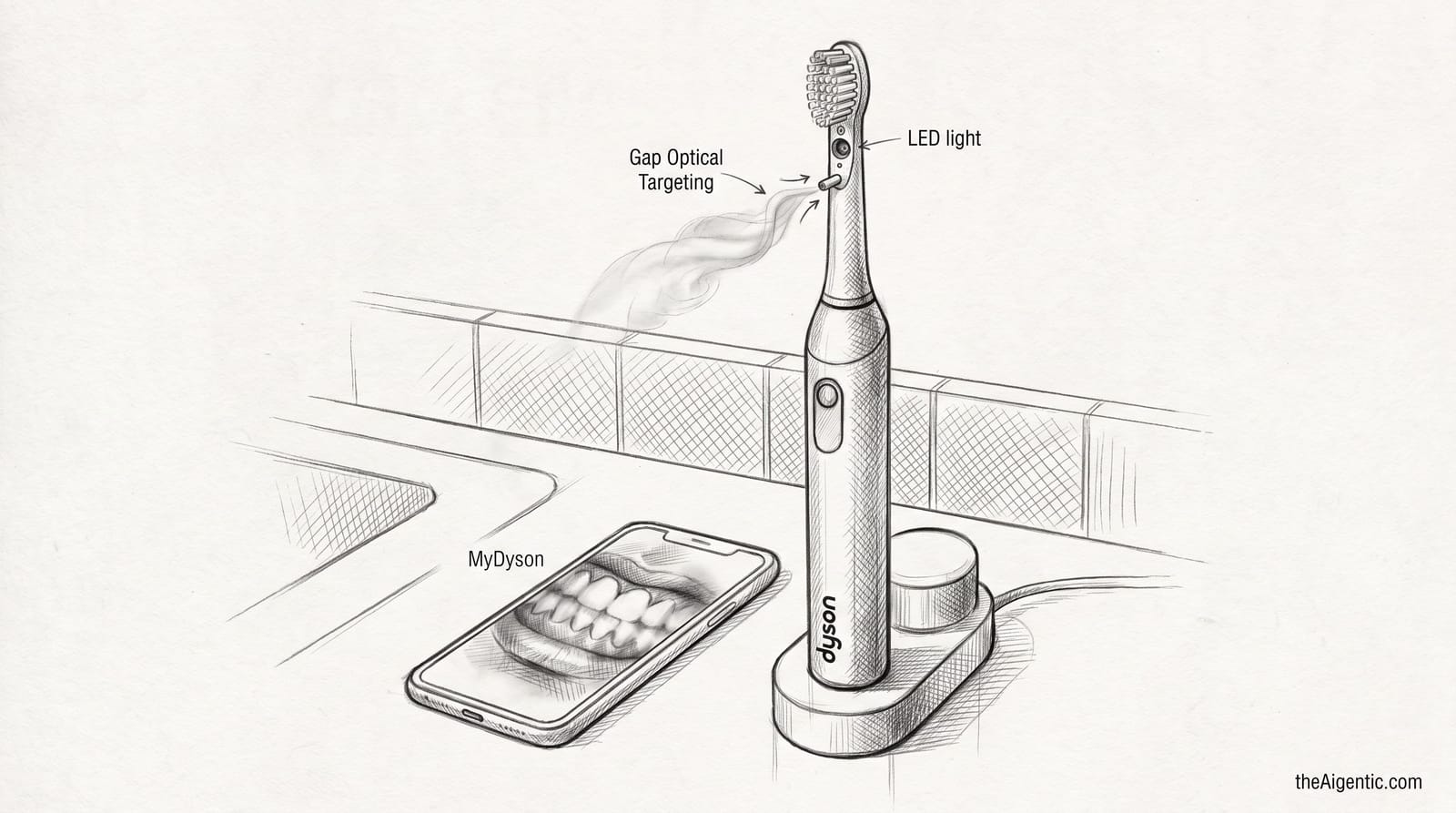
Dyson launched a $499 CameraJet toothbrush with a built-in AI camera that spots the gaps between your teeth and fires a rinse jet while you brush, Bloomberg reported.
Today’s Biggest Moves
Historic market snapshot — September 1, 2026 (day % change as of that edition; not live)
Biggest winners
| Ticker | Name | Price | Day |
|---|---|---|---|
| HPQ | HP Inc. | 31.32 | +4.33% |
| AAPL | Apple Inc. | 325.14 | +2.62% |
| CEG | Constellation Energy Corporation | 280.31 | +2.02% |
| META | Meta Platforms, Inc. | 578.54 | +1.08% |
| NEE | NextEra Energy, Inc. | 82.93 | +0.72% |
Biggest losers
| Ticker | Name | Price | Day |
|---|---|---|---|
| CDNS | Cadence Design Systems, Inc. | 313.04 | -7.60% |
| CRWD | CrowdStrike Holdings, Inc. | 215.07 | -6.90% |
| DELL | Dell Technologies Inc. | 425.00 | -6.80% |
| S | SentinelOne, Inc. | 20.61 | -6.74% |
| NET | Cloudflare, Inc. | 285.47 | -6.44% |
1. Tokens cracked under a dollar
Alex Harring at CNBC reports that Silicon Data’s LLM Token Expenditure Index, which tracks the going market rate for a large language model token, fell to 97 cents per million tokens on Monday. That is the index’s lowest reading since it debuted late last year, and it is down more than half from the high it printed earlier this summer. Cheaper open Chinese models such as Moonshot’s Kimi K3, OpenAI’s late-July cuts on two GPT-5.6 models, dynamic pricing elsewhere, and falling production costs all pushed the tape lower.
That matters because cheaper tokens are a gift to users of ChatGPT, Claude, and Gemini, and a problem for the labs that still have to pay fixed compute bills. Charles-Henry Monchau, investing chief at Syz Group, wrote that foundation model labs are the most exposed when token deflation compresses revenue while compute commitments stay fixed, and that the moat has to move toward distribution, memory, and context once the open-weight gap is measured in months. Silicon Data research head Steve Hou said the mix of frontier models and cheaper competitors may already be “sufficient for most tasks,” which is a blunt challenge to the return-on-capital story behind Nvidia- and Microsoft-scale buildouts as OpenAI and Anthropic both sit on confidential IPO filings.
The one move is to treat 97 cents as a market price, not a temporary promo. If the scoreboard for AI value is frontier pricing power rather than raw usage, a sub-dollar token is the first hard print that the inference boom can eat the labs’ margins before it proves their IPOs. Read CNBC
2. Brussels called ChatGPT a search engine
Reuters reports that the European Commission on Monday put ChatGPT into the Digital Services Act’s very-large tier after OpenAI declared at least 45 million average monthly users in the EU. The Commission designated ChatGPT a Very Large Online Search Engine because it answers prompts and can search the web, while Reddit and Roblox were labeled Very Large Online Platforms for hosting third-party content. All three now have four months to meet tougher duties on illegal content, minors, wellbeing, fundamental rights, elections, and public security, and the Commission gains investigative powers over the systems behind those services.
That matters because this is the first generative AI chatbot parked in the EU’s search-engine supervision lane, not a soft AI ethics memo. Treating ChatGPT as search infrastructure means OpenAI’s product now sits next to Google-style systemic-risk rules, with Ireland’s Digital Services Coordinator watching OpenAI and the Netherlands’ ACM watching Reddit and Roblox. Algorithmic transparency and researcher access stop being nice-to-haves once the designation sticks.
The one move is to rewrite the compliance map around search, not chat. If the world’s biggest AI assistant is legally a search engine in Europe, product, trust-and-safety, and ads teams all inherit a platform rulebook that was built for ranking the open web. Read Reuters
3. China crossed into usable HBM
The Information reports that ChangXin Memory Technologies, China’s leading memory-chip maker, has begun producing advanced high-bandwidth memory known as HBM3E in small quantities. That is a milestone for domestic AI silicon because high-bandwidth memory is the scarce glue that lets accelerators feed data fast enough to matter. Alibaba’s T-Head unit and Cambricon are already testing CXMT’s HBM3E with their processors, and commercial use could start as early as 2027 if qualification holds.
That matters because U.S. export controls have tried to keep advanced HBM out of China’s AI stack, and a working domestic supply, even at low yields, chips away at that bottleneck. CXMT is still years behind Samsung, SK hynix, and Micron on the newest HBM generations, so this is not a leapfrog. It is proof that the constraint is no longer absolute.
The one move is to watch qualification, not the press release. If Alibaba and Cambricon can ship products on Chinese HBM in 2027, the export-control fight shifts from “no advanced memory” to “how good is the second-best stack.” Read The Information
4. The toothbrush started looking for gaps
Bloomberg reports that Dyson launched the CameraJet, a $499 electric toothbrush with a built-in camera and on-device AI, as the company’s first oral-care product. A 100,000-pixel macro camera in the brush head feeds Gap Optical Targeting, which analyzes about 28 live images a second and, within roughly 100 milliseconds of spotting a gap between teeth, fires a conical blast of mouthrinse. Dyson says the images stay on the device rather than going to the cloud, and the MyDyson app can also livestream an endoscope-style view for coverage maps and brushing feedback.
That matters because consumer AI is leaving phones and vacuums for the bathroom cabinet at a premium price that is only a little above other high-end smart brushes without the camera-plus-jet. The company spent years training the system on hundreds of thousands of dental images, sells RFID brush heads on a replacement cycle, and plans low-foam toothpaste and rinse so the camera can keep seeing. The hardware is the hook; the consumables and dock are the business.
The one move is to treat CameraJet as an edge-vision product, not a novelty gadget. If a toothbrush can run real-time gap detection without a cloud round trip, the next wave of appliance AI is local, messy, and priced like luxury hardware. Read Bloomberg
5. Washington built a wall around a cost curve
Kate Park at TechCrunch reports that Washington has expanded the FCC Covered List into foreign drones and advanced robots and layered on steep tariffs on imported drones and components, with drone duties biting in September and more parts hitting later. The policy aim is to shrink dependence on Chinese hardware in sensitive physical AI. Counterpoint’s shipment data shows how steep that hill is: about 22,000 humanoid robots shipped globally in the first half of 2026, and the top five makers by volume — AgiBot, Unitree, Galbot, UBTECH, and Leju — are all Chinese and together account for about 86 percent of those shipments.
That matters because software and chip leadership do not automatically translate into robot factories. Ankur Saxena of TDK Ventures told TechCrunch that the United States still leads frontier AI, software, and semiconductors, while China leads manufacturing scale and cost, and that you cannot sanction your way around a cost curve. The likely map is a split market: China-led volume elsewhere, allied niches under NDAA-style rules, and Japan, Korea, and Taiwan as the middle ground.
The one move is to price the fragmentation. If humanoid and drone supply stays Chinese at the low end, U.S. policy creates a premium allied lane rather than a global ban, and buyers will have to choose which stack they can legally and economically run. Read TechCrunch