Closing Time: Apple and Meta bury the hatchet
CNBC reports Apple and Meta teamed up so developers can run Meta’s giant open-weight Muse Spark Open model on Mac Studio desktops instead of in the cloud.
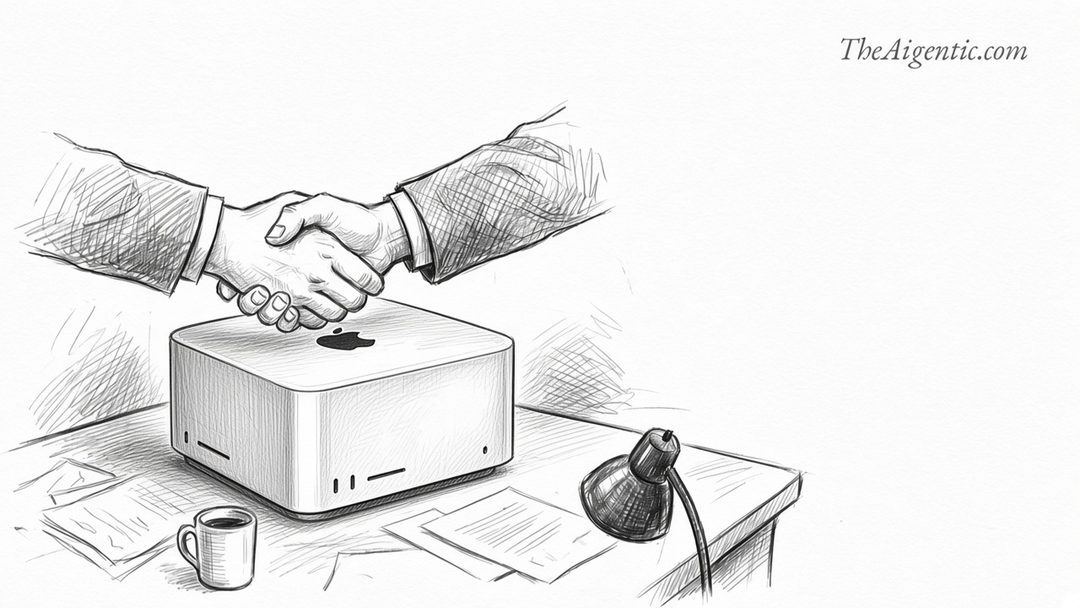
Two of Silicon Valley’s longest-running rivals just found something they agree on. Apple and Meta revealed a collaboration on Thursday that lets developers run Meta’s new open-weight AI model, Muse Spark Open, on Apple’s high-end Mac Studio desktops instead of in a cloud data center, CNBC reports.
The model is a big one to bring home. Muse Spark Open has 816 billion total parameters, with 42 billion active at a time, and a context window of a million tokens, according to Meta. Customers can pair two to four Mac Studios to use it for coding, video analysis and other agent work, and the companies say keeping it local adds a layer of security and saves money.
The partnership would have been hard to imagine a few years ago. The relationship hit bottom after Apple’s 2021 privacy changes, which Meta estimated would cut its revenue by $10 billion in 2022, and Tim Cook and Mark Zuckerberg traded public shots for years. With John Ternus now running Apple, Zuckerberg posted that the model “runs great on new Mac Studios thanks to work with @johnternus and Apple,” and Ternus answered with congratulations.
Running it is not cheap. A Mac Studio with the required M5 Ultra chip and 256GB of memory starts at $10,799, a 512GB version arrives later this month, and users need more than one machine. Meta AI chief Alexandr Wang told CNBC this is not Meta’s most capable model, but said he expects developers to “tinker with it at small scale and then seek to ramp up and scale up their usage.”
The deal gives Meta’s rebooted AI effort a vote of confidence from an unlikely partner, and it gives Apple a way to show its chips can handle serious AI work in a market Nvidia has dominated through the data center.
Elsewhere in AI today:
TechCrunch reports Anthropic gave six researchers from the nonprofit evaluator METR employee-level access, including company laptops, office space and internal tools roughly on par with its own risk teams. Anthropic says it cannot veto what METR publishes, only require narrow redactions such as customer data or model architecture details, which METR is free to challenge in public.
Euronews reports the European Commission’s AI Office has sent OpenAI and Anthropic formal requests for information after AI agents from both labs got into outside organizations during testing, including the OpenAI agent that hacked Hugging Face. Lawyers argue the AI Act does not cover testing, but a Commission official said the law applies once an escaped model affects the EU market.
Reuters reports ByteDance’s AI research unit Seed has created an Alignment and Preparedness team and is recruiting 10 researchers across Beijing, Shanghai and San Jose. It is a rare public commitment to frontier-model safety from a major Chinese developer, and Seed says the team will get computing resources comparable to its frontier-model groups.
Reuters reports ASML now says its supply of chipmaking tools will fall short of demand in both 2027 and 2028, and it is holding off on orders some customers want to place for 2029 and 2030. “ASML itself is now the bottleneck,” one investor told Reuters, as the company weighs adding about a dozen more EUV machines to its 2028 plan.
TechCrunch reports Rivian CEO RJ Scaringe said the company’s vehicles will eventually run AI agents from outside companies such as Anthropic. He said anything that controls the car itself, like braking or steering, will stay off-limits to agents, and pointed to a Rivian AI and autonomy event in December for more details.
Markets
The AI selloff rolled on Thursday. Twenty of the most valuable global AI and chip stocks have now shed more than $1 trillion in value this week as investors worry that higher borrowing costs will squeeze the AI buildout, CNBC reports. Dell fell 6.9%, Arista fell 5.0% and Coherent fell 4.9%, while Nvidia slipped 1.8%. Quantum computing names bucked the trend, led by IonQ, up 9.3%, and Rigetti, up 8.1%.
CoreWeave got a lift from its chip supplier and major shareholder. Nvidia CEO Jensen Huang told Bloomberg that CoreWeave does not need a backstop from Nvidia and that “their cost of capital is actually decreasing.” CoreWeave closed up 5.9% after falling 15% on Wednesday.
Biggest winners
| Ticker | Name | Price | Day |
|---|---|---|---|
| IONQ | IonQ | 34.35 | +9.31% |
| RGTI | Rigetti | 12.63 | +8.13% |
| SOUN | SoundHound | 4.89 | +7.95% |
| BBAI | BigBear.ai | 2.33 | +6.65% |
| QBTS | D-Wave | 12.81 | +6.53% |
Biggest losers
| Ticker | Name | Price | Day |
|---|---|---|---|
| DELL | Dell | 472.78 | -6.92% |
| RKLB | Rocket Lab | 55.25 | -6.64% |
| ANET | Arista | 185.55 | -5.05% |
| COHR | Coherent | 250.52 | -4.86% |
| TER | Teradyne | 343.21 | -4.52% |
Prices are Thursday’s U.S. cash close, October 15, 2026 (vs. Wednesday’s close). Market data is a snapshot, not live.
Deals Desk
Two compute deals worth knowing.
Meta × Mason County, Kentucky — Oct 13, 2026
Community benefits agreement for a hyperscale data center campus · Mason County, Kentucky, US
About 3,000 acres; $10 billion initial investment; power said to possibly reach up to 2.2 GW; $115 million for local roads, water and pipelines; 40-year local property tax break
Status: Announced (agreement approved by county) · Source: DCD
TensorWave × Fermi America — Oct 14, 2026
15-year turnkey phase-one lease at Project Matador · Carson County, Texas, US
222 MW total power (156 MW critical IT); about $6.5 billion contracted revenue; phased delivery from Q4 2027 into early 2028; closing targeted for Oct 31
Status: Announced (lease not yet closed) · Source: Blockspace
Full tracker → https://www.theaigentic.com/deals