Gemini 4 Neon vs. Claude Opus 5.5: Which wins at coding, writing and spreadsheets?
Gemini 4 Neon costs 25% less per token than Claude Opus 5.5. Here is where it wins, where Claude still leads, and when the cheaper model is worth switching for.

Opus 5.5 still builds the better-looking thing. Gemini 4 Neon handles the spreadsheet better, writes about as well, and costs less every time it runs. That is where the evidence stands two days after Google released Neon on November 18. 1
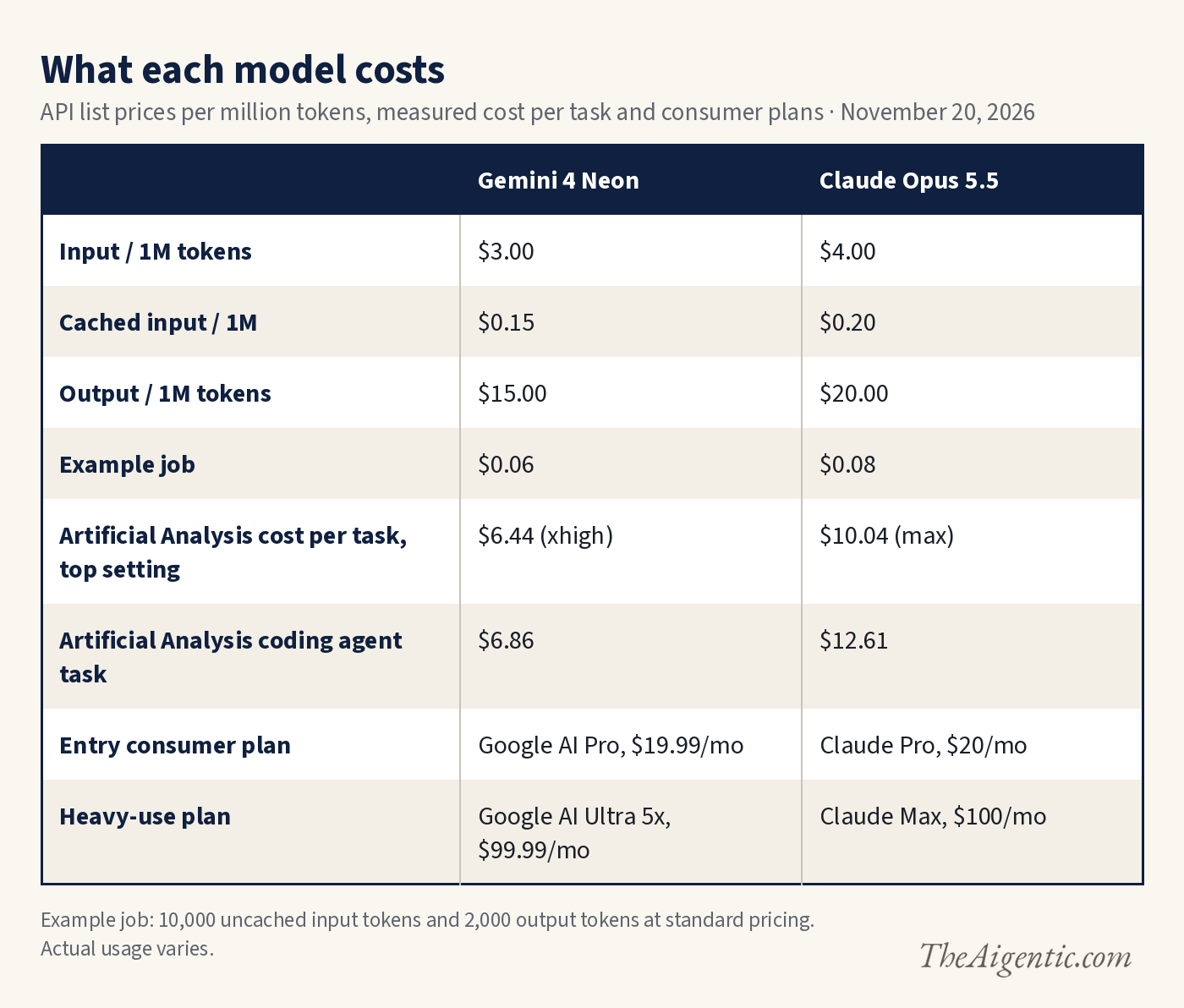
Neon costs $3 per million input tokens and $15 per million output tokens. Opus 5.5 costs $4 and $20. 3 4 Artificial Analysis scored Neon at 61 on its Intelligence Index at the xhigh setting, two points above Opus 5.5 at max effort, for $6.44 a task against $10.04. 5 The real question for anyone paying an Anthropic bill is whether that holds up on ordinary work.
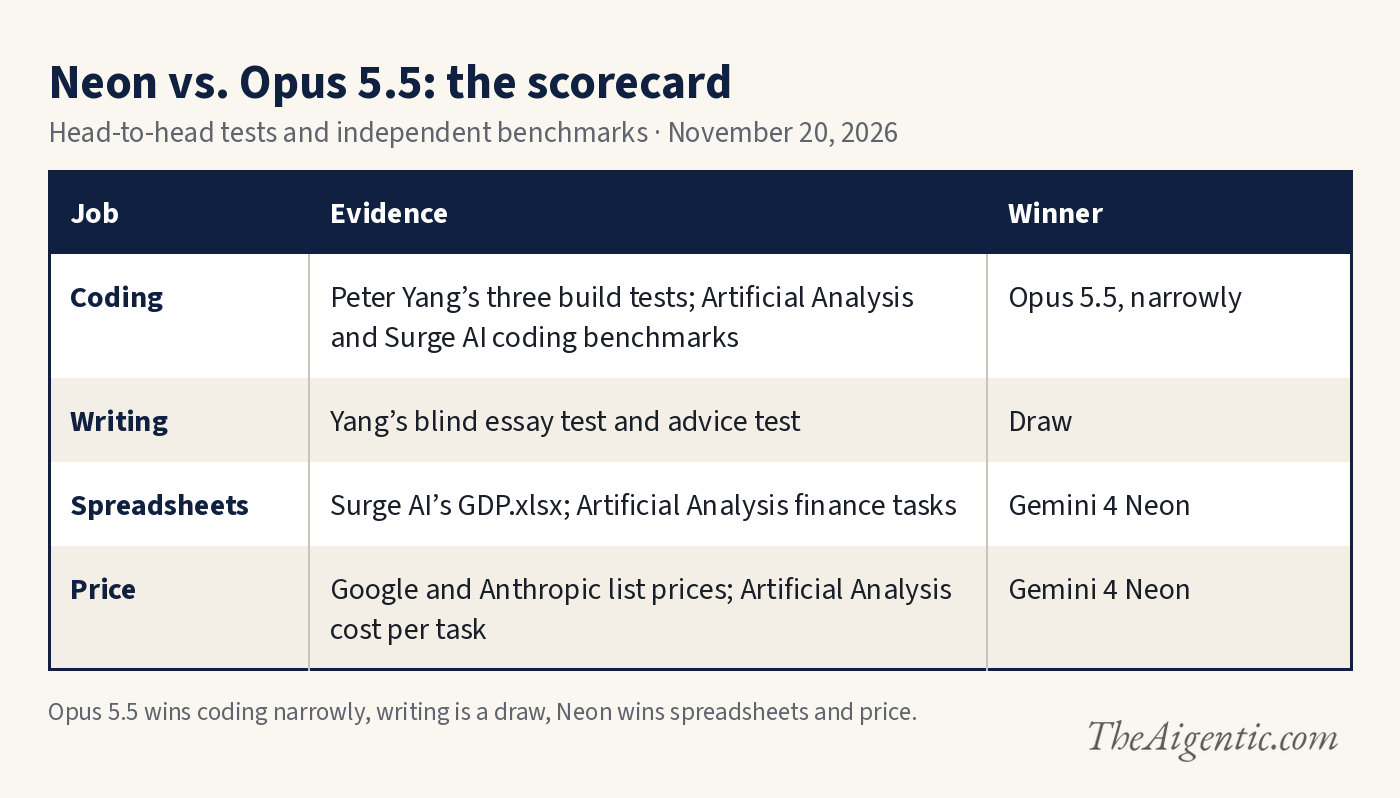
The scorecard
| Job | Evidence | Winner |
|---|---|---|
| Coding | Peter Yang’s three build tests; Artificial Analysis and Surge AI coding benchmarks | Opus 5.5, narrowly |
| Writing | Yang’s blind essay test and advice test | Draw |
| Spreadsheets | Surge AI’s GDP.xlsx; Artificial Analysis finance tasks | Gemini 4 Neon |
| Price | Google and Anthropic list prices; Artificial Analysis cost per task | Gemini 4 Neon |
Tap to enlarge.
Who tested what
Peter Yang ran the only side-by-side test among the three creators who covered the launch within a day. He gave Neon and Opus 5.5 the same five jobs, with Gemini 4 Carbon as a third entrant. Matthew Berman used Neon on his own coding projects and reviewed the launch benchmarks, but he did not run Opus on the same tasks. Wes Roth walked through Google’s claims and showed early results from a benchmark he is building.
None of them gave both models a spreadsheet, so the spreadsheet verdict rests on Surge AI and Artificial Analysis. Figures from Google’s model card are Google’s own runs. 2
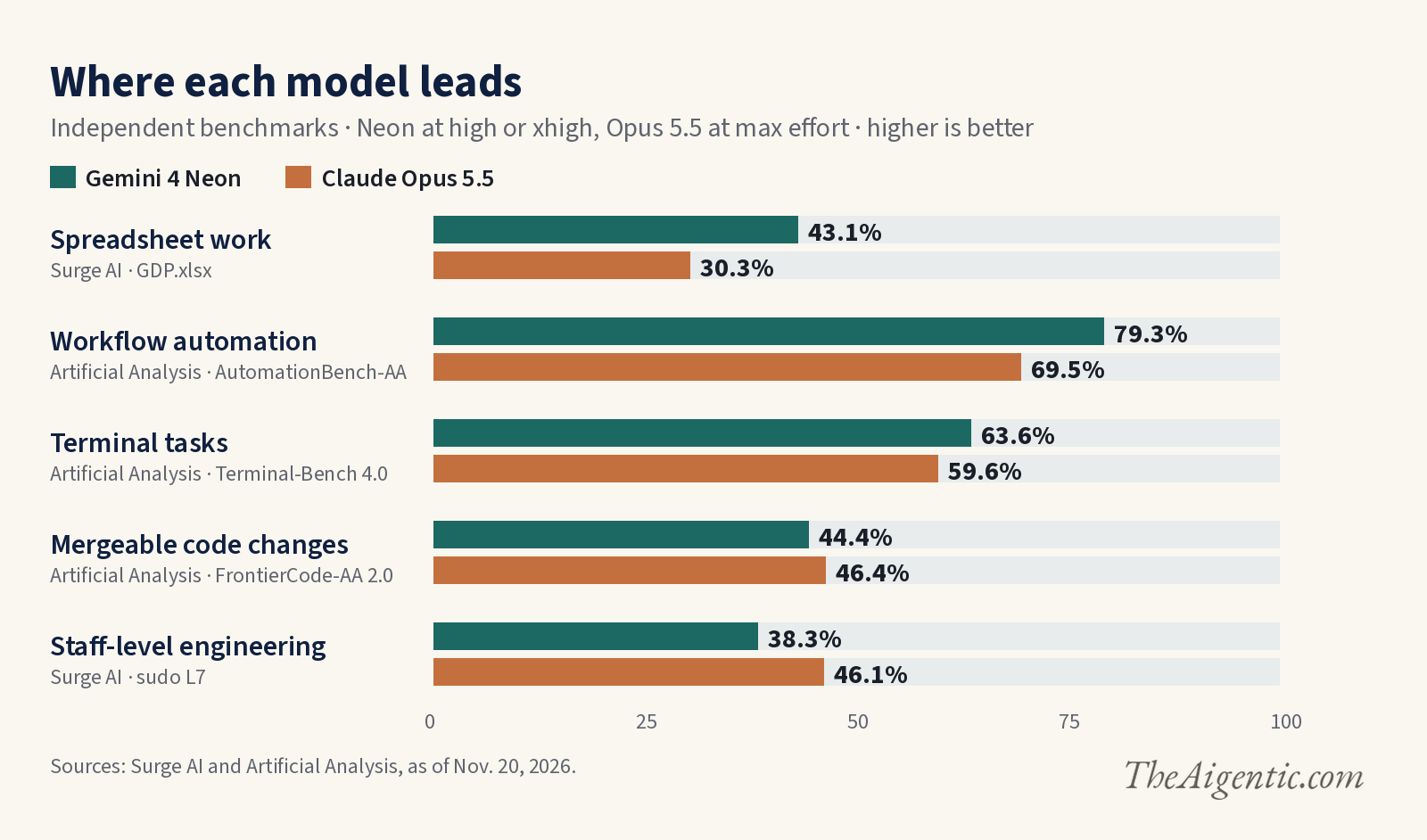
Artificial Analysis comparison · Surge AI’s Neon results
Peter Yang’s head-to-head
Yang uses Opus 5.5 as his daily driver. After five tests he called Neon “the first model that in my opinion has actually caught up to Opus for everyday use,” except for 3D and design work.
3D video at 2:28 · Game at 3:57 · Website at 6:05 · Blind essays at 7:50 · Pushback at 12:39 · Verdict at 14:30
Coding: Opus still builds the better product
Opus won all three of Yang’s build tests. For a 3D video ad of Shibuya Crossing, both models took about 40 minutes. Opus opened on a wide shot with a train in the background and zoomed down to street level. To Yang, Neon’s intersection looked too small, more like an everyday street crossing than the world’s most famous one. In a Godzilla game, Opus had the more cinematic intro and more to do, though it lagged on his MacBook. Neon’s version ran smoothly, with graphics he compared to the original PlayStation. When he asked for a redesign of his own website, he called Neon’s “simple and decent” and Opus’s the most creative.
The independent coding numbers are much closer:
- Artificial Analysis Coding Agent Index: Neon in Google’s Antigravity CLI scored 59, and Opus 5.5 in Claude Code scored 58. Neon averaged $6.86 a task to Opus’s $12.61. 6
- FrontierCode-AA 2.0, which grades whether a maintainer would merge the change: Opus 46.4%, Neon 44.4%. On Terminal-Bench 4.0, Neon led, 63.6% to 59.6%. 5
- Surge AI’s sudo L7, a staff-level engineering benchmark: Opus 46.1%, Neon 38.3%. Surge found Neon more likely to write tests that validated its own implementation than the risk the task was meant to catch. 7 8
- Google’s model card has Opus slightly ahead on Terminal-Bench 4.1 (65.8% to 65.2%) and FrontierCode 2.0 (47.3% to 46.2%), with Neon well ahead on CursorBench 4.1 (65.4% to 58.1%). 2
Berman’s coding examples were with Neon alone, on Scarlet, his open-source video editor. He liked how it handled loose prompts and how briefly it explained its changes. A one-line request to tidy a model picker came back in about five minutes. Adding Gemini models across the app took 45. Roth put an asterisk on Google’s coding claims: “That asterisk’s name is Claude.” He had not yet given Neon deep coding work.
Berman’s coding threads at 3:53 · Roth on coding benchmarks at 9:49
Verdict: Opus 5.5, narrowly. Use Opus for front-end work, games, 3D and changes a senior engineer will review. Neon matches it on agent coding indexes for about half the measured cost per task, so it is worth trying on high-volume work that already has good tests.
Writing: too close to call
Yang’s blind test asked each model for a software engineer’s reflection on no longer writing code by hand. He ranked Neon’s essay first, Carbon’s second and Opus’s third, while saying “they’re all pretty close.” He flagged Opus’s closing line, “They are. I’m the part that moved,” as AI slop. Asked how to improve its essay, Neon came back with a few concise bullet points and before-and-after examples.
Advice went the other way. Yang asked each model for the single change that would grow his YouTube channel fastest. Neon told him to move interviews to a second channel. Opus told him to make fast solo tests of big launches and book guests only when they built the tool everyone was searching for that week. He preferred Opus’s answer. When he pushed back five different ways, including with a made-up fact, both models held their position and gave ground only to real data.
Berman’s main reason for liking Neon is its communication: he no longer has to keep asking for shorter, simpler explanations. Anthropic made writing a selling point at the Opus 5.5 launch too, citing early testers who found it clearer and easier to follow. 9
Verdict: draw. Try Neon for drafts, summaries and status notes where brevity matters. Keep Opus for advice where nuance matters more than length. One essay prompt is too small a sample to pick a winner.
Spreadsheets: Neon’s clearest win
- Surge AI’s GDP.xlsx has 70 workplace questions, each paired with a real professional workbook or CSV. Neon at high reasoning scored 43.1% and ranked first. Opus 5.5 at max effort scored 30.3% and ranked sixth. 8
- Artificial Analysis Finance & Accounting: Neon 65 at xhigh, Opus 59 at max. 5
- Surge’s DAYJOB: Finance, 80 tasks such as credit memos, valuation models and covenant tests: Neon took first place with 50.5%, using about one-third the output tokens of Claude Fable 5.2. 7
Verdict: Gemini 4 Neon. For financial models, reconciliations and questions about a workbook, try Neon first. Check its conclusions, though. Surge found that Neon’s decisiveness made it “more prone to overstating what the evidence supports.” 7
Is the lower price worth switching for?
| Gemini 4 Neon | Claude Opus 5.5 | |
|---|---|---|
| Input / 1M tokens | $3.00 | $4.00 |
| Cached input / 1M | $0.15 | $0.20 |
| Output / 1M tokens | $15.00 | $20.00 |
| Example job | $0.06 | $0.08 |
| Artificial Analysis cost per task, top setting | $6.44 (xhigh) | $10.04 (max) |
| Artificial Analysis coding agent task | $6.86 | $12.61 |
| Entry consumer plan | Google AI Pro, $19.99/mo | Claude Pro, $20/mo |
| Heavy-use plan | Google AI Ultra 5x, $99.99/mo | Claude Max, $100/mo |
Tap to enlarge.
Neon bills thinking tokens as output. 3
On the API, yes, for knowledge work. Neon’s token prices are 25% lower, and its measured cost per task is lower still. At its default high setting, Artificial Analysis scored Neon at 60, a point above Opus 5.5 at max, for $3.74 a task against $10.04. 5 For pipelines built on spreadsheets, finance and documents, you get better benchmark scores for less.
For shipped code and design, not yet. Opus won every build test Yang ran and leads on the benchmarks closest to code review. A redo costs more than the token savings.
For subscribers, price isn’t the argument. Google AI Pro costs $19.99 a month and Claude Pro $20. Google AI Ultra 5x is $99.99, and Claude Max is $100. 10 11 Both companies charge about the same, so the decision comes down to the work.
Our call: move spreadsheet and analysis jobs to Neon and measure the results. Keep Opus for code you ship and anything visual. Before canceling a subscription, run both on a week of your own tasks.
Watch and read next
Matthew Berman’s Gemini 4 Neon is ridiculous... covers his Scarlet coding threads and reactions from developers. Wes Roth’s Google’s Neon is wild... goes through Google’s launch claims and the Gemini 4 lineup.
Continue with The Aigentic’s Fable 5.2 vs. the field, which tested Opus 5.5 against Fable 5.2 and GPT-6 Astra.
Sources
- Google — Introducing Gemini 4 Neon
- Google DeepMind — Gemini 4 Neon model card
- Google — Gemini Developer API pricing
- Anthropic — Claude API pricing
- Artificial Analysis — Gemini 4 Neon vs. Claude Opus 5.5
- Artificial Analysis — Google continues to accelerate its release cadence with Gemini 4 Neon
- Surge AI — Gemini 4 Neon scores #1 on the Tuesday@Work Index
- Surge AI — GDP.xlsx benchmark and leaderboards
- Anthropic — Introducing Claude Opus 5.5
- Google — Google AI plans
- Anthropic — Claude plans and pricing
- Peter Yang — I Tested Gemini 4 Neon vs Claude Opus 5.5 (Full Breakdown)
- Matthew Berman — Gemini 4 Neon is ridiculous...
- Wes Roth — Google’s Neon is wild...