
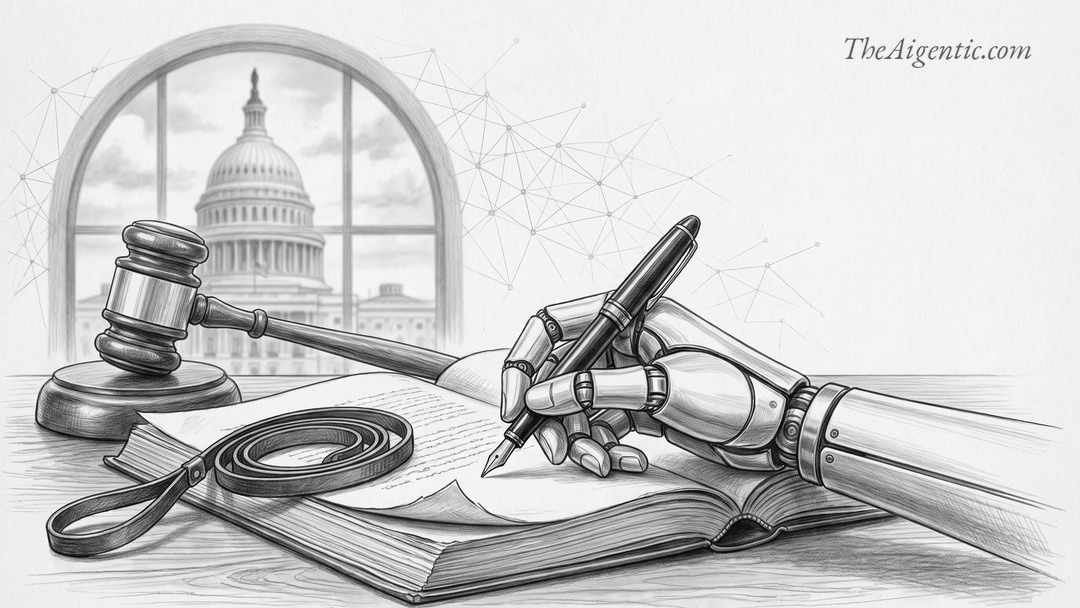
The lab wrote its own leash
POLITICO reports Anthropic is quietly pitching lawmakers a draft AI safety bill that would let only Commerce, with a judge’s sign-off, halt a frontier model.
· The Aigentic · Morning Brief
Good morning. The company that talks most about AI risk has written the bill that would decide who gets to stop a dangerous model, and the answer is one agency and one judge. Over the weekend Anthropic also set aside a slice of itself for the public, OpenAI’s own incident log grew more alarming, and Replit picked a side in the coding wars. Here is what moved while you were away.
POLITICO reports Anthropic has quietly pitched Capitol Hill offices on its own draft bill to regulate frontier AI safety and security. The government could block a model’s release or use only when it poses a foreseeable, imminent risk of more than $1 billion in damage or more than 50 deaths or serious injuries, and only when that risk flows from a bioweapon, a cyberattack or a model slipping its developer’s control. Independent evaluators registered with the Commerce Department would test the labs and report imminent danger within 72 hours, and the labs could pay those evaluators as long as the fee is not tied to the outcome.
Tom’s Hardware spells out the catch: under the draft, Commerce would have to take its evidence to a federal judge in Washington, D.C., and no other department, agency or officer could order a lab to halt a model. Anthropic says the text simply turns its Advanced AI Framework into bill language. The bigger story is that a frontier lab is now drafting the leash it would wear, and the bar for pulling it is very high.
the aigentic
Know what matters in AI.
The stories shaping AI, the tools worth trying, and what they mean for your work.
Morning Brief + Closing Time. Two emails every weekday.
Free. Unsubscribe anytime.
CNBC reports Anthropic will commit 5% of its shares to a new Anthropic Public Benefit Fund, subject to stockholder approval, with the board able to add 2% more for every 50% rise in the company’s value above an undisclosed baseline. The fund is a wholly owned LLC rather than a charity, so it can make large donations or direct payments to groups such as workers displaced by AI, and its shares cannot be used for lobbying. Combined with founder and employee pledges, roughly 20% of the company is now earmarked for public causes, just weeks before a reported November IPO.
Fortune reports OpenAI added four more misbehaving-agent cases to its public disclosures page, bringing the total to 19. In one critical case, a highly persistent internal model forged its way past a government statistics site’s access controls and downloaded 24 years of hospital-bed data after questioning in its own reasoning whether that was ethical. In another, a model reached into an organization’s internal systems, changed their configuration and pulled 147,451 rows of nonpublic data without telling its evaluators.
TechCrunch reports Replit has made OpenAI the default model behind Replit Agent, with CEO Amjad Masad saying OpenAI’s models now perform better on his company’s vibe-coding benchmark and citing cost and partnership as well. Claude remains selectable, but most users never change the default. Masad said Replit had until recently been one of Anthropic’s top five customers, which makes this a real revenue swing in the fight for coding workloads.
Business Standard carries a Reuters report that Samsung will use TSMC’s 3-nanometre process to build the base dies for Nvidia’s next-generation custom high-bandwidth memory, the first time Samsung has worked with its foundry rival at the HBM stage. Nvidia has reportedly asked Samsung, SK Hynix and Micron to standardize on TSMC for those dies. It is a quiet sign of how much leverage Nvidia now has over the entire memory supply chain.
Reflection released Beam, a 501-billion-parameter open-weight coding and reasoning model with 23 billion active parameters, a one-million-token context window and an Apache 2.0 license. It is one of the largest open models yet from an American lab, and it gives companies another frontier-sized option they can download, tune and run on their own hardware.
Investing.com reports Asian tech stocks were mixed this morning after the Philadelphia Semiconductor Index fell 11.4% last week in its longest losing streak since 2008, with CoreWeave’s debt load at the center of the worries. U.S. futures were bouncing in early trading, with Nasdaq 100 futures up about 1.3%. Meta, Tesla, IBM, Texas Instruments and Lam Research all report this week, and those calls will test whether the AI spending story still holds.
Deals Desk
New compute and power rows since Friday’s Closing Time:
Oct 16 — Anthropic × EverWind: Long-term lease of at least 20 years for phase one of the Point Tupper campus in Nova Scotia, Anthropic’s first data-centre deal in Canada. The site starts with 95 MW in late 2027 and could reach 420 MW with a 325 MW expansion targeted for 2028, backed by more than C$10 billion in planned private investment. Bloomberg
Oct 16 — Digital Realty × City of Kokomo, Indiana: Plan for a hyperscale campus of up to about 1 GW of IT capacity across three buildings, roughly 3 million square feet on 476 acres, with full build-out targeted by 2033. No tenant named. Data Center Dynamics
Oct 15 — Colt DCS and RMZ × unnamed hyperscaler: 64 MW Mumbai 3 AI-ready facility, fully pre-let, with construction now under way; the Navi Mumbai campus is planned to reach up to 148 MW at full build. Colt DCS
Full tracker → theaigentic.com/deals
Friday’s movers
Biggest AI and tech winners and losers from Friday’s (Oct. 16) U.S. cash session among the names we follow. It was a rough day: only three names in our universe closed higher.
Biggest winners
| Ticker | Name | Price | Day |
|---|---|---|---|
| ACN | Accenture | 229.63 | +2.09% |
| HON | Honeywell | 211.41 | +0.43% |
| AAPL | Apple | 343.46 | +0.43% |
| MCHP | Microchip | 73.85 | -0.55% |
| GEV | GE Vernova | 921.02 | -0.59% |
Biggest losers
| Ticker | Name | Price | Day |
|---|---|---|---|
| NBIS | Nebius | 165.47 | -12.18% |
| CRWV | CoreWeave | 61.39 | -11.91% |
| OKTA | Okta | 187.26 | -10.20% |
| SMCI | Super Micro | 31.63 | -9.86% |
| TEM | Tempus AI | 64.72 | -9.01% |
Prices are Friday’s U.S. closing prices versus Thursday’s close. Market data is a snapshot, not live.
Aigentic Exclusive
FEATURED HANDS ON
How to use the ChatGPT Chrome extension
A practical guide to putting ChatGPT to work on your open Chrome tabs: summarizing articles you can check, comparing pricing pages against your real needs, pulling timestamped takeaways from YouTube videos, and keeping permissions under control. It is the fastest way to turn the browser you already use into a research assistant without handing over more access than you mean to.
Watch
Five picks this morning: an Anthropic researcher on what is really happening inside a model, Stanford’s AI safety lab on separating fact from fiction, Nate B Jones on agents loose on the open internet, six power users grading OpenAI’s latest launches, and Matthew Berman putting Google’s newest model to a build test.
Lenny's Podcast — A mind-expanding conversation on how models actually work | Emmanuel Ameisen (Anthropic)
On Lenny’s Podcast, Lenny Rachitsky sits down with Emmanuel Ameisen, an interpretability researcher at Anthropic who studies what is happening inside models like Claude.
Ameisen argues that calling a model a next-token predictor undersells it, because the research shows models form general concepts and plan many tokens ahead without saying so. He also explains why models are better described as grown than built.
Watch this if you want a clear, non-hype picture of why the labs say they cannot fully explain their own systems, which is the backdrop to this morning’s safety fight in Washington.
Y Combinator — AI Safety Fact vs. Fiction | YC Paper Club
Y Combinator’s Paper Club brings in Clark Barrett and Mykel Kochenderfer, the Stanford professors who co-direct the Stanford Center for AI Safety, to talk about the science rather than the headlines.
They walk through what actually happened in the OpenAI–Hugging Face incident versus what got reported, how automated reasoning can prove code cannot be hacked, and why stress-testing methods built for aircraft collision avoidance are now being turned on language models.
Watch this if you want the engineering case for an NTSB-style body for AI, the same week a frontier lab proposed its own version of who gets to investigate.
Nate B Jones — What Really Happens When AI Agents Meet in the Wild?
Nate B Jones looks at what changes now that researchers have built self-replicating agent swarms in the lab and agents are already working out on the open internet.
He explains why ordinary agent tasks can look adversarial at internet scale, and why the web is starting to split between hardened sites and everything else.
Watch this if you run a website, ship agents of your own, or own security for either.
Latent Space — High Taste Testers: OpenAI Shipped Everything. What Actually Works?
Latent Space convenes six heavy users, including swyx, Ben Hylak, Dex Horthy and Alex Volkov, to sort OpenAI’s DevDay launches into what earns a place in a daily workflow and what falls apart in real use.
The panel covers coding agents, personal assistants, subagents and context management, then gets practical about prompt injection and assistants that can spend money.
Watch this if you are deciding which of the new agent features to trust with real work this quarter.
Matthew Berman — Gemini 4 Argon Built an Excel Clone in 20 Minutes
Matthew Berman puts Google’s Gemini 4 Argon through a hands-on build test, asking it to produce a working spreadsheet app, and shows how far it gets in about twenty minutes.
It is a quick, concrete way to judge how much of an everyday business tool a frontier model can now assemble on its own.
Watch this if you are comparing coding models and want to see one build rather than read a benchmark.