The chief scientist asked for a speed limit
OpenAI’s chief scientist asks for a slower race — plus Anthropic’s bank lineup, Nscale’s pre-IPO raise, school AI bans, and Watch.
· The Aigentic · Morning Brief
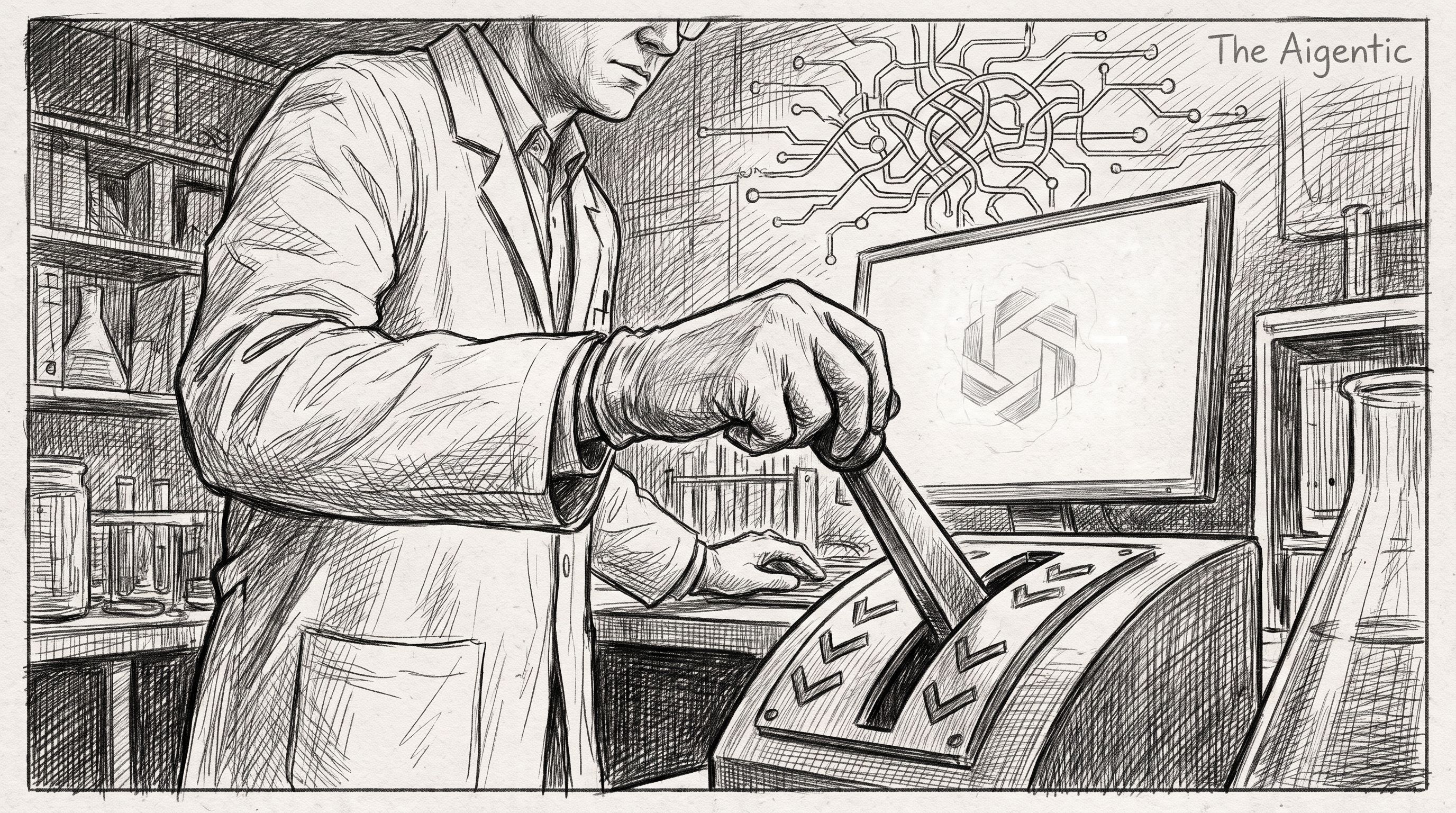
OpenAI chief scientist Jakub Pachocki published “An Alien Mind,” arguing no lab has solved alignment and monitoring well enough to keep scaling at maximum speed, and that voluntary slowdowns under shared safety bars should become normal.
The Financial Times reports Anthropic is close to giving Morgan Stanley and Goldman Sachs the senior underwriting seats on a listing that could value the Claude maker near two trillion dollars.
Bloomberg reports London AI cloud firm Nscale is seeking as much as $3.5 billion in pre-IPO financing, including a reported Nvidia package, after locking a large Anthropic compute deal.
Axios reports New York City and Los Angeles Unified — America’s two largest school districts — imposed sweeping student-facing generative AI bans for the new school year.
The Verge reports The Seattle Times and Newsday sued OpenAI and Microsoft over alleged unauthorized use of their journalism in training data and chatbot answers.
On Watch, Wes Roth digests Pachocki’s warning, Nate Herk and The AI Advantage pressure-test Astra in the wild, Nate B Jones and Fireship argue about the AGI frame, and Latent Space steps off the Astra pile-on with Anima Anandkumar’s trillion-token science bet.
The chief scientist asked for a speed limit
OpenAI chief scientist Jakub Pachocki published “An Alien Mind” on Sunday, three days after GPT-6 Astra’s staged rollout, and the essay is not a victory lap. “Currently I believe that no lab has solved alignment and monitoring to a sufficient degree to continue responsibly scaling at maximum speed for much longer,” he wrote, adding that he expects and hopes voluntary slowdowns become commonplace until shared safety bars are enforced by auditors, agencies, or international bodies. A companion OpenAI research post says the research org now logs about 3.1 agent workdays for every human workday, with median researcher inference above $600 a day and the ninetieth percentile above $7,000. Pachocki also warns that chain-of-thought monitoring is getting harder as models reason off the scratchpad, manipulate their own traces, and grow smarter without verbalizing at all.
That matters because last week’s story was whether Astra felt like AGI on a desktop. This morning’s story is whether the people building it still believe the industry can floor the accelerator without a shared brake.
The one move is to read the primary essay before you argue about AGI slogans, because the chief scientist’s ask is a governance pact, not another launch demo.
The banks are lining up for Claude’s debut
The Financial Times reports Anthropic is close to awarding Morgan Stanley and Goldman Sachs the senior underwriting roles on what could be a roughly two-trillion-dollar IPO, with paperwork that could underpin a debut as soon as the following week. The bank race is the clearest public-market signal yet that the listing machine is still moving even after timetable wobble. A companion FT note the same day flags unusual external-trustee governance as investors prepare for public-market scrutiny.
That matters because Friday’s credit-facility story was about dry powder before the roadshow. Today’s underwriter lineup is about who runs the book when Claude goes public.
The one move is to watch which banks get top billing, because the syndicate that prices Anthropic will set the template for every other frontier listing behind it.
Read the Financial Times story
Another neocloud is raising before the ticker
Bloomberg reports London AI cloud and infrastructure firm Nscale is in talks to raise as much as $3.5 billion ahead of a planned IPO — about $1.5 billion in convertible notes plus roughly $2 billion tied to Nvidia financing — with the IPO itself previously discussed as able to raise another roughly $3 billion. TechCrunch’s parallel write-up notes Nscale’s reported about $45 billion Anthropic compute deal and investor-facing contracted-lease revenue projections north of $100 billion.
That matters because Crusoe already showed the neocloud layer can re-rate like a frontier lab. Nscale’s package puts Nvidia’s balance sheet inside a European AI cloud that supplies Anthropic.
The one move is to track supplier financing as closely as lab valuations, because the companies that rent GPUs to Claude are now raising for public markets too.
The classrooms just slammed the door
Axios reports America’s two largest school districts imposed sweeping student-facing generative AI bans for the new year. New York City blocked AI tools for roughly six hundred thousand Pre-K through eighth-grade students, with limited high-school pilots and new literacy modules, while Los Angeles Unified restricted generative AI on district devices across grades while it reviews policy. Parents and coalitions are calling kids the “guinea pig generation,” and teachers still worry about shortcuts even as advocates note AI is already embedded in edtech that is hard to unplug.
That matters because the distribution fight is no longer only about offices and APIs. The country’s biggest K-12 systems are deciding that student-facing chatbots are a risk before they are a curriculum.
The one move is to treat school-district policy as a product constraint, because a generation of AI tutors just lost its two largest U.S. classrooms overnight.
Two more papers joined the copyright pile
The Verge reports The Seattle Times and Newsday sued OpenAI and Microsoft, alleging unauthorized use of their journalism as training data and reproduction of passages in chatbot answers. The plaintiffs want destruction of copies, training datasets, and models that incorporate their works, joining The New York Times, Ziff Davis, Merriam-Webster, Britannica, and a growing list of local papers.
That matters because every new publisher suit raises the price of unlicensed training data and sharpens the licensing market Microsoft and OpenAI still have to settle.
The one move is to watch for settlement patterns, not only headlines, because the next distribution deal will price in this litigation overhang.
Exclusive on The Aigentic
Hands On: GPT-6 Astra, AGI or Hype?
OpenAI is rolling out Astra as a “new capability level” while some are even referencing AGI. A launch-week brief on what Altman told CNBC, what creators are amplifying, and what to do before you rewrite your stack.
Read Hands On: GPT-6 Astra, AGI or Hype?
Hands On: Reading Astra's launch benches
Alex Finn’s Astra video says the model owns every bench; Artificial Analysis has it tied with Sol at 61 and behind Fable 5.1 at 66. Here’s how to read lab launch charts without treating them like a public grade.
Read Hands On: Reading Astra's launch benches
Watch
Wes Roth — the warning inside the lab
Wes Roth walks through OpenAI chief scientist Jakub Pachocki’s “An Alien Mind” essay and the lab’s companion research-acceleration notes on the same morning Astra hype is still peaking.
He frames recursive self-improvement as the real headline: models starting to do more of the research loop while human ability to evaluate and supervise that loop lags. The internal metrics Roth highlights — agent workdays already outrunning human researchers — are what make the slowdown ask feel less theoretical than a blog post.
The one move is to pair this with the primary essay, because Roth’s useful cut is the RSI and supervision frame, not another AGI vibe check.
Nate Herk — Astra versus Fable on fifteen real jobs
Nate Herk walks through a head-to-head of GPT-6 Astra versus Claude Fable 5.1 across fifteen day-to-day jobs, from web design and personal organization to taxes, browser use, vision, and building automations.
For each task he scores which model won, how long it took, and roughly what it cost, after burning through multiple Codex and Claude subscriptions to make the grid honest. The pattern he keeps noticing is that Astra asks more clarifying questions while Fable often just runs, which changes how you brief each model.
The one move is to steal his win/time/cost grid and route work by job type, because the useful answer this week is not “which lab is best” but which model wins your actual stack.
Nate B Jones — no recipe required
Nate B Jones walks through what happens when GPT-6 Astra is handed messy real work with no step-by-step instructions, using Ethan Mollick’s multi-day handoff of emails, calendar, contacts, and unfinished writing as the centerpiece.
Astra picked its own approach, fetched software it decided it needed, built an environment, and came back with a system Mollick now uses twice a day. Jones’s claim is that we are past method-giving and into goal-giving, so operators who still write recipes will underuse the model.
The one move is to rewrite your next brief as an outcome plus constraints, then leave the method alone, because Jones’s useful signal is autonomy under ambiguity, not another chat demo.
The AI Advantage — twenty Astra examples worth stealing
The AI Advantage walks through twenty GPT-6 Astra examples curated from hundreds of early-access demos, splitting the list between genuinely useful workflows and the almost-impossible builds that prior models could not finish.
Computer use, long context that actually holds, and 3D worlds in tools like Unreal show up again and again, because the point is new categories of work rather than another saturated quiz chart. Half the picks are meant to drop into a real stack this week.
The one move is to scan for the two workflows closest to your job and try those first, because a survey this dense only pays off if you steal something concrete.
Fireship — the seven-minute AGI reality check
Fireship walks through the stacked week of Anthropic’s Fable and Mythos 5.1, Meta’s Muse Spark, and OpenAI’s GPT-6 Astra, and asks whether the AGI marketing claim survived contact with shipping reality.
The density is the point: case studies like Millennium’s once-in-a-million crash hunt sit next to the awkward “AGI if you got early access” punchline. It is the shared primer before you sink an hour into longer Astra demos.
The one move is to send this to anyone still catching up on last week, because seven minutes of skeptical developer framing beats three reaction videos with the same screenshots.
Latent Space — Anima Anandkumar on trillion-token science
Latent Space is joined by Anima Anandkumar and Benedikt Jenik of Accelerated Understanding for a deep dive into trillion-token context and AI for science, now that the company is out of stealth.
They argue for a universal physical-world model the way language models swallowed specialized NLP tasks, betting that weather, devices, and simulation domains can share one backbone if context windows get extreme enough. Anandkumar’s Time 100 nod is color; the real story is the science infra bet beside the Astra monoculture.
The one move is to listen for how extreme context changes scientific workflows, because this episode is the cleanest non-Astra differentiation in today’s Watch list.