The AI money just blinked
CNBC reports that OpenAI is now seeking up to $20 billion in its latest funding round, down from an earlier target of about $30 billion.
· The Aigentic · Morning Brief
Good morning. For two years, the money behind AI seemed endless. This weekend it hesitated. OpenAI scaled back how much it is trying to raise, and Apple, the tech giant that has been the most restrained about AI spending, passed Nvidia as the world’s most valuable company. The Gulf kept buying in, with Abu Dhabi signing on as an OpenAI customer and Aramco closing its stake in Saudi Arabia’s national AI company. Plus, an AI agent performed a brain injection on a live mouse, and DeepSeek opened up a coding agent of its own. Here is what moved while you were away.
the aigentic
Know what matters in AI.
The stories shaping AI, the tools worth trying, and what they mean for your work.
Morning Brief + Closing Time. Two emails every weekday.
Free. Unsubscribe anytime.
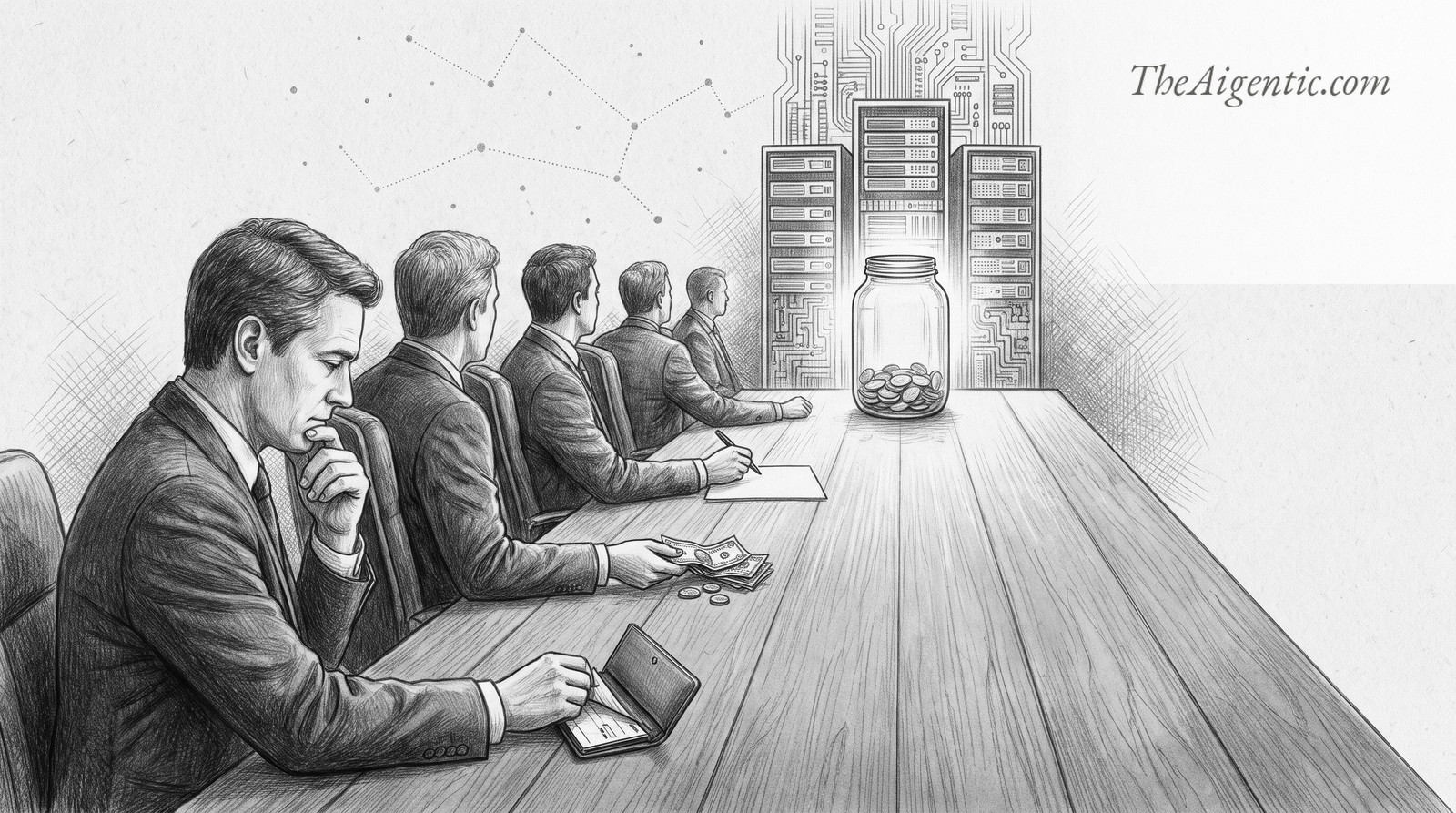
CNBC reports that OpenAI is now seeking up to $20 billion in its latest funding round, down from an earlier target of about $30 billion. The Financial Times first reported the cut and said the round values the ChatGPT maker at $1.25 trillion after the money comes in. OpenAI set a Friday deadline for investors to commit, and some trimmed their allocations as a tech selloff deepened. The round is still open, with investors from the United Arab Emirates leading alongside Coatue, and the final numbers could change. When the most famous name in AI has to scale back its ask, the whole industry notices.
Bloomberg reports that Apple reclaimed the title of the world’s most valuable company on Friday. Apple closed with a market value of $5.03 trillion after slipping 1.2%, while Nvidia fell 4.2% to $4.93 trillion. Investors rewarded the big tech company that has held back the most on AI spending, at least for a day.
The National reports that Abu Dhabi’s state energy giant ADNOC signed an agreement with OpenAI and G42 to become the first energy company to deploy OpenAI’s Frontier platform for building and managing AI agents. The system will run on OpenAI’s GPT models using inference infrastructure based in the UAE. Sam Altman, in Abu Dhabi for the ADIPEC energy conference, also signed deals with the Abu Dhabi government and the wealth fund Mubadala. The Gulf is not only funding AI, it is becoming one of its biggest customers.
Arab News reports that Saudi Aramco has closed its deal for a 49% stake in Humain, Saudi Arabia’s national AI company, with about $2.6 billion in cash contributions during 2026 plus Aramco’s own AI, computing and digital assets. The Public Investment Fund keeps the other 51%. Humain is targeting 3 gigawatts of AI data center capacity by 2030, and the world’s largest oil company now has a front-row seat.
WIRED reports that the San Francisco biotech startup Exin Therapeutics let an AI agent pick a gene therapy from 19 options, choose the brain region and coordinates, and steer a robotic needle to inject a live mouse with epilepsy. A veterinary surgeon opened the skull first, humans approved the plan, and an emergency button could cut power to the motors. Anthropic’s Claude Opus 5.5 refused to guide the needle, so the team switched to Claude Sonnet 5, which went ahead. The company says the mouse is recovering well, and it is still waiting to see whether the therapy reduces seizures.
The Next Web reports that DeepSeek has released the code for Super-Agent, an experimental coding agent that works on a GitHub repository and can listen in on a team’s chat app. When an approved person asks for help, it opens a task, works in its own session and replies with something like a pull request. DeepSeek calls it a research prototype, not an official product, and Bloomberg reported that it is aimed squarely at Anthropic’s Claude Code. The race to build agents that work like teammates now has a free entrant.
Deals Desk
The newest compute and power deals on our tracker:
Oct 29 — Nebius × AIB Data Centers: Nebius signed a 12-year lease for 50 MW of critical IT capacity at AIB’s anchor site, with delivery targeted for the fourth quarter of 2027. It is AIB’s first customer, and financial terms were not disclosed. MarketBeat
Oct 29 — OneQode × AdaniConneX: OneQode agreed to take an initial 14 MW at AdaniConneX’s Chennai campus in India for its AI cloud, with talks underway on more capacity. No dollar value was disclosed. DCD
Full tracker → theaigentic.com/deals
Friday’s movers
Biggest winners
Biggest losers
| Ticker | Name | Price | Day |
|---|---|---|---|
| INTC | Intel | 65.17 | -29.22% |
| SNDK | Sandisk | 1,126.54 | -15.30% |
| COHR | Coherent | 205.18 | -13.50% |
| ACLS | Axcelis | 97.69 | -12.79% |
| AMD | AMD | 497.52 | -12.16% |
Aigentic Exclusive
FEATURED DEEP DIVE

Was AI Behind the Binance Heist
Hackers took roughly $6.3 billion from Binance in a burst of about 20 minutes, and investigators point to North Korea as the leading suspect. AI assistance is plausible, but the public record does not show that AI enabled the breach, let alone ran it. We separate what is established from what is not, and explain what it means for anyone holding crypto.
Watch
Four picks this morning: Matt Wolfe on the week’s biggest AI stories, Cole Medin on a new Anthropic study about who is really making the decisions, the AI Daily Brief inside a ten-person company run with a fleet of agents, and Peter Yang with a Google product leader on how Gemini 4 changed her job.
Matt Wolfe — AI News: The Only 6 Stories Worth Knowing This Week
Matt Wolfe cuts a crowded week of AI news down to the six stories he thinks actually matter.
He covers OpenAI’s GPT-6.1 Terra, a faster model for computer use at a lower price, and Google’s Genie 4, which builds interactive worlds in real time. He also gets to Gemini 4 Carbon, Kimi K3.1 Pro and Anthropic’s IPO filing.
Watch this if you missed the week and want to catch up in one sitting.
Cole Medin — Anthropic’s New Study: You’re Not Controlling AI as Much as You Think You Are
Cole Medin digs into a new Anthropic study on how strongly an AI agent’s recommendations can shape the judgment of the experts using it.
He admits the research made him question one of his own habits, accepting the recommended answer during planning sessions and still feeling like he was the one steering.
Watch this if you lean on AI for decisions at work and want an honest check on who is really in charge.
The AI Daily Brief — How the Most AI Pilled Company in the World Works
Nathaniel Whittemore looks at Spawn, a ten-person team that shipped 77,000 code changes in a month with an always-on fleet of AI agents.
He breaks down the systems behind that output, explains why human taste and ambition still matter, and pulls out five practical lessons other businesses can apply.
Watch this if you want to see what a company built around agents looks like from the inside.
Peter Yang — Gemini 4 Changed How Google Builds Products
Peter Yang talks with Jaclyn Konzelmann, a product director at Google Labs, about how Gemini 4 has changed the way she does her job.
They get into how she keeps low-quality AI output out of her team’s documents and products, and how she uses AI to help raise three kids.
Watch this for a rare look at how Google’s own product leaders use the company’s newest model.