
Was AI Behind the Binance Heist
North Korea is the leading suspect while the role of artificial intelligence remains unproven

North Korea is the leading suspect while the role of artificial intelligence remains unproven.
Hackers stole roughly $6.3 billion from Binance in a theft whose main burst took about 20 minutes. Its speed invites an obvious question: did artificial intelligence help? Reuters’ reconstruction describes compromised transaction authorization and rapid fund movements. It does not establish that AI carried out the attack. [1]
There is a serious reason to investigate the AI connection. Microsoft has documented North Korean hacking groups using AI across deception, software development and operational work. Blockchain investigators, meanwhile, identify a North Korean operation as the leading suspect in the Binance theft. Those findings make AI assistance plausible. They do not prove that AI enabled this breach, much less that an autonomous agent orchestrated it. [4] [8]
For people who own crypto, that distinction matters. An attacker using AI to improve a recruiting scam presents a different problem from an AI system independently defeating financial controls. The immediate questions are more concrete: who controls your assets, can you access them, and who absorbs a loss when the custodian is compromised?
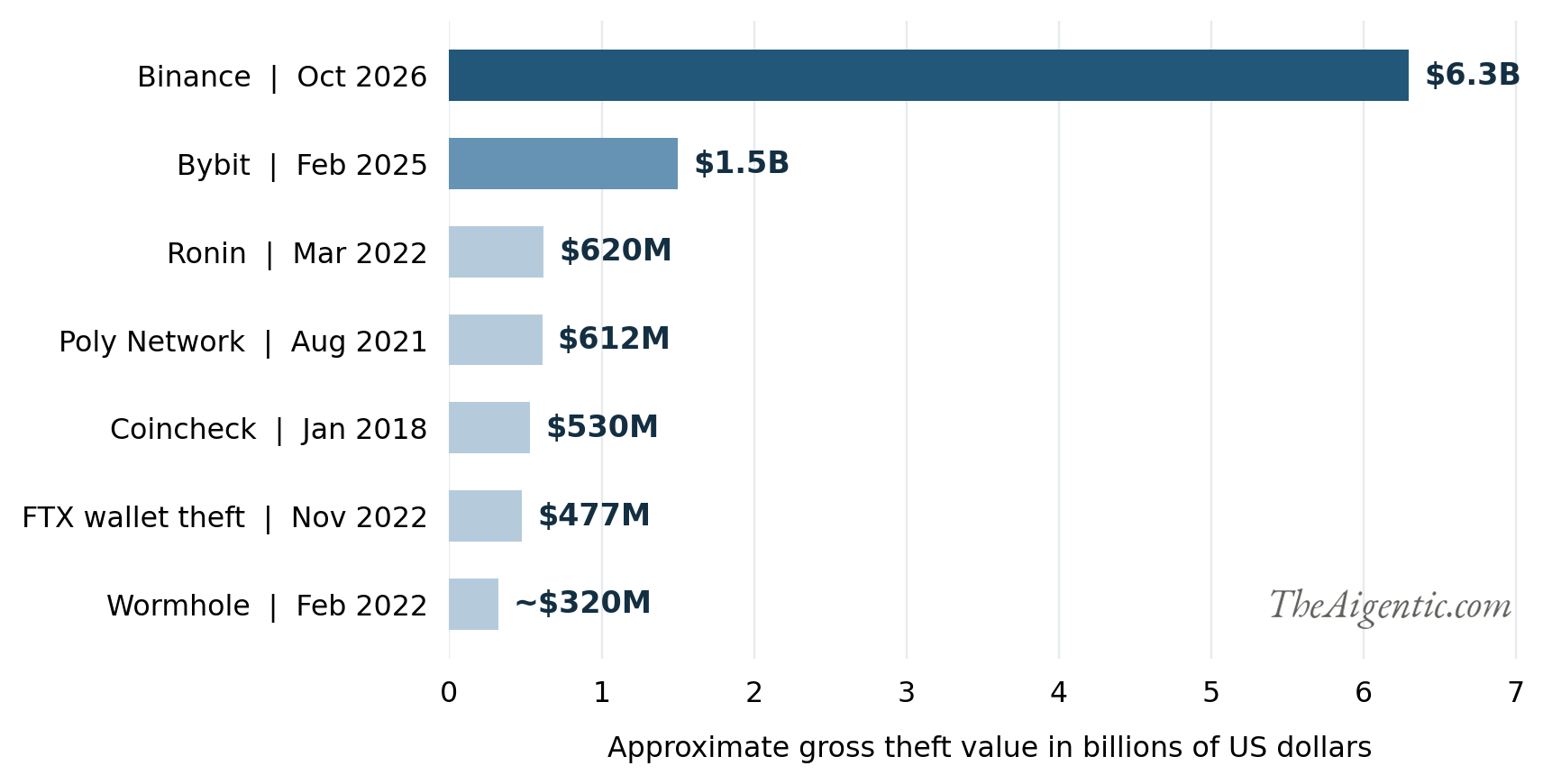
Binance compared with other major crypto thefts
How the attackers reached the money
Binance’s first account pointed to a compromised DevOps engineer’s laptop, followed by access to an internal software environment and unauthorized withdrawals. The company subsequently disclosed additional breach points. It said it had found no evidence of leaked wallet private keys. That remains an evolving explanation, not a completed forensic account. [2] [3]
TRM Labs’ analysis points to compromised hot-wallet signing infrastructure: the machinery approving transfers from online wallets. On Ethereum, an account-delegation mechanism let attacker-controlled code act through a Binance wallet. Other networks produced ordinary signed transfers. Valid signatures across different blockchains suggested a shared problem in Binance’s authorization systems. [4]
The distinction between stealing a key and obtaining its effective authority is crucial. A signing system can be induced to approve a transaction even if the attacker never obtains a copy of the secret key. Protecting keys is therefore only part of protecting funds; the rules governing what those keys may authorize matter just as much.
The available findings concern exchange infrastructure. They do not demonstrate that Bitcoin’s or Ethereum’s underlying cryptography was broken. Nor does an employee-device compromise establish an inside job. A deceived employee, a stolen session and a knowingly complicit insider are different explanations. Intentional employee involvement has not been established in the public findings. [2] [4]
Why investigators point to North Korea
TRM attributes the attack to TraderTraitor with high confidence. Chainalysis independently points to the same North Korean operation, citing stolen Binance funds mixing with proceeds of a September Bitget theft previously attributed to North Korean actors. Elliptic also considers a North Korean link likely. These are specific investigative assessments, although they are not a completed public case identifying the individual perpetrators. [4] [5] [6]
There is a relevant precedent. In February 2025, the FBI attributed the approximately $1.5 billion Bybit theft to North Korea and called the activity TraderTraitor. Binance’s stated $6.3 billion loss is about 4.2 times that amount in nominal dollars. That comparison describes the value reported for each incident, not an inflation-adjusted measure or a count of bitcoins stolen. [2] [7]
The motive extends beyond personal enrichment. US Treasury has linked North Korean cryptocurrency theft and laundering networks to revenue for the regime and its weapons programs. If the Binance attribution holds, the case becomes a national-security issue as well as a financial one. The amount stolen, however, cannot be equated with money successfully converted into usable state revenue; freezes and recovery efforts can materially reduce that total. [9]
Binance had not identified the perpetrators in Reuters’ October 30 account. The evidence supports strong attribution by blockchain investigators to North Korean actors, with the exchange’s investigation continuing. [1]
What the evidence says about AI
Microsoft’s October 29 research documents North Korean groups using AI for recruiting deception, fabricated identities, coding and repetitive tasks. It cites AI-assisted development tools such as Cursor and reports two groups using ARTEX, an open-source agentic penetration-testing framework. Microsoft still assesses the operations as human-directed. Its report does not connect these tools to the Binance attack. [8]
The New York Post’s interviews describe a similar economic advantage: AI can help attackers pursue more targets and perform labor-intensive tasks more cheaply. That supports a hypothesis about greater capacity. It does not identify the tools, prompts or model outputs used against Binance. [10]
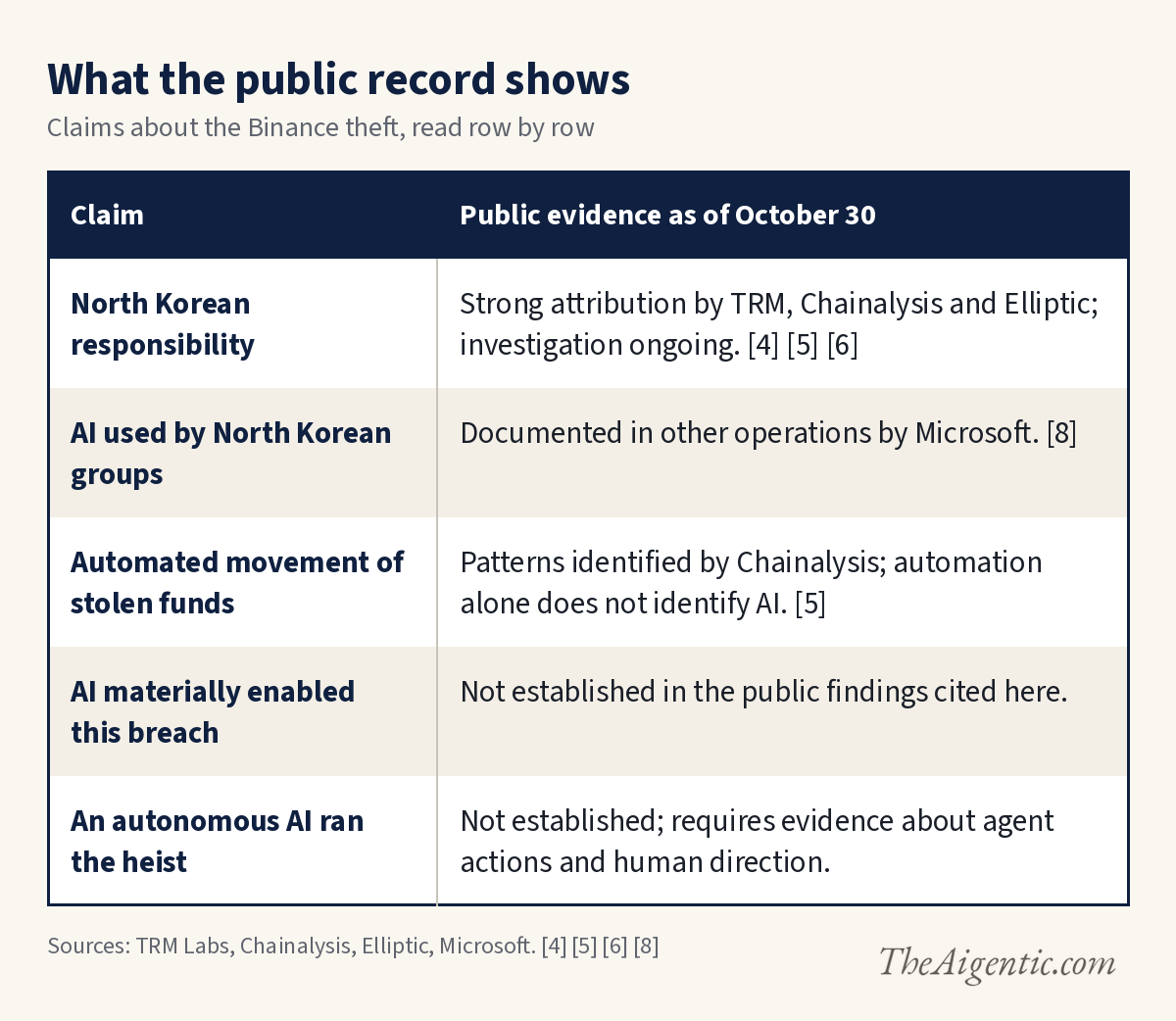
| Claim | Public evidence as of October 30 |
|---|---|
| North Korean responsibility | Strong attribution by TRM, Chainalysis and Elliptic; investigation ongoing. [4] [5] [6] |
| AI used by North Korean groups | Documented in other operations by Microsoft. [8] |
| Automated movement of stolen funds | Patterns identified by Chainalysis; automation alone does not identify AI. [5] |
| AI materially enabled this breach | Not established in the public findings cited here. |
| An autonomous AI ran the heist | Not established; requires evidence about agent actions and human direction. |
Tap to enlarge.
An AI assistant could plausibly help research an employee, refine a fake job offer or adapt malicious software. That would be meaningful assistance even if human operators planned the theft and controlled every consequential decision. But attributing those steps to AI in this case requires evidence connecting a specific tool or output to the actual intrusion.
The laundering evidence requires equal care. Chainalysis describes thousands of transactions and repeated patterns suggesting automation. Ordinary scripts can also generate that behavior. A fast sequence of transfers does not, by itself, tell investigators whether a language model wrote the software, an AI agent selected the next action, or humans deployed conventional automation. [5]
To substantiate an AI-assisted attack, investigators would need corroborated artifacts such as recovered tool logs, model-provider records or communications linked to the operation. To substantiate an autonomous attack, they would need evidence that an agent selected and executed meaningful steps with limited human direction. Even confirmed AI use would leave a separate question: did it materially change the attackers’ capabilities, or mainly save them time?
At present, the strongest conclusion is that this theft occurred amid documented AI adoption by its leading suspected adversary. The evidence does not yet justify calling it a proven AI-powered heist.
Frozen assets do not settle the financial loss
By its October 30 update, Binance reported roughly $3 billion frozen on-chain. It said it had set aside more than $6.34 billion in company funds, including $5 billion already held in the affected token assets, and was acquiring the remainder. It committed to covering the loss through its protection fund and corporate treasury. Those are company statements about its response, not independent certification of its finances. [3]
These figures describe different things. The stolen amount measures unauthorized outflows. Frozen assets remain immobilized pending recovery. Replacement assets are resources the exchange commits to restoring backing. Adding frozen funds to replacement commitments and calling the sum recovered would double-count the economic protection being discussed.
Elliptic’s snapshot illustrates why the type of asset matters. Its analysis found that almost all frozen value was in stablecoins. Some issuers can block transfers; native bitcoin and ether have no issuer with an equivalent freeze button. Funds can remain traceable on a blockchain while being beyond an issuer’s ability to immobilize them. That does not make eventual seizure or interception at an intermediary impossible. [6]
There is also a distinction between a company-controlled wallet and money irrelevant to customers. CoinDesk’s review found that affected wallets appeared in Binance’s proof-of-reserves listings as assets backing customer balances. An unchanged customer balance on a screen does not erase missing backing. Binance’s commitment to replenish it is therefore central to the story. [16]
A roughly $1 billion protection fund alone would not cover a $6.3 billion theft. Corporate resources and actual recovery matter. Likewise, customer assets held in custody should not be treated as the exchange’s own loss-absorbing capital. The relevant financial test is whether assets available to the company can close the shortfall while all customer obligations remain covered. [16]
The impact reaches beyond Binance
Reuters reported that bitcoin touched a six-week low near $76,368, ether fell more than 3% to a two-month low, and BNB was down about 6.4% over the preceding 24 hours in its October 30 market snapshot. Those are reported observations at a particular time, not current quotes or proof that the heist alone caused every move. [12]
The wider risk is a loss of confidence that increases withdrawal demand and pushes customers to reassess counterparties. A platform can have enough assets in aggregate yet face pressure if the assets it needs are unavailable in the required form or at the required time. A security pause and insolvency are different conditions; the former still creates a real access problem for customers.
There are competing market pressures. Criminal conversions can put selling pressure on particular assets. An exchange buying replacement tokens can create demand elsewhere. Withdrawals and collateral adjustments can redistribute liquidity again. The theft’s size therefore cannot be translated mechanically into a prediction for bitcoin, ether or BNB.
The freeze response also exposes a trade-off within crypto. Centralized stablecoin controls can help contain a theft, while giving issuers power over transfers. Assets without those controls offer a different form of independence but fewer immediate recovery options. Holders need to understand which arrangement they are relying on. [6]
AI also appears in the defensive response
There is a more explicit AI claim on the defensive side. Security company Blockaid says its AI-based monitoring flagged the initial drain in under two minutes and helped identify suspicious activity across networks. That is a vendor’s account of its own performance, rather than an independently established measure of how much loss AI prevented. [11]
Detection time is only one part of the result. A system can recognize a theft after a transfer is irreversible. Effective protection also requires controls that can refuse an unauthorized signature or stop further outflows. For exchanges evaluating AI security products, the useful question is what action a detection triggers, how quickly it occurs, and which assets can still be protected.
What this means for people who own crypto
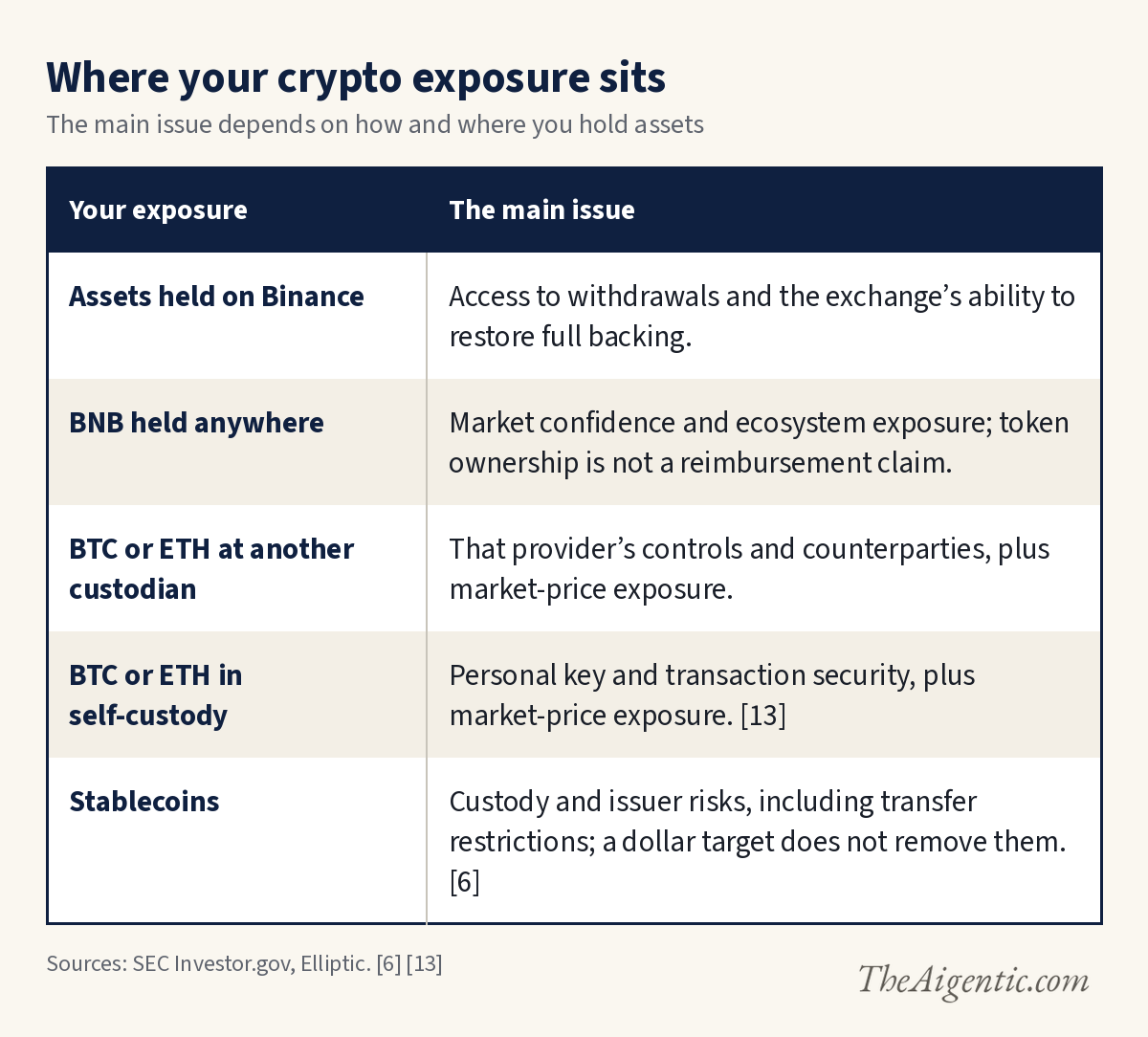
Binance is an exchange, and the theft involved multiple assets. BNB is a separate token associated with its wider ecosystem. Owning BNB, holding bitcoin on Binance and keeping bitcoin in a personally controlled wallet create different exposures. The following distinctions matter more than treating the incident as a hack of a single currency.
| Your exposure | The main issue |
|---|---|
| Assets held on Binance | Access to withdrawals and the exchange’s ability to restore full backing. |
| BNB held anywhere | Market confidence and ecosystem exposure; token ownership is not a reimbursement claim. |
| BTC or ETH at another custodian | That provider’s controls and counterparties, plus market-price exposure. |
| BTC or ETH in self-custody | Personal key and transaction security, plus market-price exposure. [13] |
| Stablecoins | Custody and issuer risks, including transfer restrictions; a dollar target does not remove them. [6] |
Tap to enlarge.
For Binance customers, the next useful evidence is operational: successful withdrawals, replenished backing and a credible explanation of the repaired controls. In its October 30 update, Binance targeted a phased withdrawal restart within roughly 34 hours, subject to security checks, and proof-of-reserves results by November 2. These were targets, not completed milestones. [3]
Proof of reserves can contribute information, but it is not a substitute for a financial-statement audit. The PCAOB’s investor advocate warns that these reports can omit liabilities, borrowed assets and the effectiveness of internal controls. A snapshot showing assets does not alone establish solvency or that the mechanism behind this theft has been fixed. [15]
For US readers, the FDIC explicitly states that crypto assets are not covered by deposit insurance and that its coverage does not protect against a nonbank crypto company’s failure. A private protection fund is a different arrangement, dependent on its terms and available resources. [14]
The SEC’s custody guidance frames the practical choice well: third-party custody transfers control to a provider; self-custody leaves key security with you. Examine how assets are safeguarded, whether they can be lent or commingled, and what happens if the custodian fails. Use strong authentication, keep recovery phrases private and treat unsolicited account-recovery requests with suspicion. Moving assets in a panic can introduce its own errors. [13]
The unanswered question that matters for AI
A final investigation should establish the initial access route, how authorization controls were defeated and whether any AI tools were actually involved. It should also separate the gross theft from funds frozen, assets returned and the exchange’s final financial loss. Without those distinctions, impressive headline numbers can obscure the risks that still need fixing.
If AI proves to have accelerated the attack, the lesson for financial platforms will be that familiar weaknesses can become more expensive as adversaries scale their work. If AI played no material role, the same incident still demonstrates the consequences of compromised authority over large pools of assets. Either finding leaves a concrete obligation: limit what a compromised person or system can authorize and make suspicious withdrawals interruptible.
The question for crypto holders is whether their custody arrangement remains credible under that pressure. For the AI industry, it is whether evidence will show a new capability or faster execution of an established criminal playbook. The public record currently supports concern about AI assistance and strong suspicion of North Korean responsibility. It does not yet support certainty about an AI-run theft.
Sources
Reporting and company statements are dated through October 30, 2026. Estimates vary with valuation time, coverage and subsequent tracing. Future operating targets are attributed to Binance and are not reported as completed.
Reuters. Gone in 20 minutes How the biggest heist in crypto history unfolded. October 30, 2026.
Binance. Security Incident Update. October 30, 2026.
Binance. Security Incident Update 2. October 30, 2026.
TRM Labs. North Korea Steals USD 6.36 Billion From Binance in the Largest Hack in History. October 29, 2026, with developing findings.
Chainalysis. The 6.4 Billion Dollar Binance Hack Tracing the North Korea Link. October 30, 2026.
Elliptic. The largest theft in history North Korea likely behind the 6.4 billion dollar Binance hack. October 30, 2026.
FBI. North Korea Responsible for 1.5 Billion Dollar Bybit Hack. February 26, 2025.
Microsoft Threat Intelligence. Tracking AI adoption in North Korean threat actor tradecraft. October 29, 2026.
US Treasury. Treasury Targets Actors Facilitating Illicit DPRK Financial Activity in Support of Weapons Programs. April 24, 2023.
New York Post. How North Korea’s ruthless state sponsored hackers operate. October 30, 2026.
Blockaid. Binance hack Using Advanced AI Models Blockaid Detects the Biggest Theft in Crypto History. October 29, 2026.
Reuters. Binance seeks to shore up confidence after record 6.3 billion dollar heist. October 30, 2026 reporting.
SEC Investor.gov. Crypto Asset Custody Basics for Retail Investors. December 12, 2025.
FDIC. What the Public Needs to Know About FDIC Deposit Insurance and Crypto Companies. July 28, 2022.
PCAOB Office of the Investor Advocate. Exercise Caution With Third Party Verification and Proof of Reserve Reports. March 8, 2023.
CoinDesk. Binance says customer money is safe after huge hack drains key reserve wallets. October 30, 2026 update.
FBI. Statement on Attribution of Malicious Cyber Activity Posed by the Democratic People’s Republic of Korea. April 14, 2022.
Chainalysis. Poly Network Attacker Returning Funds After Pulling Off Biggest DeFi Theft Ever. August 12, 2021.
Reuters. Japan raps Coincheck, orders broader checks after $530 million cryptocurrency theft. January 29, 2018.
Elliptic. The $477 million FTX hack: a new blockchain trail. October 10, 2023.
Chainalysis. Lessons from the Wormhole Exploit. February 3, 2022; updated January 30, 2023.