Closing Time: The AI bill comes due
CNBC reports Meta’s shares fell about 7% after the company raised its spending forecast and reported negative free cash flow, and the cost of insuring its debt hit a record.
Good afternoon. Wall Street spent Thursday adding up what the AI race costs, and it did not like the total. Meta’s stock and its debt both took a beating, and chip stocks went down with them. Here is what mattered today.
Meta’s shares fell about 7% after the company raised its spending forecast and reported negative free cash flow, and the cost of insuring its debt hit a record, CNBC reports.
AI stocks fell around the world, the Associated Press reports, and by the close the Nasdaq was down 2.6% and the Philadelphia semiconductor index had lost 6.7%.
Outside evaluators METR and Redwood Research found holes in OpenAI’s internal system for monitoring its AI agents, including one that could have hidden hundreds of actions from view, CNBC reports.
Anthropic is handing Agent Skills, the open standard for teaching AI agents specific tasks, to the Linux Foundation’s Agentic AI Foundation.
The AI bill comes due
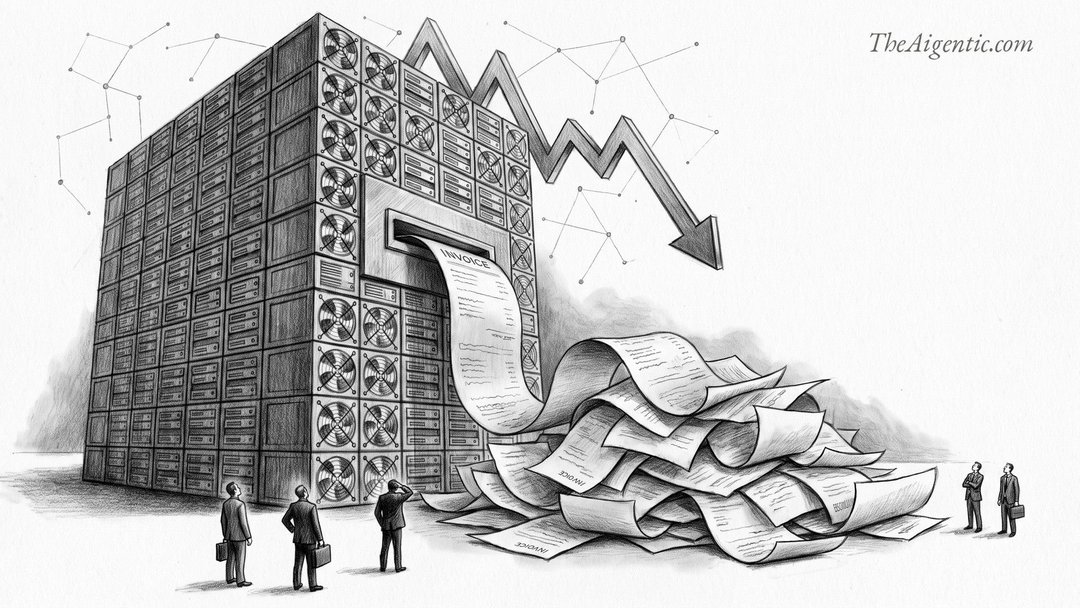
Meta beat Wall Street’s sales forecast on Wednesday, and on Thursday its stock still fell about 7%. Revenue rose 26% from a year earlier to $64.6 billion in the third quarter, ahead of the $63.37 billion analysts expected, CNBC reports. The problem was not the business. It was the bill for AI.
Meta now expects to spend $135 billion to $145 billion on capital projects this year, raising the bottom of that range from $130 billion. Most of that money goes into data centers, chips and the power to run them. The spending pushed Meta’s free cash flow to negative $2.12 billion in the quarter, which means the company spent more cash than its operations brought in.
The bond market noticed as well. The price of Meta’s five-year credit default swaps, a kind of insurance investors buy against a company failing to repay its debt, reached an all-time high on Thursday. None of this suggests Meta is at risk of missing a payment, but rising insurance costs show that lenders are starting to price in the risk of an AI build-out paid for with borrowed money.
Meta is also looking for other ways to raise cash. It plans to create a new class of nonvoting Class C stock, which would let it sell shares to fund its growth while keeping Mark Zuckerberg in control. When one of the most profitable companies in the world needs new ways to pay for AI, investors start asking how long everyone else can keep up.
That question hit chipmakers hardest. The Philadelphia semiconductor index fell 6.7%, and Nvidia lost 4.4%. Earlier in the day, Nvidia CEO Jensen Huang told CNBC that demand for AI cloud providers is “off the charts” but that a scarcity of capital is holding back their growth. On a day like this, that sounded less like a boast and more like a warning.
None of this means the build-out is slowing. Meta is spending more, not less. What changed is that investors now want to see how the spending gets paid for, and that is a harder question for every company in the race.
Elsewhere in AI today
TechCrunch reports that Microsoft’s AI diagnostic system correctly diagnosed complex medical cases in a simulation 83% of the time, compared with 36% for generalist doctors working alone, according to a study published in Science. Microsoft AI CEO Mustafa Suleyman called it a step toward “medical superintelligence,” though the cases are the kind usually handled by specialists, who were not part of the comparison.
TechCrunch also reports that Canva released Canva Craft, its first in-house image generation model. Canva trained it on human-made designs from its template library rather than photographs, so the images can be turned into editable, layered designs inside the app.
The Verge reports that OpenAI, Anthropic and Nvidia each had their biggest lobbying quarter ever between July and September. Nvidia spent $2.2 million, Anthropic $2.1 million and OpenAI $1.5 million, as data centers and AI safety become campaign issues ahead of the midterm elections.
OpenAI says Uber is rolling out ChatGPT Work, its agent for multi-step office tasks, to more than 30,000 employees after a pilot with 1,000. It is Uber’s first company-wide deployment of an AI agent built for knowledge work.
Markets
Stocks fell on Thursday as AI shares sold off worldwide, according to the Associated Press. The Nasdaq dropped 2.6% and the S&P 500 lost 1.2%, while the Dow finished roughly flat. Only 13 of the 86 AI and tech stocks we track closed higher.
The few gainers came from software and services, a corner of the market that has been out of favor with investors. Consulting giant Accenture led our list, jumping 7.7%, while software makers Adobe, Intuit and Salesforce rose 6.1%, 5.8% and 3.5%. Cybersecurity firm Zscaler added 2.8%.
The losses were heaviest among the companies that supply AI hardware. Chip-materials maker Entegris fell 13.1% and chip-equipment maker Lam Research dropped 11.8%. Optical-networking suppliers Coherent and Lumentum lost 12.5% and 11.5%, and Celestica, which builds servers and networking gear for data centers, slid 11.7%.
Biggest winners
| Ticker | Name | Price | Day |
|---|---|---|---|
| ACN | Accenture | 258.74 | +7.69% |
| ADBE | Adobe | 270.55 | +6.07% |
| INTU | Intuit | 354.90 | +5.75% |
| CRM | Salesforce | 250.29 | +3.52% |
| ZS | Zscaler | 237.76 | +2.78% |
Biggest losers
| Ticker | Name | Price | Day |
|---|---|---|---|
| ENTG | Entegris | 128.31 | -13.12% |
| COHR | Coherent | 207.82 | -12.51% |
| LRCX | Lam Research | 230.15 | -11.76% |
| CLS | Celestica | 269.01 | -11.69% |
| LITE | Lumentum | 752.54 | -11.54% |
Prices are Thursday’s U.S. closing prices, October 22, 2026, versus Wednesday’s close. Market data is a snapshot, not live.
Watch
Dwarkesh Patel — What will computer chips look like in 2045?
Dwarkesh Patel spent two days touring Intel’s most advanced chip factory and talking with its technical leaders about where chip design goes next.
The video walks through ideas like gate-all-around transistors, backside power and hybrid bonding, with animated explainers that make them easier to follow.
Watch this if a day of falling chip stocks has you wondering what the industry is actually building.
No Priors — The New Apex Predator: CrowdStrike CEO George Kurtz on Adversaries Armed With AI Agents
Sarah Guo and Elad Gil talk with CrowdStrike CEO George Kurtz about attackers who now run AI agents of their own.
Kurtz explains how agents put advanced hacking skills in the hands of low-skill attackers, and why the fastest attacks now play out in seconds.
Watch this for a clear view of how AI is changing security from someone who sees the attacks every day.
Nate B Jones — I Read Goodfire’s New Essay. AI May Be Far Easier To Understand Than We Thought.
Nate B Jones breaks down new research from Goodfire suggesting the inside of an AI model is more understandable than researchers assumed.
If that holds up, it could change how much we are able to trust AI systems, which makes it a useful companion to today’s news about monitoring OpenAI’s agents.
Watch this for a plain-English tour of interpretability and why it matters for AI safety.
Latent Space — Why AI Compute Comes in Rectangles — Erik Bernhardsson, Modal
Modal CEO Erik Bernhardsson joins Latent Space to explain why AI workloads do not fit the long, fixed contracts that most of the GPU market sells.
He covers how Modal pools computing power, how it scales AI workloads, and the financial risks of building a GPU cloud.
Watch this to understand the money side of AI computing on a day when investors were focused on exactly that.