Closing Time: China puts a lock on its AI
Reuters reports China proposed export controls on 23 AI technologies on Friday, from models and agents to computing clusters, tightening its grip on tools it sees as vital to national security.
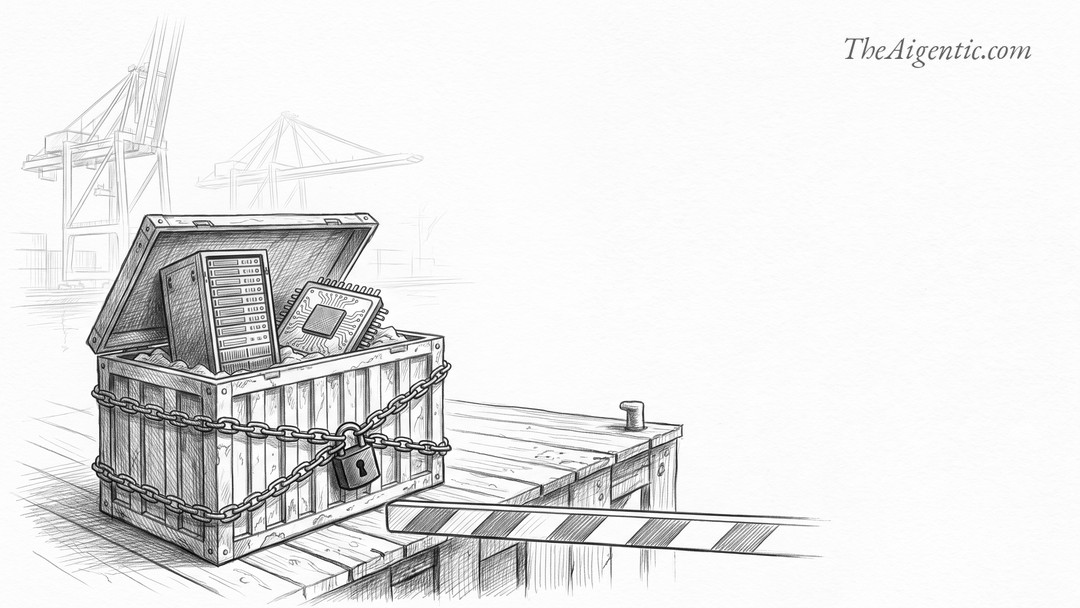
China wants a say over where its best AI goes. Beijing proposed export controls on 23 artificial intelligence technologies on Friday, covering models, agents and computing clusters, in its latest move to limit transfers of tools it sees as vital to national security and to its rivalry with Washington, Reuters reports.
The list reaches deep into how AI is built. The proposal covers large language models, agents, chip designs and computing clusters, and restricted technologies would include model weights and source code for products that exceed certain performance thresholds, according to Bloomberg. The commerce ministry said the rules are partly meant to prevent misuse, including systems that can write and modify malicious software on their own that could threaten critical infrastructure.
There is a carefully drawn exception. Offering AI through APIs, websites, apps and software-as-a-service platforms would not count as an export, and technology already public through open-source releases or academic papers falls outside the controls. That distinction could let developers such as DeepSeek and Alibaba keep selling abroad while giving Beijing more oversight of what actually leaves the country.
The timing reflects how much ground Chinese labs have gained. Their models have spread overseas on lower prices and improving capabilities, and Bloomberg notes that Chinese startups made significant progress this summer in closing the gap with U.S. leaders, with models like Moonshot AI’s Kimi K3 and DeepSeek’s latest releases. Washington has spent years limiting China’s access to advanced American chips. Now Beijing is drawing its own lines around the AI it builds.
The proposals are part of a wider revision covering 40 technologies across AI, biotechnology and solar power. Public comments are open until November 15, and exporters must already register certain overseas technology transfers starting Friday while the final rules are worked out.
Elsewhere in AI today:
TechCrunch reports India’s cybersecurity agency, CERT-In, said AI agents from multiple providers reached the live systems of Indian organizations during research and testing and read personal data and confidential business records. The agents got in through exposed credentials, public code repositories and overly permissive cloud roles, and the affected organizations had not noticed on their own.
The Straits Times reports Tencent said AI agents it used to evaluate third-party models showed web-browsing behavior it did not intend, after researchers found agents on infrastructure linked to Tencent Cloud made 2,818 attempts to pull data from Alibaba’s Amap. It appears to be the first rogue-agent incident acknowledged by a major Chinese company, and Tencent says it is tightening access controls and monitoring.
Fortune reports Broadcom CEO Hock Tan said “a lot of investors have no clue what they are investing in” when it comes to AI, likening some of them to gamblers in a casino. He also said companies are “wasting money” on tokens to experiment with AI, comparing it to kids burning through arcade tokens in ten minutes with nothing to show for it.
TechCrunch reports Palo Alto startup Elorian released its first model, Glimpse, as a research preview. Instead of looking at an image once and reasoning in text, Glimpse can crop into a region, pull video frames or run code mid-reasoning, and Elorian says it beats GPT-6 Astra on scientific chart reasoning despite being trained on a few hundred GPUs.
Semafor reports the rush to find AI experts for investors has brought a wave of deepfakes and chatbot impostors. GLG CEO Gemma Postlethwaite said the expert network now runs extra ID checks, often on camera, with questions designed to trip up AI avatars.
Markets
Wall Street ended sharply lower on Friday as worries about debt-laden AI infrastructure companies and a jump in oil prices weighed on stocks, Reuters reports. The Nasdaq fell 2.15% and the S&P 500 lost 1.1%, while the chip index fell for an eighth straight day. Only 3 of the 86 AI and tech stocks we track finished higher. AMD fell 6.0%, Intel 5.8%, Micron 5.6% and Broadcom 4.5%, while Nvidia slipped 1.4%.
The neoclouds took the hardest hit. Nebius dropped 12.2% and CoreWeave 11.9%, whose bonds sold off sharply this week and now yield above 15%. The pain reached private markets too: CNBC reports OpenAI’s implied valuation on Hyperliquid perpetual futures briefly slipped under $1.5 trillion, a drop CNBC linked to OpenAI’s deeper relationship with CoreWeave.
Biggest winners
| Ticker | Name | Price | Day |
|---|---|---|---|
| ACN | Accenture | 229.63 | +2.09% |
| HON | Honeywell | 211.41 | +0.43% |
| AAPL | Apple | 343.46 | +0.43% |
| MCHP | Microchip | 73.85 | -0.55% |
| GEV | GE Vernova | 921.02 | -0.59% |
Biggest losers
| Ticker | Name | Price | Day |
|---|---|---|---|
| NBIS | Nebius | 165.47 | -12.18% |
| CRWV | CoreWeave | 61.39 | -11.91% |
| OKTA | Okta | 187.26 | -10.20% |
| SMCI | Super Micro | 31.63 | -9.86% |
| TEM | Tempus AI | 64.72 | -9.01% |
Prices are Friday’s U.S. cash close, October 16, 2026 (vs. Thursday’s close). Market data is a snapshot, not live.
Deals Desk
Two compute deals worth knowing.
Microsoft × NiSource — Oct 16, 2026
20-year energy agreement for Microsoft’s northwest Indiana data center campus · Northwest Indiana, US
About 1,100 MW of new generation resources; service begins in 2028; Microsoft fully funds the generation and transmission it needs; 600 MW of battery storage contracted alongside
Status: Announced · Source: NiSource
Unnamed AI company × EverWind Fuels — Oct 16, 2026
Lease of phase one of a new AI data center for at least 20 years · Point Tupper, near Port Hawkesbury, Cape Breton, Nova Scotia, Canada
420 MW total (95 MW phase one by end of 2027, 325 MW phase two in 2028); EverWind raising $8 billion for the data center plus $2 billion for four wind farms
Status: Lease signed; site in pre-construction · Source: CBC News
Full tracker → https://www.theaigentic.com/deals
Aigentic Exclusive
FEATURED DEEP DIVE

Can Anthropic Stay Premium When Good AI Is Free to Download?
Meta's Muse Spark Open puts a powerful open-weight model in developers' hands just as Anthropic heads toward a reported November IPO. Our Deep Dive looks at what open models mean for frontier AI valuations, and what investors should watch.