
Three AI Assistants and One Broken Inbox
The Outlook outage reached Copilot, ChatGPT and Claude. What went wrong inside Microsoft, and how much could the assistants see when the mail came back?

November 13, 2026
At 4 p.m. Eastern on Thursday, Workhorse told investors that its 4:30 earnings call would have to wait until Monday. The electric-truck maker cited the global Microsoft outage. Two weeks earlier, it had announced a $10 million agreement to build a prototype AI data center in Union City, Indiana. [1, 2]
In Melbourne, Manny Flores told Australia’s ABC he couldn’t get into Teams for a job interview. It moved to the following week. He had been out of work for almost a year. As he put it, “getting to a final interview is huge.” [3]
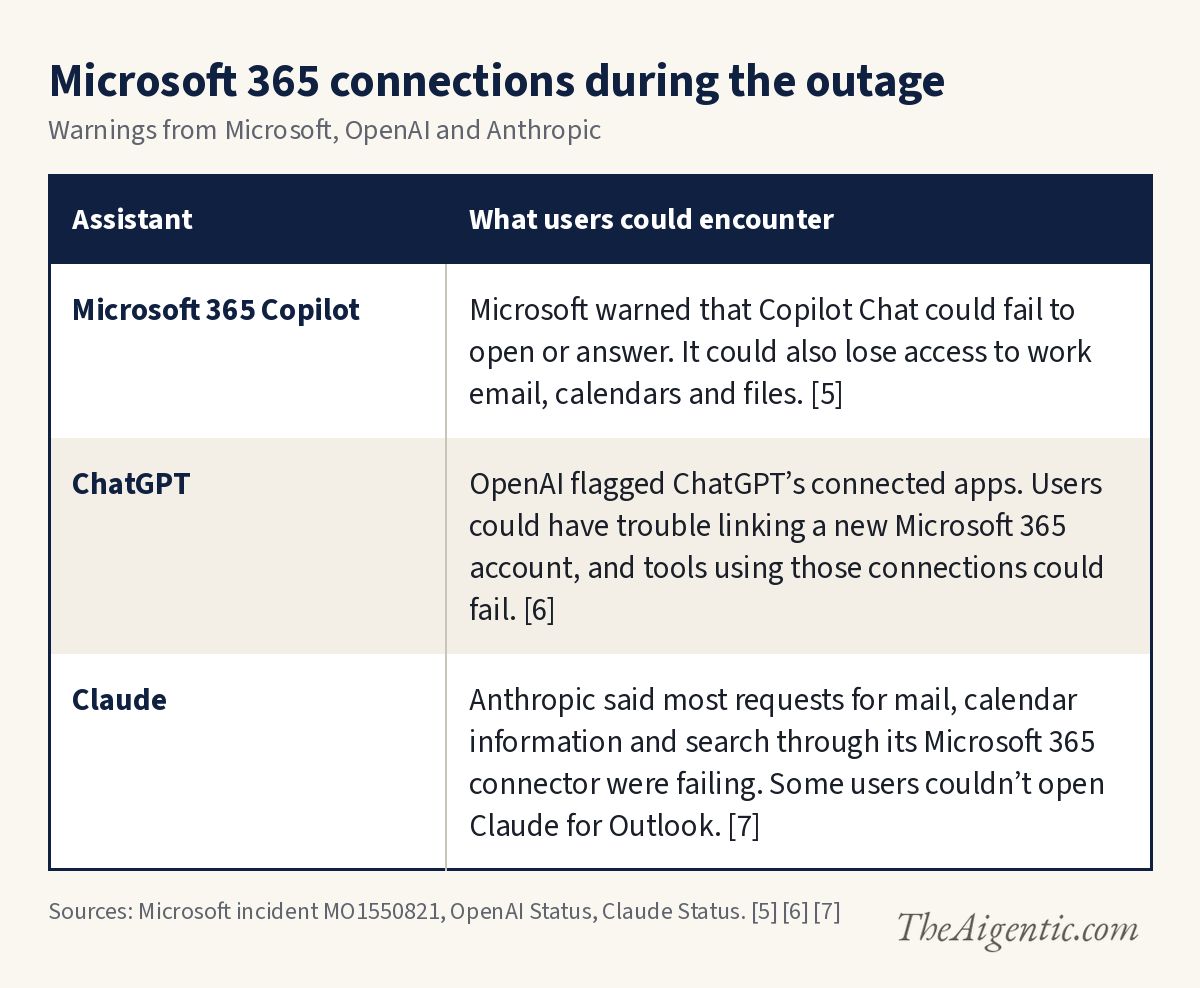
Trouble also turned up in two places a frustrated Copilot user might have gone for help. OpenAI and Anthropic both reported problems connecting to Microsoft 365. A person could switch AI companies in seconds and still be waiting for the same email. [6, 7]
When the servers stopped responding
Outlook is the app people open. Exchange Online runs many of the work and school inboxes behind it. Shortly after 1 p.m. Eastern on November 12, Downdetector recorded nearly 130,000 reports of Outlook problems. By 2:43, Microsoft had found that servers were failing automated checks and dropping out of service. The usual traffic had fewer places to go. [4, 5]
Some machines looked healthy after a restart, then stopped responding as soon as traffic returned. By 8 a.m. Eastern on Friday, November 13, Microsoft reported progress across North America, Europe and Asia Pacific, with some users still seeing delays. It had extended the time it would hold queued mail for delivery to 48 hours. Microsoft found no evidence of malicious activity. It had yet to establish the underlying cause, and its updates gave no indication that AI triggered the outage. [5]
The network change under investigation
At 8:06 p.m. Eastern on Thursday, Microsoft disclosed a telling detail. Engineers had begun reversing a recent change to the network’s settings because its timing lined up with the first failures. Tom Warren of The Verge reported that the change involved Azure’s virtual network, which governs how systems in Microsoft’s cloud communicate. Microsoft had yet to confirm that specific account. [12, 13]
Engineers could see what happened inside an affected machine. The software that establishes secure connections became overwhelmed, and the machine stopped answering requests. When servers failed their health checks and dropped out, the remaining machines inherited the work. During recovery, Microsoft also saw a surge of calls between its own services as they tried to reach servers behind them. A customer could see an overload error even though overall traffic had never spiked. [5, 12, 16]
By 3:06 a.m. Friday, machines were staying stable longer after engineers patched a component that helps verify connections and route requests. Microsoft began applying that fix more widely. What its promised post-incident report still needed to explain was why the first servers faltered and how one change, if responsible, reached so many of them. [12]
The evidence on foreign involvement
A foreign actor could target Microsoft. In 2023, a group the U.S. Cyber Safety Review Board linked to China used forged digital credentials to read Exchange Online mailboxes, including the U.S. commerce secretary’s. State Department analysts found unusual mailbox activity in their logs. Investigators could establish whose mail the intruders accessed and how they got in. [15]
This time, Microsoft said it had found no evidence of malicious activity. After speaking to Microsoft’s local leadership and Australia’s national cybersecurity coordinator, Home Affairs Minister Tony Burke said the company suspected a faulty update. A flood of incoming traffic is one way an attacker could overwhelm a service. Microsoft traced the initial strain here to lost server capacity. The public evidence favors an internal technical failure and gives no basis to attribute the outage to a foreign government. [5, 12, 14]
What three assistants could see
Ask an assistant what a client agreed to yesterday and the job sounds like reading comprehension. First it has to find the right thread. For Microsoft 365 Copilot, that can mean using Microsoft Graph, the interface that gives it access to records the person asking is allowed to see. During the outage, Microsoft said requests through Graph for mail, calendars and contacts could time out. [5, 8]
There’s a good reason to build an assistant this way. When someone leaves a research project and loses access to its shared mailbox, that restriction should follow them into their AI tools. Anthropic says its connector for work and school accounts retrieves information on demand and keeps no cache of file contents. A separate copy would have to stay current with every new message and every change in who is allowed to read it. [9]
That design gives Microsoft an unusual position in the market for workplace AI. An organization can choose a rival assistant and keep years of correspondence in Microsoft 365. Microsoft can lose the sale of the assistant and still run the service that makes the winner useful. A second subscription buys another opinion on a contract both assistants can read. If the client sends revised terms during an outage, both opinions may be about yesterday’s deal.
One Taiwanese financial firm found a workaround that morning. A source told Reuters the firm used a fax machine to confirm trades. Whatever its other limitations, a fax allowed someone at the other end to confirm the terms. Opening another chat window offered no such assurance. [11]
The morning the mail came back
At 6:23 a.m. Friday, Clark University’s IT staff in Worcester, Massachusetts, reported that campus users were still waiting for their email. Canvas and Zoom were available, so a professor could still reach a class through its course page. At 7:40, the university said the affected services appeared accessible again. New messages seemed to be getting priority while older mail worked its way through the queue. [10]
Imagine a professor at that point asking an assistant which students had emailed to request an extension. The mailbox opens. The assistant finds three students and supplies a link to each email. Every name on the list is right. A fourth student may have written the night before, and her request may still be on its way.
A citation lets the professor check the three messages the assistant found. It gives her no way to discover the fourth. Even a timestamp showing that the assistant searched at 8:01 tells her little about which messages Microsoft had delivered by then. Microsoft knew it had a backlog. How much of that information makes it into the answer a professor sees?
Give that assistant permission to send reminders and the missing email takes on a different weight. The student who asked for an extension could get a warning for missing the deadline. She has the original message in Sent Items. Her professor has a tidy answer with three citations. Each has good reason to trust what’s on the screen.
I’d like to see that scenario in a campus software demo. Leave the fourth message in the queue. Let the professor review the other three and ask whether she can send the reminders. I’d trust the assistant that gave her a reason to wait.
“I found three requests. Some mail is still delayed. I’d check again before sending those reminders.”
Sources
The outage and Microsoft’s updates
4. Outlook outage reports and Microsoft’s early findings · AP
5. Microsoft 365 incident MO1550821 updates · Microsoft, via University of Pennsylvania
11. Microsoft 365 and Outlook down for thousands of users · Reuters
12. Exchange Online incident EX1550543 updates · Microsoft, via University of Pennsylvania
13. Microsoft’s massive Outlook outage continues · The Verge
14. Microsoft outage hits Outlook email and Microsoft 365 · AP
16. Access to Outlook being restored as cyber security chief investigates · ABC News
The assistants
6. Elevated errors affecting the Microsoft 365 connector · OpenAI Status
7. Elevated errors affecting the Microsoft 365 connector · Claude Status
8. Data, privacy and security for Microsoft 365 Copilot · Microsoft Learn
9. Microsoft 365 connector security guide · Claude Help Center
Who was affected
1. Workhorse postpones its third-quarter earnings release and call · Workhorse via GlobeNewswire
2. Workhorse enters the modular AI infrastructure market · Workhorse
3. How the Outlook outage affected Australians, from schools to workplaces · ABC News
10. Microsoft outage notices for campus users · Clark University IT
Background
15. Review of the Summer 2023 Microsoft Exchange Online intrusion · Cyber Safety Review Board