
The Rise and Fall of Jensen Huang
How a bet on gaming chips gave Nvidia’s founder a voice in Washington, and how his 33 years in charge came to an end.
November 12, 2026
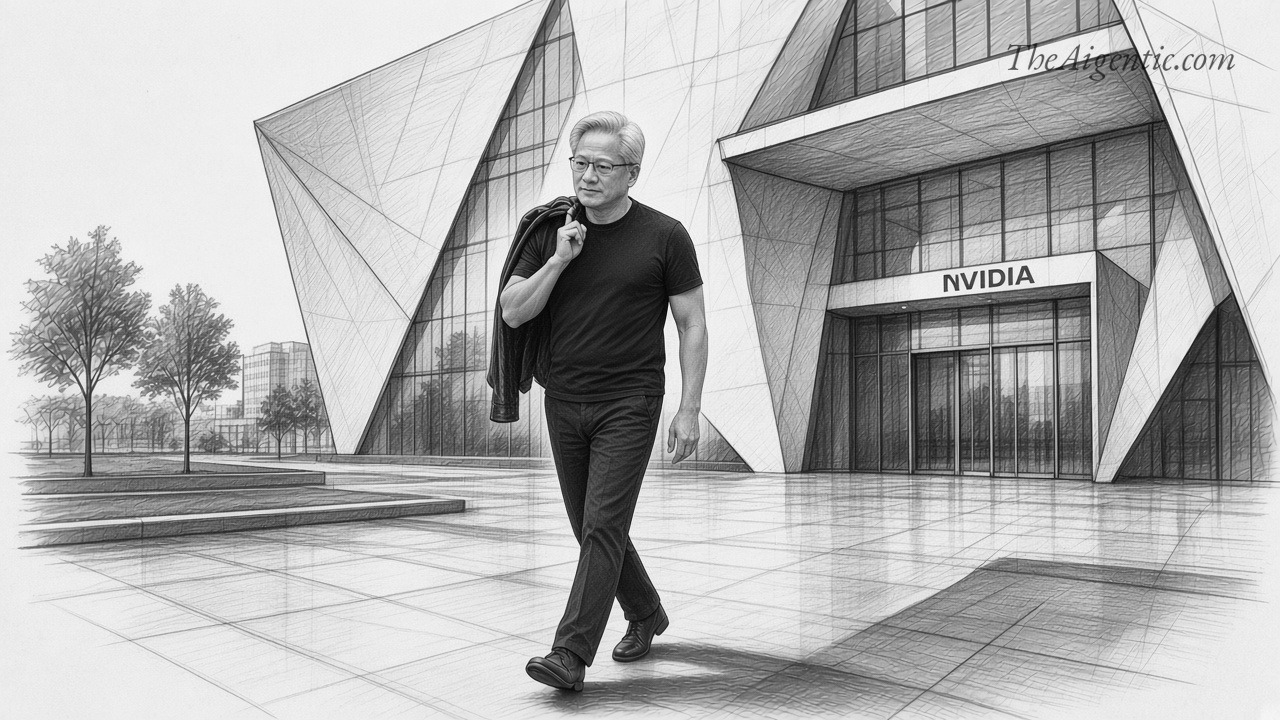
On October 8, President Donald Trump presented Jensen Huang with the National Medal of Science. The citation honored him for turning a chip designed to draw pictures into a tool for scientific discovery. Exactly five weeks later, on November 12, he resigned as Nvidia’s president, chief executive and board member.
Four days earlier, after Huang acknowledged being unfaithful, Nvidia’s directors had publicly backed him and opened an inquiry into whether a foreign intelligence service had targeted him. Then came a report of another affair, with a senior executive who answered to him. The board named finance chief Colette Kress interim CEO. For the first time since 1993, someone other than Huang runs Nvidia.
One month of payroll
Huang was born in Taiwan and got his first job at 15 at a Denny’s in Portland, Oregon. He washed dishes, cleared tables and waited on customers. Years later, with an electrical engineering degree from Oregon State and a master’s from Stanford, he chose a Denny’s in San Jose to meet fellow engineers Chris Malachowsky and Curtis Priem. The coffee was cheap, he told The New Yorker, and it was quieter than home. In 1993, the three set out to make 3D games look better on a home computer.
They nearly went broke over a question of geometry. Nvidia’s early chips used four-sided shapes to draw objects. Microsoft chose triangles for its graphics software. Sega was paying Nvidia to develop a console chip, and Huang had to tell Sega executive Shoichiro Irimajiri that Nvidia was building the wrong thing. Then he asked him for $5 million to keep the company alive. Irimajiri agreed.
By the time Nvidia’s redesigned RIVA 128 reached stores, it had about a month of payroll left. It sold a million chips in four months. In a 2023 commencement speech in Taiwan, Huang recalled the visit to Sega. “Confronting our mistake and, with humility, asking for help saved NVIDIA,” he said.
For years afterward, Huang opened staff presentations by reminding employees that Nvidia was 30 days from going out of business. In 1999, the company introduced the GeForce 256 graphics processing unit, or GPU. It could work out how objects moved through a scene and how the light hit them. Gamers wanted those effects. Huang wondered what else people might do with the arithmetic.
What two gaming cards could do
Drawing a scene in a video game means doing similar arithmetic for many pixels at once. Training a neural network also involves vast numbers of calculations that can run in parallel. In 2006 Nvidia unveiled CUDA, software that let programmers put a graphics chip to work on problems like these. A year later Huang committed to building that capability into every Nvidia GPU. It added cost to chips that people were still buying to play games. Shareholders wanted better profits, Huang later recalled. He kept funding the work.
In 2012, University of Toronto researchers Alex Krizhevsky, Ilya Sutskever and Geoffrey Hinton trained the image-recognition network known as AlexNet on two Nvidia GTX 580 gaming cards in five to six days. In the ImageNet competition, teams could offer five guesses for each picture. Toronto’s winning entry left the correct label off its list 15.3% of the time. The runner-up missed 26.2%. Any lab hoping to reproduce the work could look up the model of graphics card in the paper.
In 2016 Huang personally delivered Nvidia’s first DGX-1 supercomputer to OpenAI, then a research nonprofit. In 2020 Nvidia paid $7 billion for Mellanox, whose networks let processors in different machines exchange data at high speed. By the time OpenAI released ChatGPT in November 2022, a cloud provider could buy the chips, the networking and the software to run a large AI model from a single supplier. In October 2025, Nvidia became the first public company worth $5 trillion.
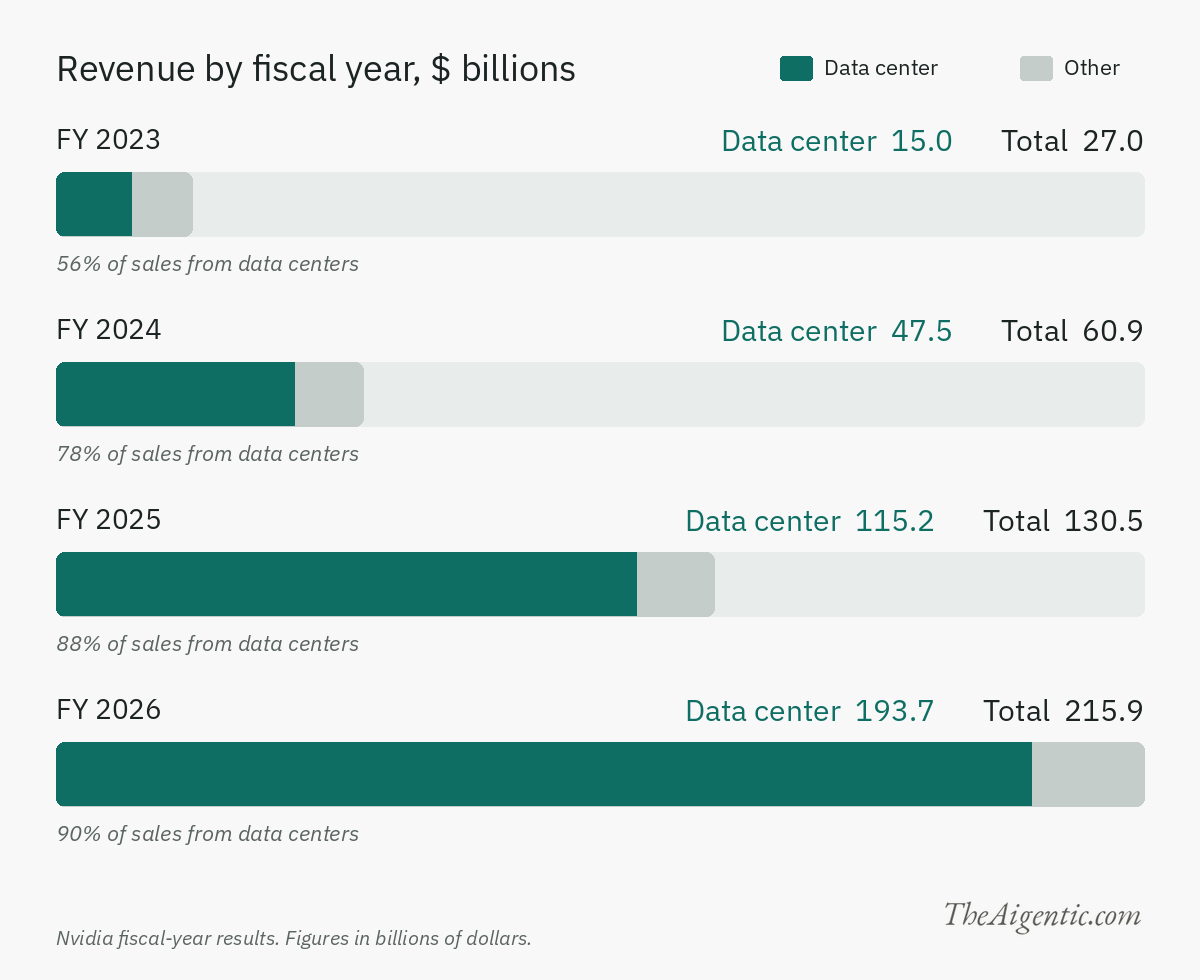
Data centers drove an eightfold rise in Nvidia’s annual sales
The case Huang made to Washington
In a September 2025 interview with the BBC’s Faisal Islam, Huang argued that selling chips to China served American interests. Chinese researchers who built on American hardware and software would help make it the global standard. U.S. lawmakers worried those same chips could strengthen China’s military. In January 2026 the Commerce Department began reviewing licenses for exports of Nvidia’s H200 to China case by case, subject to security requirements.
On October 29, The New York Times reported that U.S. intelligence officials suspected Alice Huang, a former executive at Singapore-based Nvidia customer Megaspeed, of working for Chinese intelligence. The paper described a close relationship between the two executives. Jensen Huang subsequently told Bloomberg that his dealings with her had been routine and that Nvidia’s own checks had found no illegal shipments through Megaspeed.
Four days in November
On November 8, Jensen Huang wrote to employees, “I was unfaithful to my wife.” He did not identify his partner in the message and pledged to cooperate with the board. That day the directors said they had no reason to believe U.S. national security or company secrets had been compromised. Two days later, the independent directors hired former federal prosecutor Joon H. Kim and his firm to investigate.
Also on November 10, The Information reported that Alice Huang had used her ties to Nvidia to help Chinese companies obtain at least $7.5 billion in chips. Reuters said it could not independently verify the report. Beijing denied the espionage allegation, and Megaspeed said it had cooperated with U.S. export-control inspections. What Jensen Huang knew about any such shipments, and whether confidential information changed hands, remain open questions.
On November 11, the Times, citing five people who had worked at Nvidia, reported that Huang had also had an affair with Kimberly Powell, its vice president of healthcare, who reported to him. Nvidia declined to comment to the paper, and Powell did not immediately respond. That account raised a workplace question the board could examine on its own. Where could an employee take a concern about favoritism if the reporting chain led back to the chief executive?
That evening, The Wall Street Journal reported that directors were preparing to oust Huang. His resignation took effect the next morning. In Washington, Senators Elizabeth Warren and Chris Coons asked the administration to preserve records of its dealings with Nvidia over China. The paper trail they sought could help establish what officials knew when they made export decisions.
Who makes the next bet?
Kress, Nvidia’s finance chief since 2013, will keep that job while directors consider internal and external candidates for CEO. Harvey Jones, the former head of Synopsys, became Nvidia’s first board chair. Shares fell more than 10% in premarket trading on November 12, Reuters reported. In the quarter ended July 26, Nvidia generated $89 billion in data-center revenue. Some of its customers are building alternatives. In October, Amazon said a new tool would let developers move their PyTorch programs to its own chips with a single configuration change.
At a 2024 event, Huang described gathering about 60 direct reports in one room so everyone could hear a decision argued out. Kress faces investors on November 17, when Nvidia reports earnings. They can ask her about orders and deliveries that day. A harder question will take longer to answer. If an engineer walks in with an idea as expensive and commercially uncertain as CUDA once was, who at Nvidia can give it six years to work?
Sources
Medal, resignation and succession
1. White House — President Trump presents National Medals of Science and of Technology and Innovation
2. Nvidia — CEO transition announcement
3. Nvidia — Statement from the board of directors
4. The Wall Street Journal — Nvidia prepares to oust CEO Jensen Huang
26. Nvidia — Huang’s message to the company
27. Nvidia — Statement from the independent members of the board
32. Reuters — The board prepares to oust Huang
33. The Wall Street Journal — Senators ask the administration to preserve Nvidia-China records
34. Reuters — Huang steps down
35. Nvidia — Second-quarter fiscal 2027 results
Early years
5. Nvidia blog — Huang at Denny’s
6. Stanford Engineering — Jensen Huang, 2018 Heroes
7. The New Yorker — How Jensen Huang’s Nvidia is powering the AI revolution
8. The Wall Street Journal — The Sega loan that kept Nvidia alive
9. Nvidia blog — Huang’s National Taiwan University commencement address
10. Nvidia — GeForce 256 transform and lighting technical brief
CUDA and the AI business
11. Nvidia — Corporate timeline
12. Krizhevsky, Sutskever and Hinton — ImageNet classification with deep convolutional neural networks
13. Fortune — Huang delivers the DGX-1 to OpenAI
14. Nvidia — Completes acquisition of Mellanox
16. Reuters — Nvidia poised for a $5 trillion market valuation
37. Stripe Sessions — A conversation with Nvidia’s Jensen Huang, 2024
Financial results
17. SEC — Nvidia Form 10-K, fiscal 2023
18. Nvidia — Fiscal 2024 fourth-quarter and full-year results
19. Nvidia — Fiscal 2025 fourth-quarter and full-year results
20. Nvidia — Fiscal 2026 fourth-quarter and full-year results
Washington and China
21. BBC — Faisal Islam interview with Jensen Huang
22. Sens. Banks and Warren — Statement on national security concerns surrounding Nvidia
23. Commerce Department — License review policy for semiconductor exports
24. The New York Times — Reporting on Alice Huang and Chinese intelligence, October 29, 2026
25. Business Insider — Huang’s initial response
28. The Information — Yearslong ties to Alice Huang and chip sales to China
29. Reuters — Report that the affair aided $7.5 billion in China chip shipments
30. Reuters — Megaspeed says it cooperated with U.S. inspections
The final days and aftermath
31. The New York Times — Reporting on an affair with Kimberly Powell, November 11, 2026
36. Reuters — Amazon tool to move PyTorch programs onto its own chips