
The Crypto Miners Behind the CoreWeave Rally
Three energy traders found a new market for unwanted graphics chips. Now their AI customers are helping pay for the next generation of machines.
November 11, 2026
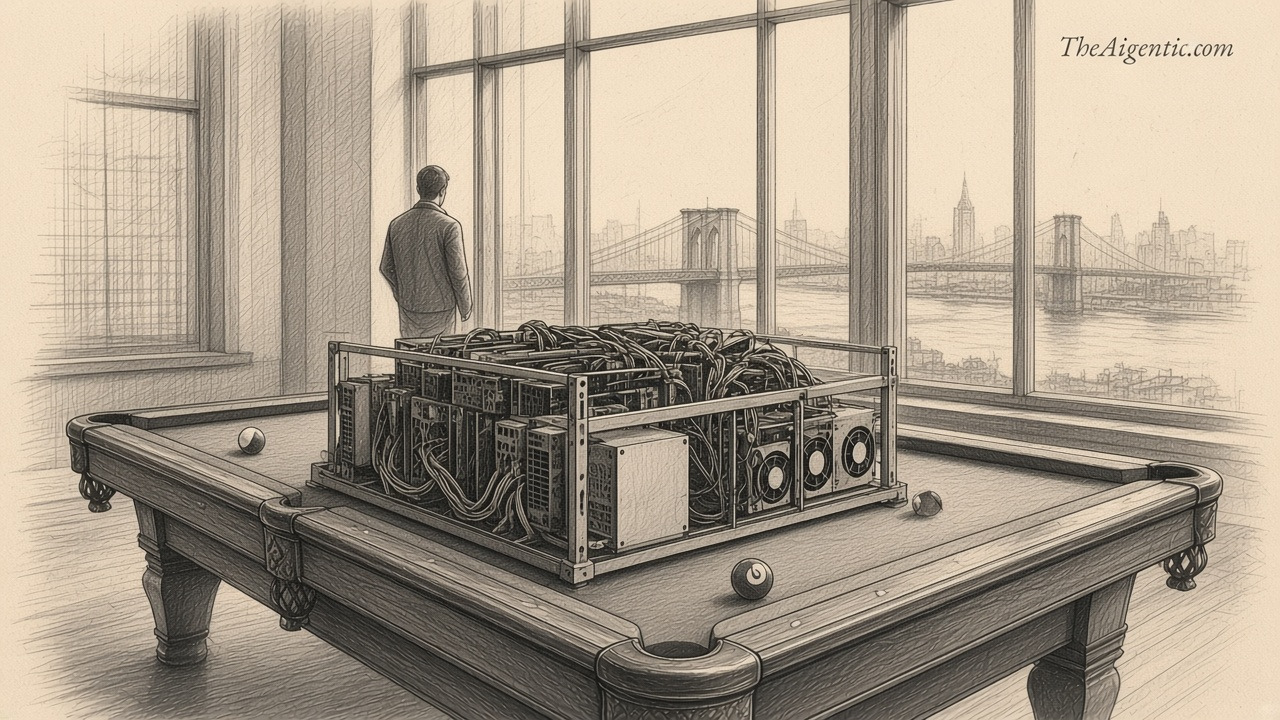
Brian Venturo and his friends used to play pool for half a bitcoin a game. They paid out their fantasy football league in bitcoin, too. By late 2016, the price had risen enough to make the energy traders curious about how cryptocurrency was made. They ordered graphics chips for delivery to their Lower Manhattan office. On a pool table overlooking the East River, they set a machine to work mining ether. [1, 2]
Those traders built CoreWeave, which rents clusters of Nvidia chips to AI developers. At 8:55 a.m. Eastern on November 11, 2026, its shares traded at $55.93, up 14.8% from the previous close. The night before, CoreWeave had reported $3.66 billion in third-quarter revenue, up 168% from a year earlier and ahead of Wall Street expectations. It now expects $13 billion to $13.3 billion in sales for 2026. [15, 17, 18]
CoreWeave also said it expected about $9 billion in customer prepayments and deposits over the next three months. For a company carrying $46.9 billion of debt at the end of September, getting paid up front would ease the need to borrow for its next data centers. The shares had fallen 41% between the October 9 and November 10 closes amid investor doubts about how CoreWeave would fund its expansion. [15, 17, 18]
CoreWeave share price · Nasdaq CRWV
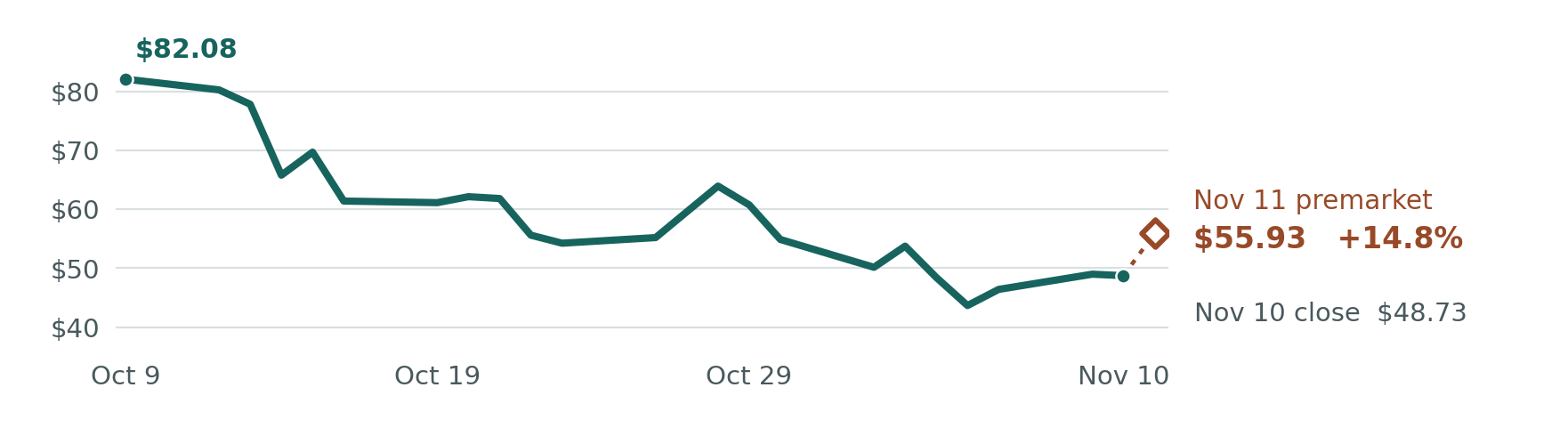
Even after the rebound, CoreWeave was changing hands for less than a third of its $183.58 closing price on June 20, 2025. That first run had taken the shares to more than four times their $40 IPO price in under three months. [15, 16, 19]
What the traders saw in used graphics chips
Michael Intrator, now CoreWeave’s chairman and CEO, co-founded Hudson Ridge Asset Management, a natural gas hedge fund. Venturo managed a portfolio there. Brannin McBee ran a firm that supplied the fund with data. The fund had used machine learning to help pick investments. The three men formed Atlantic Crypto in September 2017, and their mining rigs eventually outgrew the office and moved into Venturo’s grandfather’s garage in New Jersey. [3, 4, 19]
When crypto prices collapsed in 2018 and 2019, the partners raised money to buy equipment from struggling miners. A graphics processing unit, or GPU, can perform many similar calculations at once. They believed someone outside crypto would pay for that ability. Venturo recalled their thinking on the On the Brink podcast. “We think this compute has value, but we have no idea what the heck we’re going to use it for yet.” [1, 5]
Film studios offered one answer. A visual-effects team on deadline could spread the frames of a shot across dozens of chips, then release the machines when the work was done. In 2019 the partners bought a rendering platform called Leonardo Render and launched Concierge Render. Between customer jobs, they could put the GPUs back to work mining. Ether helped pay the bills while they found a market for the cloud service. That December, Atlantic Crypto changed its name to CoreWeave. [1, 2, 19]
A trade with the researchers
Training a language model demanded something different from rendering a movie. A studio can work on separate frames at the same time. Chips training a single model have to exchange updates, and one slow machine can leave hundreds waiting. By December 2020, researchers at EleutherAI were close to giving up on training a model the size of GPT-3 for lack of computing power. CoreWeave offered a trade. The researchers would test its hardware and work out how to train on it. In return, they could use the machines to build and release their model. [10, 11]
In February 2022, EleutherAI unveiled GPT-NeoX-20B, a 20-billion-parameter language model trained on CoreWeave’s Nvidia A100 chips. Ethereum would retire mining that September. By then, the former miner could point prospective customers to a working language model. Stability AI, the image-generation startup, heard about CoreWeave through the researchers and became a paying customer. [4, 5, 12, 14]
The researchers’ paper thanks McBee and Venturo alongside Peter Salanki, who had joined CoreWeave as engineering director in 2019. The company also names him as a co-founder. In 2024, Salanki succeeded Venturo as chief technology officer. Venturo took over strategy, and McBee became chief development officer, overseeing financing and partnerships. [6, 7, 8, 13]
How the chips became collateral
In August 2023, Magnetar and Blackstone led a $2.3 billion credit facility secured by Nvidia chips. CoreWeave could also borrow against multiyear customer contracts. Under a typical committed contract, the customer owes a minimum payment even if it uses fewer computing hours than it reserved. As Intrator put it after the latest results, “Customer contracts come first, and investment follows.” [18, 19, 20]
By September 2025, OpenAI had signed deals with it worth up to $22.4 billion in all. Microsoft, which operates its own Azure cloud, accounted for about 67% of CoreWeave’s 2025 revenue. Nvidia plays several roles. It supplies the chips, owns shares and agreed to buy certain unsold capacity through April 2032, provided CoreWeave makes it available. That gives CoreWeave a fallback buyer and ties it even more closely to its main supplier. [21, 22]
The interest bill arrives first
CoreWeave ended September with a $132.5 billion backlog. Earning that revenue over the life of the contracts requires it to deliver the computing capacity and keep it available. The company expects to spend $37 billion to $39 billion on equipment and facilities in 2026 alone. [17]
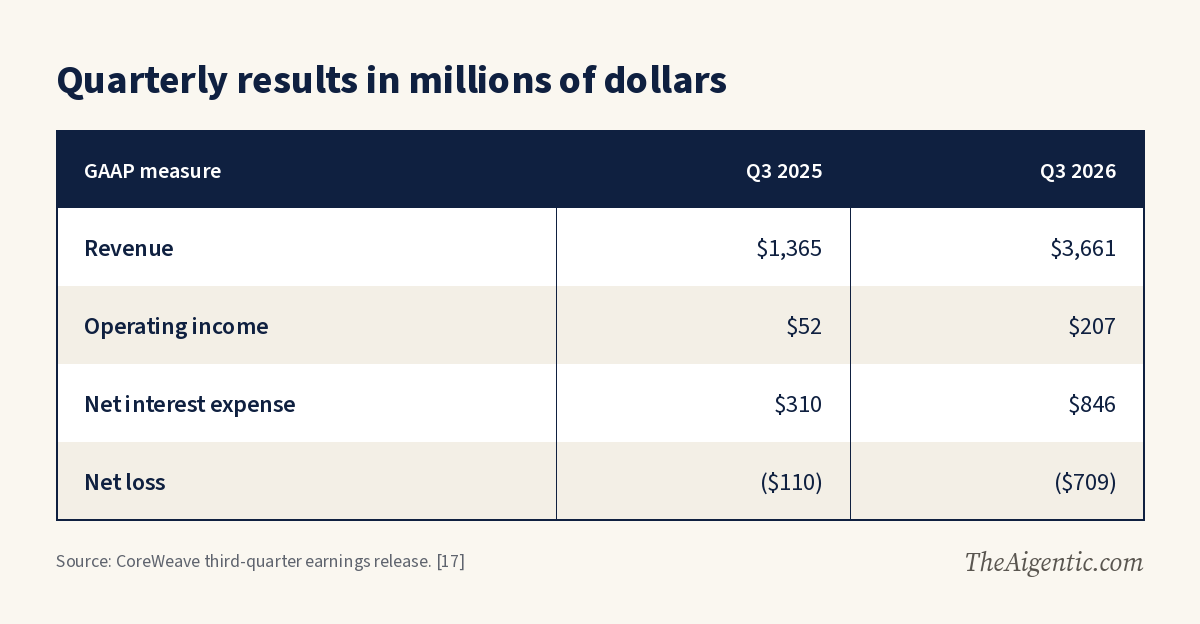
Net interest expense was more than four times operating income, and CoreWeave finished the quarter with a $709 million net loss. Nitin Agrawal, a former Google Cloud finance vice president and now CoreWeave’s CFO, told investors he expects positive adjusted net income in the first half of 2028. [9, 17, 23]
Intrator offered an earlier test on the earnings call. Customers were renewing contracts on CoreWeave’s original fleet at higher prices, he said. If those rates hold as newer chips arrive, CoreWeave can collect a second round of rent on machines the first customer has already helped pay for. The founders made their name figuring out what used chips were worth to the next customer. Their shareholders need them to be right about that price again. [23]
Reporting and sources
The founders and leadership
1. Brian Venturo on mining, rendering and the early cloud · On the Brink, episode 163
2. Michael Intrator on CoreWeave’s early years · CoreWeave
3. Michael Intrator’s executive biography · CoreWeave
4. Brian Venturo on the path from mining to the IPO · TechCrunch
5. How CoreWeave became a cloud provider · WIRED
6. Peter Salanki’s executive biography · CoreWeave
7. Brannin McBee’s executive biography · CoreWeave
8. Announcement of the 2024 leadership changes · CoreWeave
9. Nitin Agrawal’s executive biography · CoreWeave
Researchers and technology
10. Why distributed training fails at scale · CoreWeave
11. Connor Leahy on the EleutherAI hardware agreement · Toby Shevlane, Oxford DPhil
12. The February 2022 announcement of GPT-NeoX-20B · CoreWeave and EleutherAI
13. GPT-NeoX-20B research paper and acknowledgments · Black et al.
14. The September 2022 transition to proof of stake · Ethereum.org
Market data and financial reporting
15. CRWV closes and the November 11 premarket quote · Stock Analysis
16. CoreWeave closing prices in June 2025 · StatMuse Money
17. Third-quarter 2026 results and guidance · CoreWeave, SEC filing
18. Earnings, debt and the response to financing concerns · Reuters
19. IPO price, company history and customer contract terms · SEC prospectus
20. The 2023 loan secured by Nvidia chips · Reuters
21. CoreWeave’s AI customers and their contracts · Reuters
22. Agreement covering residual unsold capacity · SEC filing
23. Third-quarter earnings call with Intrator and Agrawal · November 10, 2026