How AI Could Influence the Outcome of the 2026 Midterm Elections
AI can change what voters believe, whether they cast a ballot, and how they interpret the results. Proving that it changed who won will be considerably harder.
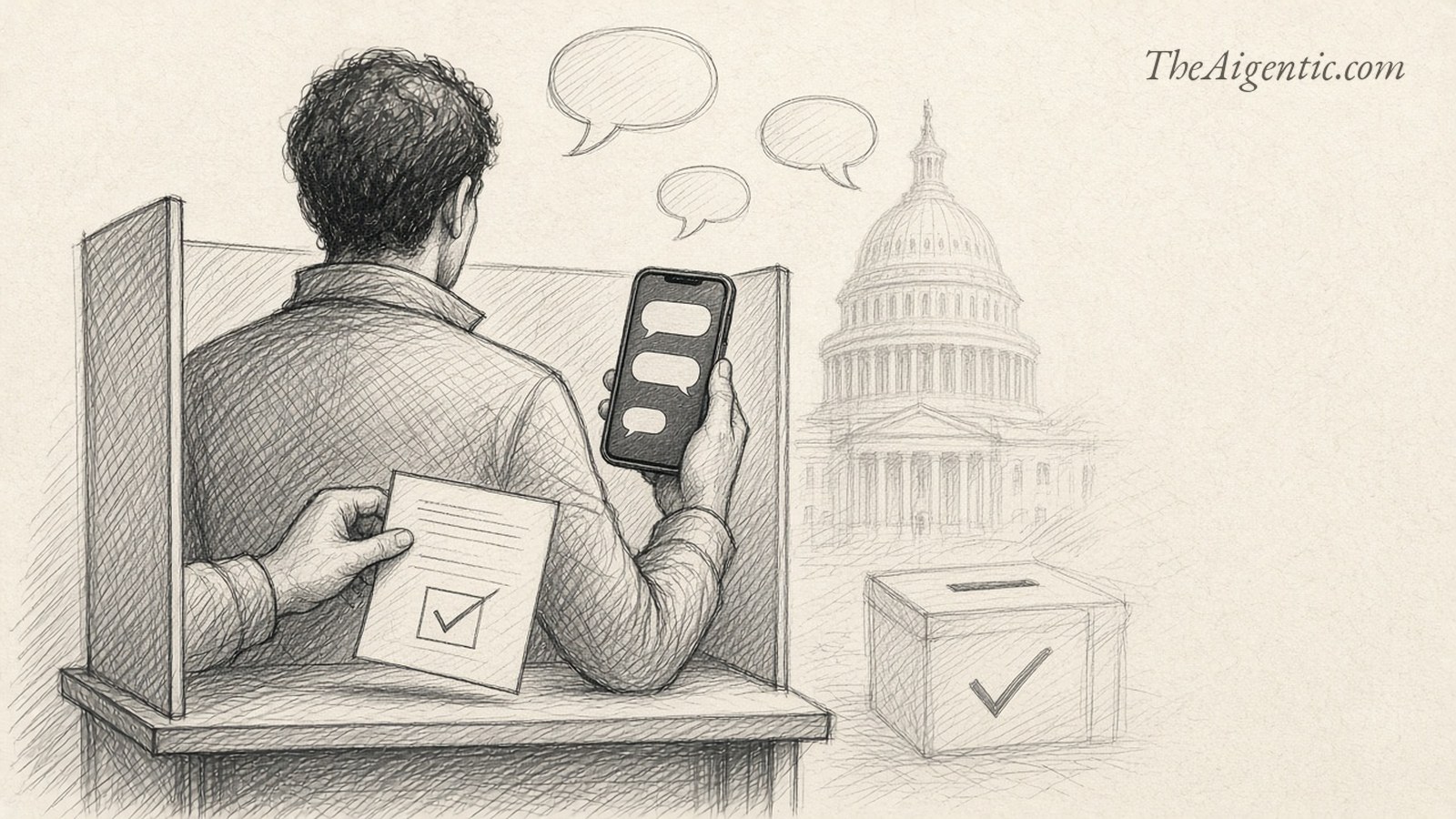
A voter does not need to believe a fabricated video for artificial intelligence to influence an election. They might simply ask a chatbot when registration closes, which candidate supports a particular policy, or whether a race has already been decided.
Each answer can shape a decision. An accurate explanation can make participation easier. A confident mistake can send someone away with the wrong understanding, or the wrong deadline.
As Americans vote in the 2026 midterms, that quieter influence deserves as much scrutiny as the spectacular deepfake. The evidence supports a serious possibility that AI could affect individual contests. It does not yet establish how many votes it will move, which party will benefit overall, or whether it will determine control of Congress.
AI has become an election information source
Two October surveys commissioned by the National Conference on Citizenship, in collaboration with researchers at The Carter Center, show how quickly this information channel is expanding. [1]
The share of U.S. adults reporting that they had used AI chat programs to learn about Senate, House or gubernatorial candidates rose from 14% in early October to 25% in mid-October. Across four election tasks, including voting logistics and checking election stories, reported use rose from 28% to 40%. [1]
These were independent national samples, rather than a panel following the same people. They measure reported use, not how often people accepted an answer or acted on it. Still, the findings suggest AI has become a meaningful part of the election information environment. Republicans and Democrats reported similar usage rates. [1]
The change has an important consequence: voters can now encounter an interpretation of the election without seeing the competing sources behind it. A chatbot chooses what to summarize, what to omit and how much certainty to express. Those choices can influence a user even when every sentence sounds neutral.
A wrong deadline can matter as much as a misleading argument
Research commissioned by Innovating for the Public Good and conducted by Dewey Digital examined more than 151,000 answers across seven AI products and 63 competitive races. [2]
In an October sample, 13.9% of answers to voting-logistics questions contained outdated or inaccurate information. A subset, 5.9% of answers, could mislead someone into missing a deadline, voting on the wrong day or skipping a required step. [2]
Those are answer-level error rates in the researchers’ tests. They are not estimates of the percentage of voters misled, and they cannot be converted into lost votes. But they identify a direct pathway from an AI mistake to a failure to participate.
The distinction matters. Changing a committed voter’s ideology may be difficult. Creating confusion about a deadline requires no ideological conversion at all.
The testing also warrants care. Anthropic told NPR that API-based research might not activate all of Claude’s safeguards; IFPG said a separate comparison found comparable results through the web interface. Model updates and testing conditions can affect performance, making a snapshot an imperfect guide to every user’s experience. [3]
Conversation gives AI a different kind of persuasive power
Political advertising asks voters to absorb a message. A chatbot can respond to their objections.
A study published in Nature tested AI conversations advocating for candidates in U.S., Canadian and Polish elections. Researchers found significant changes in candidate preferences, with effects larger than those typically observed for traditional video advertising. Their analysis suggested relevant facts and evidence were central to persuasion, although some claims were inaccurate. [4]
That is evidence of persuasive capacity under experimental conditions. It does not tell us how many people will seek out partisan AI conversations, how long an attitude change will last, or whether it will survive competing messages and translate into a ballot.
Even so, the mechanism is consequential. A conversational system can make a political case feel responsive and personal. The same qualities that make AI useful for explaining a confusing issue can make its conclusions unusually easy to accept.
NPR found another concern: in its tests, several leading chatbots initially declined to recommend candidates but supplied candidate lists after follow-up prompts. OpenAI said those deliberately elicited responses were not representative of typical voter use; Anthropic said it had updated instructions governing voting advice. These tests reveal possible failures, rather than their prevalence across ordinary conversations. [3]
AI advertising is already substantial
The Wesleyan Media Project’s October 29 update identified 289 political ads generated or enhanced with AI, associated with more than $187 million in advertising spending. Just over 90% of that spending came from Republican candidates, a Republican party committee or Republican-leaning groups. [5]
That updates the smaller figures discussed in an October 26 UC Berkeley article. It is also essential to interpret the number correctly: $187 million represents spending on identified advertisements containing AI, rather than money spent purchasing AI tools. Nor does every AI-enhanced advertisement contain deception. [7]
Wesleyan describes its tracking as an undercount because some AI use is difficult to identify. [5]
The partisan imbalance establishes who has spent more on these identified ads. It does not establish who gained more votes from them.
The broader economic implication is that AI could make political content cheaper and faster to produce. More output, however, does not guarantee more persuasion. Audiences may ignore it, distrust it or react against the sponsor. Measuring effectiveness requires more than counting advertisements.
AI could help people make better choices
There is a credible positive case.
Researchers developed an AI voter guide grounded in Ballotpedia and tested it with 2,474 eligible voters in California and Texas before the 2024 election. Participants assigned to the chatbot reported higher intentions to vote and rated its information as trustworthy, accurate and unbiased. Researchers also observed modest changes in candidate preferences, including increased intentions to vote for Democrats and, in some races, candidates whose positions aligned with participants’ own. [6]
These were reported intentions, rather than verified turnout or ballots. The directional shifts also show why a tool designed to be nonpartisan still requires evaluation of its effects.
For someone facing a long ballot, a well-designed guide could reduce the effort needed to understand unfamiliar offices and proposals. That potential may be especially valuable where accessible coverage is limited.
Berkeley political scientist Gabriel Lenz offers a useful comparison: AI should be judged against the information people would otherwise use. He also cautions that economic conditions and other substantive concerns remain powerful drivers of election outcomes. [7]
Election safeguards now extend to the answer itself
NBC’s election-war-room segment reflects the pressure on AI companies to respond as events unfold. Separate reporting describes election monitoring operations at OpenAI and Anthropic; our Wire has the latest on the companies’ election “war rooms”. [8] [9] [12]
NBC News: Inside OpenAI’s “election war room” and AI’s impact on the midterms.
OpenAI says its Democracy Works integration supplies voting information compiled with state and local officials, and its Associated Press integration supplies live vote counts after polls close. It also describes restrictions intended to reduce realistic synthetic depictions of election interference. These are company-reported safeguards, rather than independent proof that every response will be accurate. [10]
AP independently confirms its agreement to provide election results data to OpenAI through the 2028 general election. [11]
After voting ends, a chatbot must distinguish partial counts, projected winners and certified results. Conflating them could create false expectations about an unfinished race. Accurate sourcing and clear timestamps become especially important when users ask the same question at different stages of the count.
What would show that AI changed an outcome
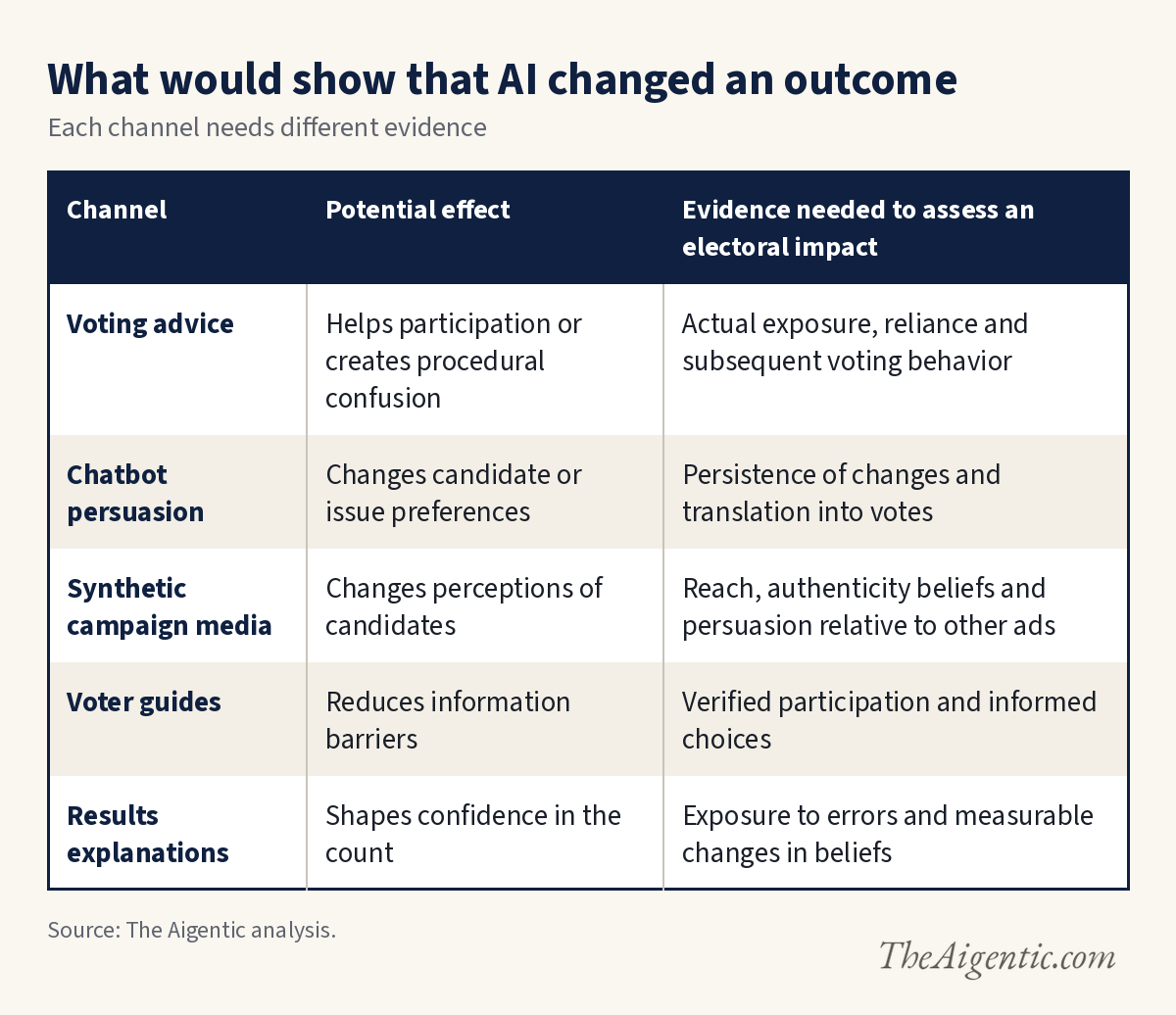
The plausible effects operate through different channels, which require different evidence.
| Channel | Potential effect | Evidence needed to assess an electoral impact |
|---|---|---|
| Voting advice | Helps participation or creates procedural confusion | Actual exposure, reliance and subsequent voting behavior |
| Chatbot persuasion | Changes candidate or issue preferences | Persistence of changes and translation into votes |
| Synthetic campaign media | Changes perceptions of candidates | Reach, authenticity beliefs and persuasion relative to other ads |
| Voter guides | Reduces information barriers | Verified participation and informed choices |
| Results explanations | Shapes confidence in the count | Exposure to errors and measurable changes in beliefs |
Tap to enlarge.
A hypothetical illustrates the stakes without pretending to forecast them. In a race with 200,000 votes, a margin of 1,000 is just 0.5% of the total. An information effect concentrated among a small number of voters could therefore matter. Whether AI reaches those voters, changes their behavior and produces a net advantage for either side remains an empirical question.
A close result alone will not answer it. Neither will a viral fake, an ad-spending total or a laboratory experiment.
The most defensible assessment on Election Day is that AI has acquired the reach and capabilities to influence competitive races, while its net effect remains uncertain. It can lower barriers to participation and introduce new ones. It can clarify a candidate’s position and confidently misstate it.
The consequence to watch is how often voters rely on an AI answer at a moment that changes what they do next.
Further viewing
- CNBC. Campaigns, political groups spend $187 million on nearly 300 AI generated ads this cycle. November 2, 2026.
Sources
Source note: The NPR report was reviewed through its WLRN republication. The NBC video’s full transcript was unavailable; no interview quotations or detailed claims from the footage are used here. This analysis does not incorporate election returns.
National Conference on Citizenship. Americans, AI, and the 2026 Midterms. October 2026 surveys, in collaboration with researchers at The Carter Center.
Innovating for the Public Good. New Analysis Finds AI Platforms Providing Voters With Inaccurate, Outdated Election Information. Research conducted by Dewey Digital.
NPR, via WLRN. AI chatbots are becoming political advisers. Their answers can mislead voters. November 2, 2026.
Nature. Persuading voters using human–artificial intelligence dialogues. Study abstract via PubMed.
Wesleyan Media Project. October 29, 2026 release. Includes tracking of AI-generated and AI-enhanced political ads.
Stanford Graduate School of Business. A nonpartisan, source-grounded AI voter guide is perceived as trustworthy and affects voting intentions. Research abstract; guide grounded in Ballotpedia.
UC Berkeley College of Letters and Science. Will AI decide who wins the midterms? October 26, 2026. Includes Gabriel Lenz.
NBC News. Inside OpenAI’s “election war room” and AI’s impact on the midterms. November 3, 2026, video.
Nextgov/FCW. Tech companies brace for AI-driven election misinformation. November 2026.
OpenAI. Election information and safeguards in 2026. Company statement, updated October 20, 2026.
Associated Press. AP adds OpenAI as elections customer. Press release.
The Aigentic Wire. OpenAI and Anthropic stand up “war rooms” to fight election misinformation ahead of midterms. November 3, 2026.