Dreams of Violets Tests the Promise of AI Filmmaking
An exiled filmmaker used AI to recreate Iran’s crackdown for a Tribeca audience. Ash Koosha says he spent roughly $2,000, chiefly on AI subscriptions and additional usage credits.
November 6, 2026 | Budget reporting updated November 7, 2026
A film about people struggling to be seen has become a test of whether audiences can connect with people who were never photographed. Dreams of Violets, written and directed by Iranian filmmaker Ash Koosha, reached the Tribeca Festival in June with AI-generated characters and environments. The achievement offers a striking example of how far a small production can now reach. The reviews expose the distance between generating convincing pictures and making a convincing film. [2, 7]
Official trailer
Trailer from FOUNTAIN 0 studios. Watch the official trailer on YouTube.
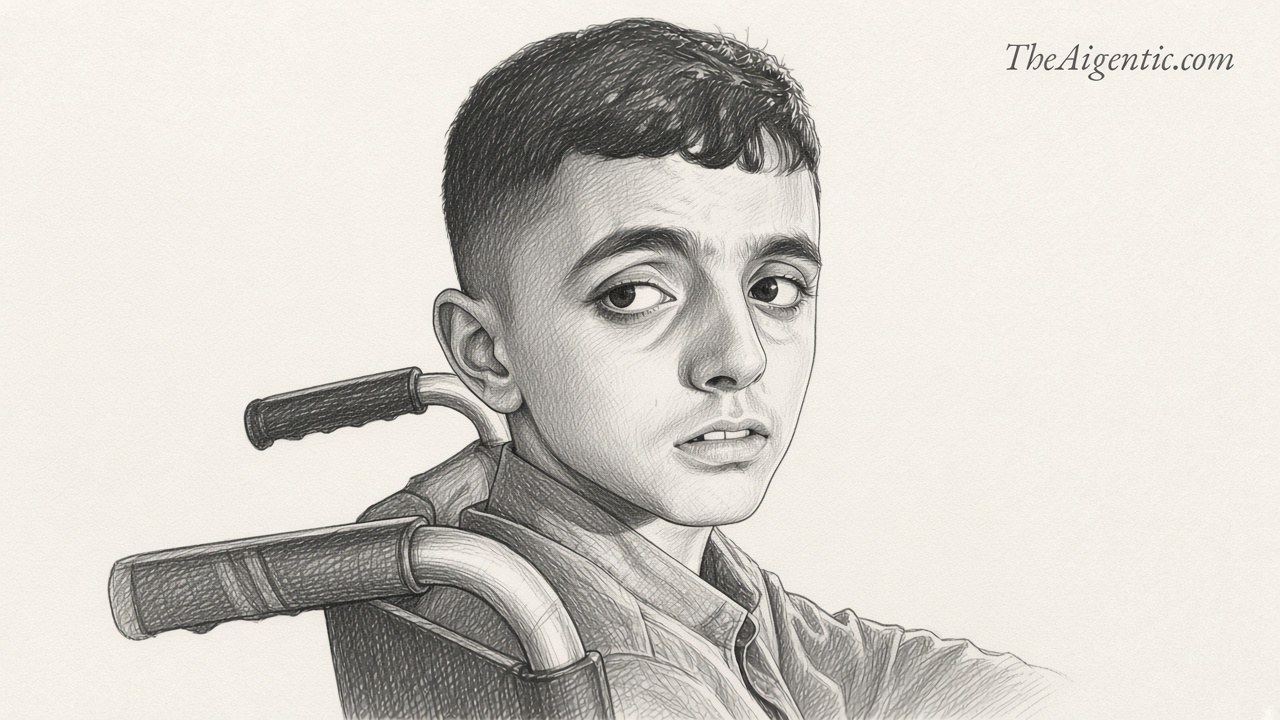
Set in Tehran during the January 2026 crackdown on protesters, the film follows strangers whose lives converge in an alley. Above them, Amir, a boy who uses a wheelchair, watches from a window and faces a decision about whether to intervene. Tribeca describes the roughly 75-minute feature as a docudrama drawing on decades of Iranian civilian resistance. Its immediate subject is political violence; its larger concern is what ordinary people can do when the state makes resistance dangerous. [1]
That historical setting is independently documented. On January 23, the United Nations Human Rights Council condemned a crackdown that had killed thousands and called for an urgent investigation. UN officials also described an internet and telecommunications shutdown that obstructed verification. This matters to the film’s premise: the absence of accessible images can itself become part of the machinery of repression. [6]
Koosha’s connection to that problem is personal. He and his brother, producer Pooya Koosha, told Rotten Tomatoes that they had faced prosecution over their musical activities in Iran and were warned against returning after leaving the country. Dreams of Violets emerged from that history as well as Ash’s background in AI. [3]
In a statement reported by Rolling Stone, Koosha acknowledged the discomfort of using synthetic images to portray actual suffering. He argued that allowing the victims to disappear from public memory would be worse. The film exists, he said, because “the dead deserve to be witnessed.” That is the strongest case for the project: it gave an exiled artist a way to attempt a memorial he believed conventional production could not deliver. [2]
The description “all-AI film,” however, compresses a complicated process into a misleadingly simple label. Koosha told Rotten Tomatoes that the work began with a screenplay, decisions about staging and a planned sequence of scenes. Music, sound, editing and color work surrounded the generation process. His description of the model’s role was precise: “The model becomes the camera, becomes the world, and becomes the performance.” [3]
He also told the Guardian that he performed the voices himself, then used AI to alter them for different characters. [5]
According to the production company’s account reported by Variety, the visual workflow combined commercial models with Fountain 0’s own software. This is the division of work the filmmakers described, rather than an independently audited production record. [4]
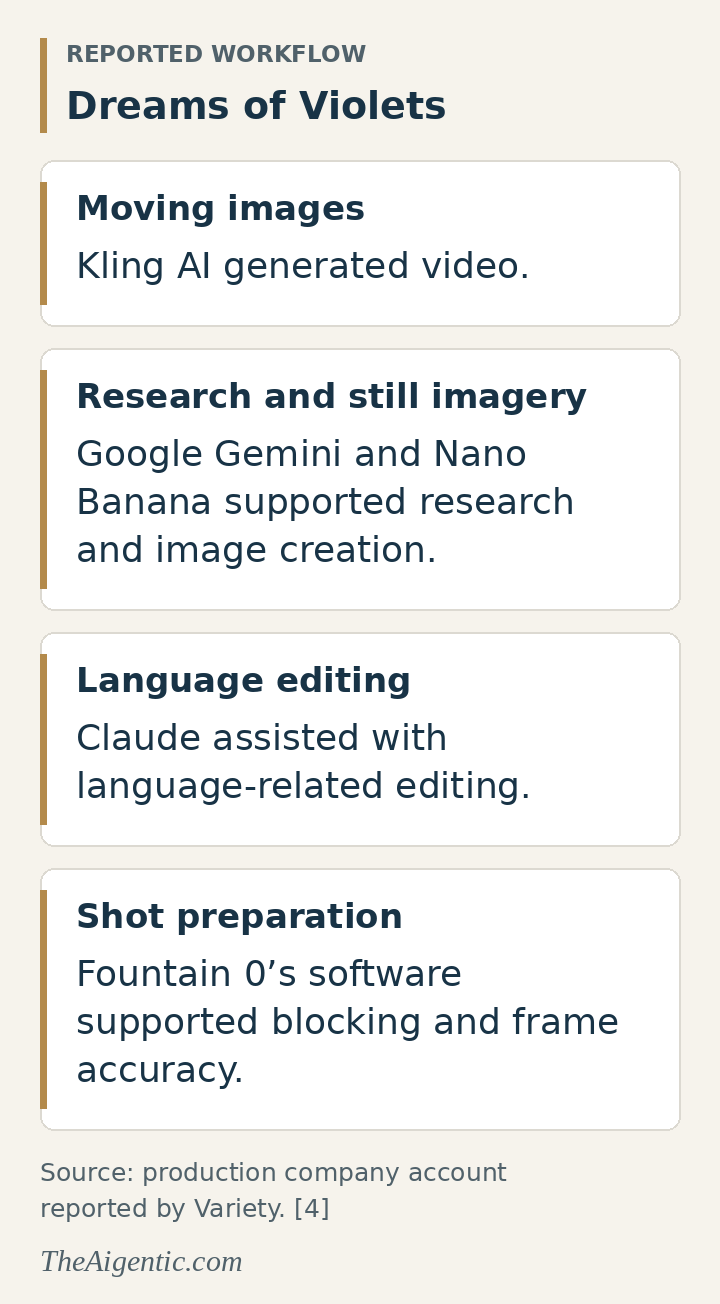
Source: production company account reported by Variety. [4]
The practical change is substantial. A director can attempt a scene without assembling a physical set or returning a cast to location. But someone still has to decide what belongs in the frame, which result is usable and why one shot should follow another. Moving production into software concentrates those decisions in fewer hands. It does not make the decisions disappear.
Koosha told Business Insider that his roughly $2,000 in spending went mainly toward AI subscriptions he already paid for and additional usage credits. He told E! News he spent a month on research and writing, followed by two months of production, much of it after work. Fountain 0 credited his brother Pooya with post-production and said the brothers used software they had developed. Their public accounts give no dollar value for that labor or the share of software development attributable to the film. The full production cost remains unknown. [13, 14, 15]
Executive producer Tom Rogers estimated that a comparable independent film made conventionally might cost $2 million or more. A second figure appeared in July, when Koosha told CBC News that the budget for his next feature, Odysseus: The Fall, ran to the mid-five figures. [14, 16]
The cash a director needs before production begins can determine which stories reach the screen. A filmmaker who can write, score and edit in their own time can attempt a politically difficult subject while a comparable production is still looking for financing. Hiring people for those same jobs would require a different budget.
Tribeca’s involvement gave the experiment cultural visibility. Co-founder Jane Rosenthal defended the selection by pointing to “the emotional immediacy and urgency of the story itself.” Fountain 0 promoted the film as the first fully AI-generated, live-action feature accepted by a major festival. Tribeca’s archive places it in Special Events. That is a programming decision, not an award or evidence of a critical consensus; “live-action” is also an awkward description for images generated rather than photographed. [1, 4]
The reviews after the premiere made that distinction consequential. TheWrap’s Matthew Creith described stiff movement, generalized facial expressions and dialogue that could feel disconnected from the images. He also saw a meaningful attempt to circumvent censorship. His assessment was neither a dismissal of the subject nor an endorsement of the execution: the film was “uneven, frequently frustrating, and undeniably flawed.” [7]
Variety’s Owen Gleiberman likewise separated the dramatic experience from the technical demonstration. He found the storytelling thin and emotionally distant while treating the imagery as a significant indication of what AI might eventually do. These are individual critical judgments, not a representative audience survey, but they identify a more useful test than whether a generated face contains an obvious visual glitch. [8]
A convincing tear is only one component of a moving scene. Audiences need to understand the person crying, what has been lost and how the moment changes what follows. If those relationships are weak, greater visual realism may simply make the weakness more conspicuous. The reviews suggest that Dreams of Violets encountered problems of narrative construction alongside problems of generation. Better models alone would not necessarily solve both.
The film’s subject makes the distinction between reconstruction and evidence especially important. A fictionalized account can help people imagine experiences that repression has concealed. It cannot establish that a particular confrontation occurred exactly as depicted. Photorealism increases the need to preserve that distinction because an isolated clip can circulate without the explanation that originally accompanied it.
For this kind of filmmaking, disclosure should travel with the images. Viewers should be able to distinguish documented events from invented dialogue, composite characters and dramatic interpretation. A clear account of the underlying sources would help people assess the work without confusing its emotional purpose with its evidentiary value. Those are standards for responsible reconstruction, rather than a claim that this film has been shown to falsify any particular event.
There is also a tension in Koosha’s appeal to witnessing. AI can give visual form to an event a filmmaker could not safely record, but the resulting face cannot supply a victim’s testimony. The moral value depends on the research, the treatment of the people represented and the honesty of the presentation. The technology provides a means of expression; the filmmaker retains responsibility for what the expression asks viewers to believe.
The labor question remains even if that responsibility is taken seriously. In a September 2025 statement about the separate synthetic character Tilly Norwood, SAG-AFTRA put its position plainly: “The union is opposed to the replacement of human performers by synthetics.” The statement was not a response to Dreams of Violets, but it articulates the objection a production built around generated performances must confront. [9]
Koosha, for his part, told Rotten Tomatoes that experienced film workers could help operate these tools and that he hoped new roles would emerge. Whether those opportunities can support the people whose work is displaced remains unproven. A filmmaker gaining access to production and a crew member losing paid work can be consequences of the same technological change. Neither experience cancels the other. [3]
The business interests behind the project also deserve attention. Fountain 0 now presents itself as both a studio and a platform for making and releasing films. Its website promotes a second feature, Odysseus: The Fall, and a catalogue of licensed likenesses. Dreams of Violets therefore serves two purposes in public: a work about Iranian resistance and a demonstration of a commercial production system. Its political sincerity does not remove the need to examine the company’s claims. [10]
Licensing faces addresses one question of permission, but it does not by itself settle compensation, the provenance of model training material or ownership of generated results. On that last issue, the U.S. Copyright Office’s 2025 report says AI-assisted works can qualify for protection when sufficient expressive elements are authored by humans; merely supplying prompts is insufficient. That principle makes human writing, arrangement and modification commercially relevant. It is not a determination of the copyright status of this particular film. [11]
The strongest forecast supported by this case is that some filmmakers will be able to attempt work that previously exceeded their financial or physical reach. Whether that produces a richer cinema will depend on what happens after the images become cheap: how stories are developed, how collaborators are paid and whether audiences choose to spend time with the results. A festival invitation establishes an opportunity to be seen. It does not answer those questions.
As of November 6, Fountain Watch lists Dreams of Violets as a free, 74-minute film in Farsi. Viewers can now assess the feature beyond its trailer and production claims. [12]
Dreams of Violets has made one change tangible: an artist working outside conventional production can bring a feature about an inaccessible place to a major festival. Its harder ambition is to make viewers care about the people represented there. That is where its value as a memorial, and its limits as a film, ultimately have to be judged.
Sources
1. Tribeca Festival — Dreams of Violets program archive
2. Kory Grow, Rolling Stone — Announcement and filmmaker statement, May 28, 2026
3. Melissah Yang, Rotten Tomatoes — Interview with Ash and Pooya Koosha, June 8, 2026
4. Variety — Tribeca premiere announcement and production details, May 28, 2026
5. Cath Clarke, The Guardian — Interview with Ash Koosha, June 3, 2026
6. United Nations Office at Geneva — Human Rights Council special session on Iran, January 23, 2026
7. Matthew Creith, TheWrap — Dreams of Violets review, June 12, 2026
8. Owen Gleiberman, Variety via Yahoo — Dreams of Violets review, June 18, 2026
9. SAG-AFTRA — Statement on Synthetic Performer, September 30, 2025
10. Fountain 0 — Studio and platform website, accessed November 6, 2026
11. U.S. Copyright Office — Part 2 report announcement on AI and copyrightability, January 29, 2025
12. Fountain Watch — Current film listing, accessed November 6, 2026
13. Business Insider — Ash Koosha on subscriptions and usage credits, June 2026
14. Fountain 0 via Business Wire — Production costs and the conventional film comparison, May 27, 2026
15. E! News — Ash Koosha on research and production time, June 10, 2026
16. CBC News via Yahoo — Interview on the budget for Odysseus: The Fall, July 15, 2026