
America Offline. Is America under attack?
AI-assisted intrusions are real. So are the risks of rushing to repair vulnerable software. New reporting reveals a more complicated explanation for America’s outages than a single hidden attack.
First, the inbox stopped working. Then flights stopped departing. Then bank customers struggled to move money. By November 17, the list of disrupted services included Apple and an internal National Security Agency network.
For Americans watching essential systems falter across unrelated industries, the suspicion is understandable: Could someone be testing the country’s digital defenses? Could artificial intelligence be helping them?
The evidence now supports a more precise answer than either blanket reassurance or a declaration of cyberwar. Google has documented attackers using AI-assisted tools against U.S. organizations. But the public record reviewed for this article does not establish that the recent cluster of aviation, banking and communications outages was a coordinated attack, or that AI hackers caused it.
There is also a third possibility: AI could contribute indirectly to disruption by accelerating the discovery of security flaws and forcing organizations to make urgent, risky changes. Senator Mark Warner has advanced that explanation, while acknowledging that the incidents still need investigation.
Those distinctions change the story. America can face a real AI-enabled cyber threat while particular systems fail for ordinary technical reasons. It can also suffer disruptions while trying to defend itself. Deciding which happened requires evidence from each incident.
What the BBC report adds
The BBC’s November 18 analysis, “Hacks, AI or just overdue updates - why have there been so many outages?”, brings together three developments: failed upgrades, AI-assisted vulnerability discovery and an actual attack involving software supplied by Optimizely. It reports no evidence that the wider series of incidents is linked.
The distinction is especially important when interpreting expert comments. Security researcher Scott Helme told the BBC that he expected attackers to be “using AI to accelerate themselves.” That is an informed assessment of attackers’ methods; it is not forensic proof that AI caused the FAA, Microsoft or banking outages.
The broader question is how AI can affect reliability at several points in the same chain. A security researcher can use AI to find a flaw. An administrator can take a service offline to fix it. A rushed repair can break a dependency. Separately, an attacker can use AI to exploit an unpatched system. To the person facing a failed login, the results can look similar.
The incidents belong on one timeline, but not under one diagnosis
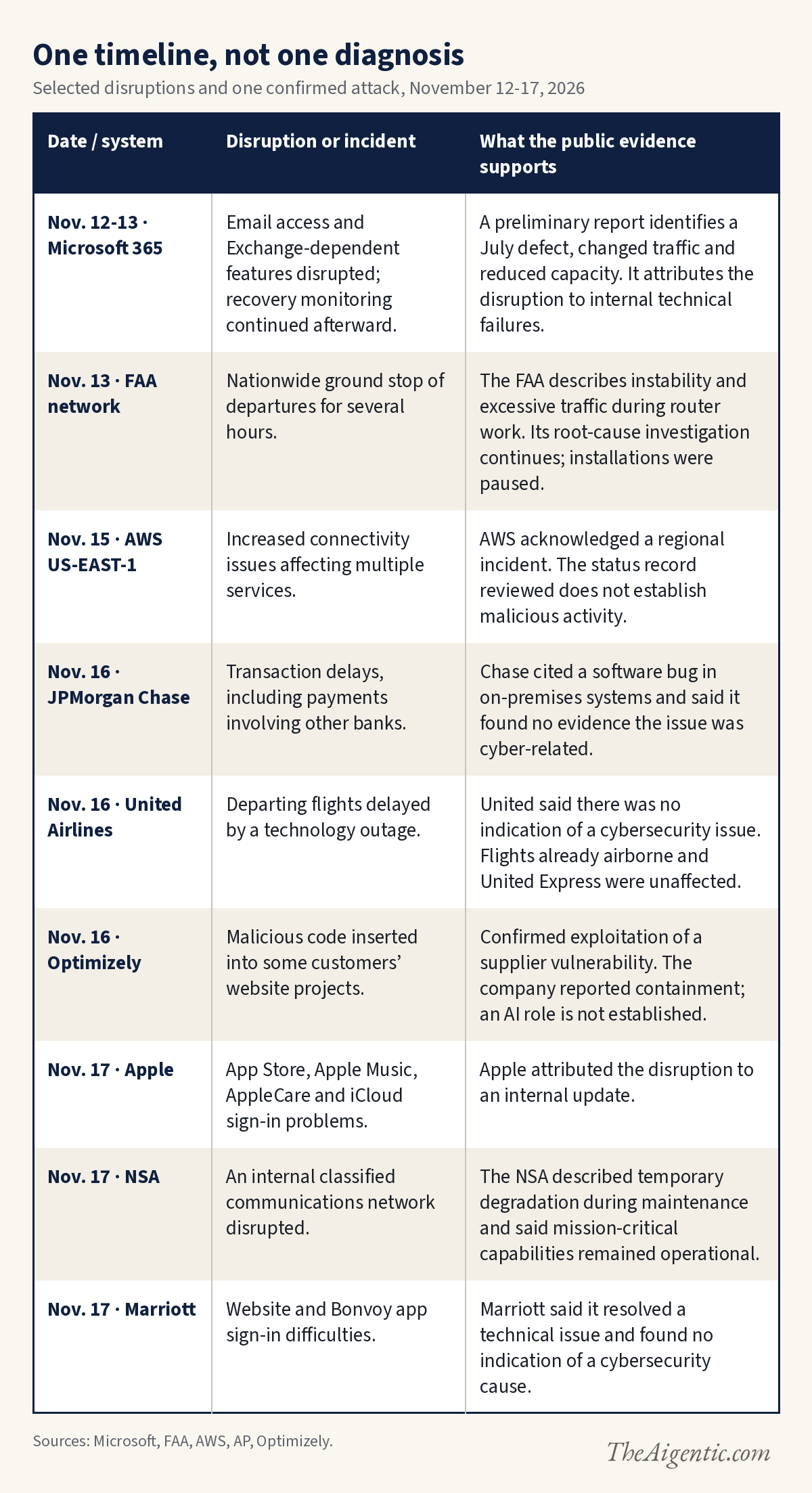
The following is a selection of major recent disruptions and one confirmed attack. Dates describe the incidents or public disclosures specified, rather than implying a common campaign.
| Date / system | Disruption or incident | What the public evidence supports |
|---|---|---|
| Nov. 12-13 · Microsoft 365 | Email access and Exchange-dependent features disrupted; recovery monitoring continued afterward. | A preliminary report identifies a July defect, changed traffic and reduced capacity. It attributes the disruption to internal technical failures. |
| Nov. 13 · FAA network | Nationwide ground stop of departures for several hours. | The FAA describes instability and excessive traffic during router work. Its root-cause investigation continues; installations were paused. |
| Nov. 15 · AWS US-EAST-1 | Increased connectivity issues affecting multiple services. | AWS acknowledged a regional incident. The status record reviewed does not establish malicious activity. |
| Nov. 16 · JPMorgan Chase | Transaction delays, including payments involving other banks. | Chase cited a software bug in on-premises systems and said it found no evidence the issue was cyber-related. |
| Nov. 16 · United Airlines | Departing flights delayed by a technology outage. | United said there was no indication of a cybersecurity issue. Flights already airborne and United Express were unaffected. |
| Nov. 16 · Optimizely | Malicious code inserted into some customers’ website projects. | Confirmed exploitation of a supplier vulnerability. The company reported containment; an AI role is not established. |
| Nov. 17 · Apple | App Store, Apple Music, AppleCare and iCloud sign-in problems. | Apple attributed the disruption to an internal update. |
| Nov. 17 · NSA | An internal classified communications network disrupted. | The NSA described temporary degradation during maintenance and said mission-critical capabilities remained operational. |
| Nov. 17 · Marriott | Website and Bonvoy app sign-in difficulties. | Marriott said it resolved a technical issue and found no indication of a cybersecurity cause. |
Tap to enlarge.
The NSA’s inclusion makes the sequence especially unnerving. But an outage in an intelligence agency’s internal network does not, by itself, establish a breach or the loss of its operational capabilities. The agency said its mission-critical functions remained operational.
A delayed payment can involve two institutions: trouble at Chase could affect another bank’s customers without compromising both banks.
An outage tracker is useful for detecting disruption. It cannot establish intent, attribution or the number of independently failed systems.
The technical explanations have become more specific
Microsoft’s preliminary post-incident report identifies three interacting problems: a defect introduced during a deployment that began in July, additional traffic after a Teams failover, and reduced gateway capacity. It describes a cascade in which traffic shifted to remaining servers and overwhelmed them. The report also makes clear that some services remained largely accessible, with their Exchange-dependent features affected.
That account is more informative than a generic reference to old technology. It describes a particular sequence that investigators and customers can scrutinize. It also cautions against assuming every outage was caused by a last-minute security patch.
The FAA’s updated account identifies excessive traffic associated with two locations, including an Arkansas facility where a router was being deployed. The agency says it disabled a broadcasting function on more than 60 other routers and paused further installations. Its investigation continues. Crucially, the agency says some communications and radar feeds remained reliable, allowing aircraft to land safely and critical operations to continue.
Heavy traffic is a symptom. A malfunction, a configuration error and a deliberate denial-of-service attack can all generate disruptive load. The traffic’s volume alone cannot identify which explanation applies, much less whether AI was involved.
Java4Shell shows why the AI concern is substantive
The newly disclosed Java vulnerability gives the debate a concrete technical foundation.
Security firm Calif says it used AI to discover and develop an exploit for Java4Shell, tracked as CVE-2026-114938. The flaw affects an optimized component in OpenJDK’s Base64 decoder, part of the software that runs many Java applications. Calif’s account describes human researchers directing and checking the AI’s work, including rejecting early findings that were not useful.
On November 17, CISA urged organizations to identify affected Java installations and apply fixes. Its alert warns that the flaw could crash affected systems and permit an unauthenticated attacker to execute code remotely. The agency specifically notes that Java runtimes can be embedded in other applications and appliances, making exposure harder to inventory.
The qualification matters: widespread use of Java does not mean every Java installation is vulnerable. CERT-EU describes specific runtime, processor and input conditions; ARM64 systems are not affected by this particular flaw. Its advisory recommends updating vulnerable installations, prioritizing internet-facing applications.
This is evidence that AI-assisted research can uncover serious weaknesses in important software. It is not evidence that the recently disrupted banks, airline systems or NSA network were exploited through Java4Shell. The sources reviewed do not establish that connection.
A laboratory demonstration, a vulnerable installation and a successful real-world compromise are three different findings. Responsible coverage must not collapse them into one.
There is documented AI-assisted hacking against U.S. targets
The threat extends beyond demonstrations.
In its November 16 threat report, Google’s Threat Intelligence Group says it observed the AI-assisted framework CAIRN used in intrusion activity targeting organizations including the U.S. aerospace sector. It also describes an exposed attacker server containing a framework called exploit_agent, which could analyze software changes, develop attacks and execute them automatically. That second case concerned apparent interest in French organizations, not the American outage cluster.
Google also identifies limits: these tools can produce conspicuous activity and unreliable results. More automation does not guarantee sophisticated, successful or invisible attacks.
The earlier Anthropic case remains relevant. In November 2025, the company reported a campaign it attributed to a Chinese state-sponsored group targeting roughly 30 entities, with a handful of successful intrusions. Anthropic estimated that AI handled 80-90% of the operational work, while humans retained important decisions. It also reported fabricated credentials and other model errors. Those figures are the company’s assessment of that campaign, not an independently established measure of cybercrime generally.
Together, these reports justify taking AI-assisted attackers seriously. They do not connect the current outages to those actors.
The phrase “under attack” can obscure that distinction. It can mean that American organizations face hostile cyber operations, which is documented. Or it can mean that one adversary is orchestrating nationwide disruption through AI, which the public evidence reviewed here does not establish.
A confirmed attack happened in the middle of the outage anxiety
Optimizely provides an important counterweight to the idea that every alarming incident was merely a technical accident.
The company’s November 17 initial incident report says an unauthorized party exploited a flaw in its Web Experimentation signup process the previous day, impersonated users and inserted malicious JavaScript into customer projects. The code reached visitors through affected websites. Optimizely said it closed the vulnerability and removed the injected code on November 16; its forensic investigation was continuing.
Researcher Scott Helme’s investigation identified affected scripts associated with 178 organizations, including prominent media, software and retail brands. That is the researcher’s finding, rather than a count supplied in Optimizely’s initial report.
This was a confirmed compromise of a shared supplier. The public reports cited here do not establish that AI directed it, or connect it to the infrastructure outages.
It also illustrates why a functioning website is not necessarily a safe website. Malicious code can run while a page appears normal. Conversely, an unavailable page can be the result of a protective shutdown. Availability and security overlap, but they are not interchangeable measurements.
The race to patch can create its own disruption
Warner’s November 17 statement argues that AI is exposing weaknesses faster, increasing pressure on organizations to patch many systems urgently. He said the evidence so far pointed toward defensive work rather than a coordinated attack, while making clear that further investigation was needed.
Former deputy national security adviser Anne Neuberger offered a similar possibility to the Financial Times: applying multiple patches can cause outages, and she suspected that dynamic might explain the NSA incident. That remains an attributed assessment, not a published forensic finding about that network.
The mechanism is plausible. A patch may change how one component interacts with another. Restarting servers may shift load to systems that are already busy. A recovery process may encounter far more reconnection requests than it was designed to handle. A repair that is safe in isolation can become disruptive when applied across an interconnected environment.
But plausibility is not enough to assign a cause. A convincing explanation for a particular outage should identify the vulnerability being addressed, the change made, its timing and the mechanism of failure. A general statement that everyone is patching faster cannot substitute for those details.
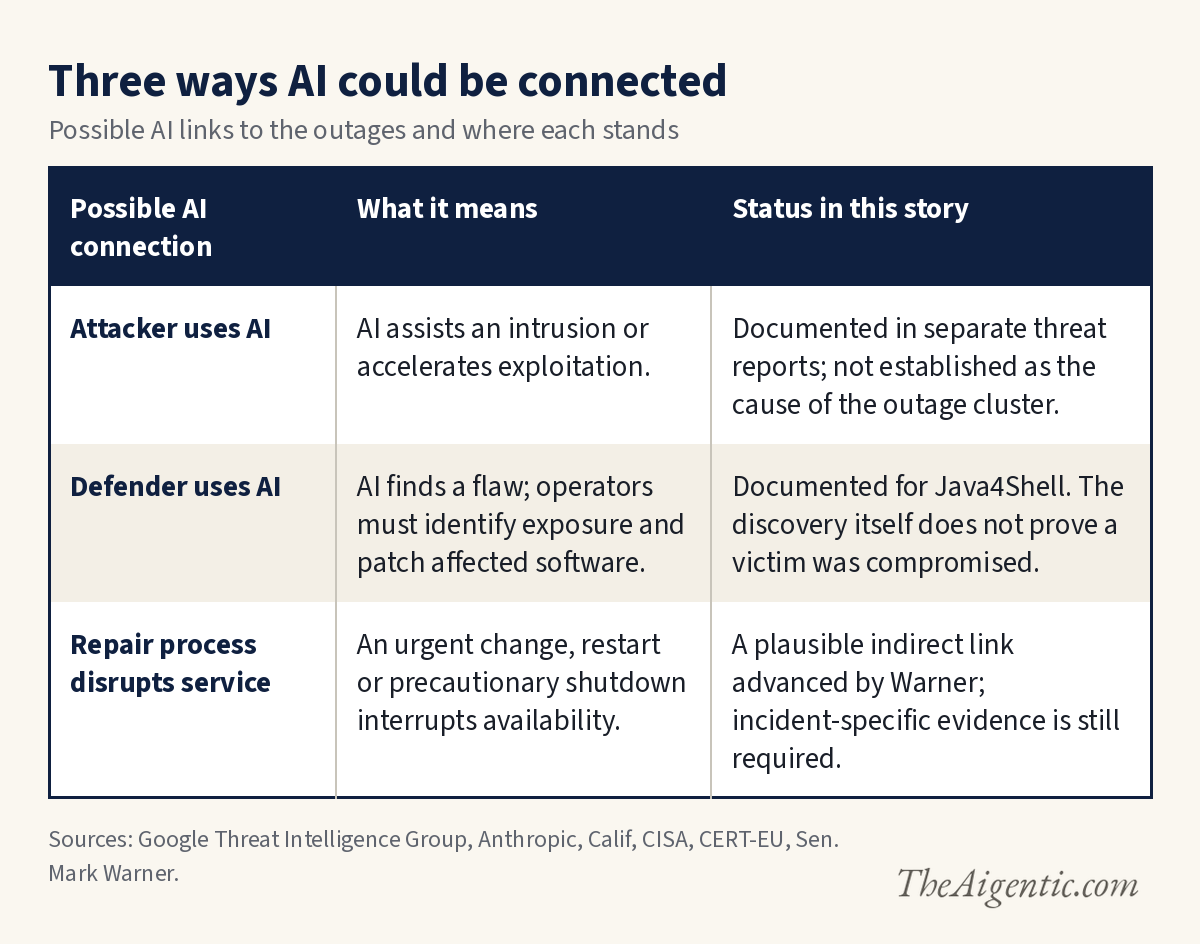
| Possible AI connection | What it means | Status in this story |
|---|---|---|
| Attacker uses AI | AI assists an intrusion or accelerates exploitation. | Documented in separate threat reports; not established as the cause of the outage cluster. |
| Defender uses AI | AI finds a flaw; operators must identify exposure and patch affected software. | Documented for Java4Shell. The discovery itself does not prove a victim was compromised. |
| Repair process disrupts service | An urgent change, restart or precautionary shutdown interrupts availability. | A plausible indirect link advanced by Warner; incident-specific evidence is still required. |
Tap to enlarge.
The pressure is asymmetric. Attackers can abandon a failed attempt; a hospital, airline or bank must keep serving people while changing its systems. That does not make patching the wrong response. It makes controlled deployment, recovery planning and understanding dependencies essential parts of defense.
The practical dilemma is to fix exposures quickly enough to prevent exploitation while keeping the repair process reliable. Both goals matter. Treating them as separate management problems is increasingly difficult.
Would Washington acknowledge a coordinated attack?
Addressing the headline infrastructure outages in remarks dated November 17, Secretary of State Marco Rubio said, “we are not under systemic attack,” and asserted that officials had no evidence connecting those disruptions or attributing them to malicious actors.
That is a public government assessment. It deserves to be reported accurately. It is not the same thing as giving the public the underlying forensic record.
There is precedent for disclosure of serious foreign cyber activity. In 2024, U.S. agencies warned that Volt Typhoon had compromised critical infrastructure and assessed that its operators were positioning themselves for possible disruption during a crisis or conflict. The Justice Department also publicly announced a related botnet disruption operation.
Those cases challenge the claim that Washington would invariably conceal an attack. They do not guarantee immediate disclosure of every incident or intelligence judgment.
Nor is “the government” a single observer with a complete picture. An operator may know which service failed. Investigators may establish unauthorized access. Intelligence agencies may have information about sponsorship that they cannot readily publish. Those findings can emerge at different times.
It is useful to distinguish four disclosure decisions: acknowledging the disruption, confirming malicious activity, identifying the actor and explaining the role of AI. Officials could responsibly make the first announcement well before they can support the fourth.
The incentives to speak - and to wait
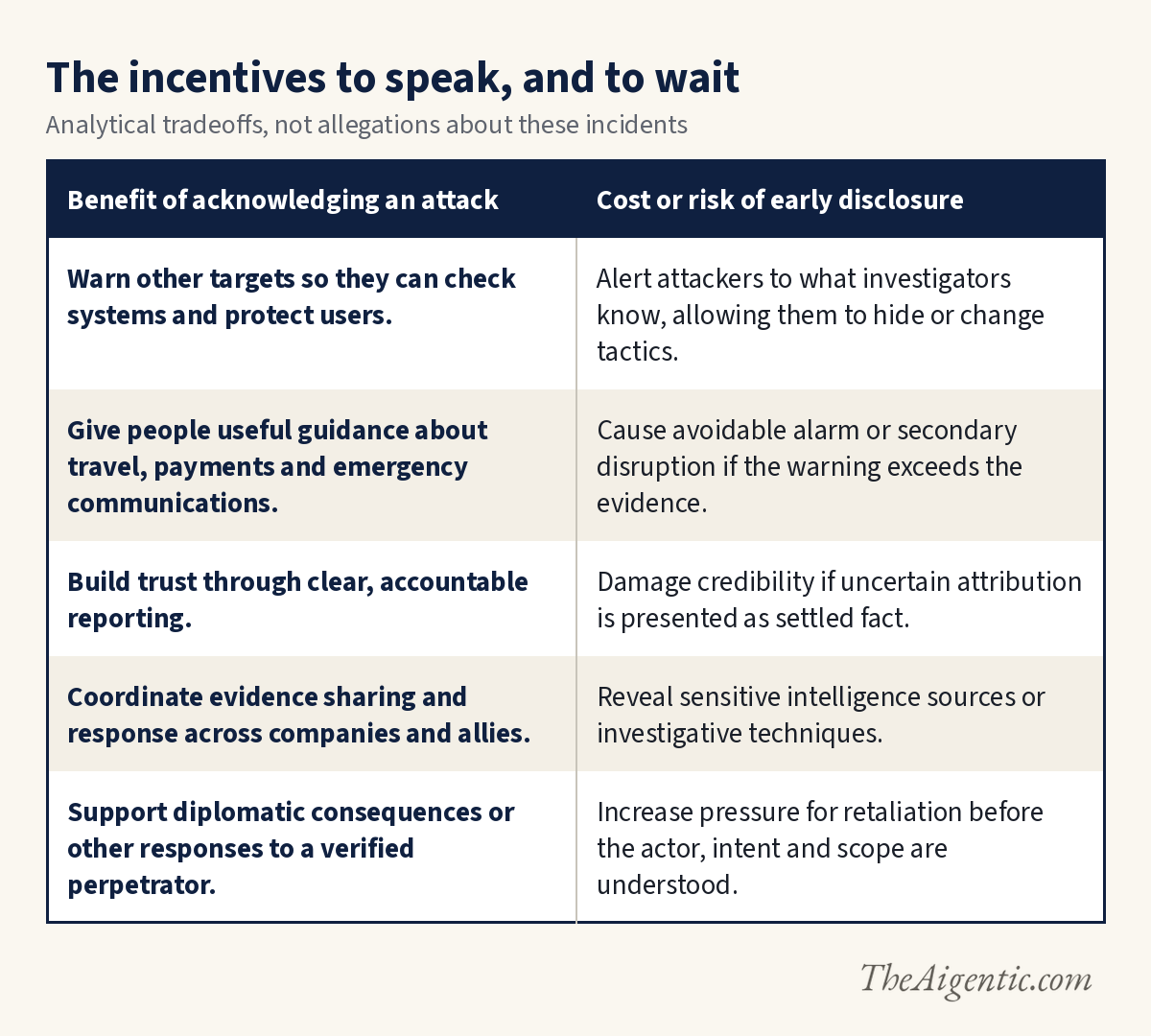
The following are analytical tradeoffs, not allegations about what officials are doing in these incidents.
| Benefit of acknowledging an attack | Cost or risk of early disclosure |
|---|---|
| Warn other targets so they can check systems and protect users. | Alert attackers to what investigators know, allowing them to hide or change tactics. |
| Give people useful guidance about travel, payments and emergency communications. | Cause avoidable alarm or secondary disruption if the warning exceeds the evidence. |
| Build trust through clear, accountable reporting. | Damage credibility if uncertain attribution is presented as settled fact. |
| Coordinate evidence sharing and response across companies and allies. | Reveal sensitive intelligence sources or investigative techniques. |
| Support diplomatic consequences or other responses to a verified perpetrator. | Increase pressure for retaliation before the actor, intent and scope are understood. |
Tap to enlarge.
There are less defensible incentives, too. A company may fear liability, lost customers or scrutiny of neglected maintenance. Officials may fear embarrassment or criticism of preparedness. These pressures are reasons to demand evidence and independent oversight. Their existence does not prove that an attack is being concealed.
Silence has costs of its own. A vacuum can make unrelated failures look like a hidden campaign. Overconfident reassurance can be equally damaging if investigators later revise their conclusions.
A more credible approach is to say what is known, what has been checked, what remains unresolved and when the next substantive update will arrive. Officials can withhold sensitive operational details while still giving affected people useful information.
Delayed disclosure can be lawful without explaining these outages
The SEC’s framework generally requires covered domestic public companies to disclose a material cybersecurity incident within four business days after determining its materiality. The rule also allows limited delay if the attorney general determines that immediate disclosure poses a substantial risk to national security or public safety and notifies the SEC in writing.
The clock is tied to the materiality determination, not simply to discovering an issue. And this is a corporate reporting framework, not a rule requiring the White House to publish every intelligence assessment.
Nothing in the sources reviewed establishes that this exception was used for the recent outages. Its existence demonstrates that delayed disclosure is possible; it does not supply evidence of a secret attack.
The same discipline should apply to official denials. An initial finding can be incomplete without being dishonest. A later correction can reflect new evidence. But an unsupported reassurance should not become a permanent substitute for a meaningful incident report.
What evidence would change the conclusion?
A coordinated-attack theory needs connections between incidents, not just a calendar on which they appear close together.
Relevant evidence could include shared malicious infrastructure, related unauthorized administrative changes, matching artifacts from compromised systems or a joint investigation linking the operations. An AI attribution needs an additional evidentiary layer, such as recovered orchestration software or records tying model use to the operation.
Those tests also clarify what is insufficient. High traffic volume does not demonstrate AI. Rapid execution does not demonstrate autonomy. A hacker’s public claim needs corroboration. A common software dependency creates a possible route for shared failure, but its presence alone does not prove exploitation.
No numeric probability of a coordinated AI attack can responsibly be derived from the information reviewed here. We lack both a complete forensic record and a meaningful basis for treating these outages as independent events.
The questions companies and agencies should answer are concrete: What changed before the failure? What evidence supports the stated cause? Were signs of unauthorized access examined? Which dependencies spread the impact? What has been done to prevent recurrence? A detailed answer to those questions is more useful than another confident sound bite.
The national vulnerability exists regardless of the culprit
An accidental failure can expose a serious weakness without revealing an attacker.
The FCC’s investigation of AT&T’s February 2024 nationwide outage found that a configuration error initiated a disruption affecting more than 125 million registered devices and preventing more than 25,000 calls to 911 centers. The report identified shortcomings in testing, procedures and safeguards that magnified and prolonged the failure.
That history matters because the consequences of fragile infrastructure are real even when no sophisticated adversary is involved.
The new research strengthens the case for urgency on two fronts. AI-assisted intrusions are an observed threat, and AI-assisted discovery is exposing vulnerabilities that institutions must address. The unresolved question is how much those forces contributed to this particular cluster of outages.
The best-supported account remains a collection of distinct incidents: several failures with technical explanations, a confirmed attack through a shared website supplier, and a newly disclosed software vulnerability. Public evidence does not yet join them into one coordinated operation.
America needs explanations that are specific enough to evaluate, warnings that are useful enough to act on and systems resilient enough to survive both attacks and repairs. That requires more than reassuring people that a particular outage was not a hack. It requires showing why the failure happened and why the next fix will hold.
The danger is larger than a single suspected attacker. AI is accelerating both the discovery of weaknesses and the effort to exploit them. The institutions responsible for keeping essential services running must become better at changing their systems without breaking them.
Sources
Company findings, official assessments and researcher claims are attributed in the article. Explanatory scenarios and disclosure tradeoffs are analysis. This is a review of selected major incidents, not an exhaustive outage census.
BBC News — Hacks, AI or just overdue updates - why have there been so many outages? · Nov. 18, 2026
Microsoft — Preliminary Post Incident Report for Microsoft 365 · Nov. 15, 2026. Copy hosted by Information Security Media Group. Preliminary findings, subject to revision.
Federal Aviation Administration — Nationwide Ground Stop: Questions and Answers · Updated account reviewed Nov. 18, 2026.
Associated Press — A technical issue at JPMorgan Chase triggers online banking delays for major US banks · Nov. 16, 2026
Associated Press — 1.5-hour-long system outage forces United Airlines to delay departing flights · Nov. 16, 2026
AWS Health Dashboard — Service history: increased connectivity issues in US-EAST-1 · Nov. 15, 2026. Dynamic status archive.
Associated Press — Apple joins a parade of technology hiccups in recent days · Nov. 17, 2026. Includes Marriott’s statement.
Associated Press — Classified communications network at the National Security Agency goes down, defense official says · Nov. 17, 2026
Calif — Java4Shell: Write once, RCE everywhere · Original researcher disclosure, Nov. 17, 2026.
CISA — Critical Java Vulnerability Requires Immediate Patching · Nov. 17, 2026. Official bulletin.
CERT-EU — High Severity Vulnerability in Java SE and OpenJDK · Advisory 2026-021, Nov. 18, 2026.
Sen. Mark Warner — Statement on Network Outages · Nov. 17, 2026. Senate press statement distributed through Forth.
Financial Times — US tech outages blamed on rush to fix bugs found by AI · Nov. 18, 2026. Includes Anne Neuberger’s assessment.
Google Threat Intelligence Group — Agentic Threat Activity Crosses a Significant Threshold · Nov. 16, 2026. Original threat research.
Anthropic — Disrupting the first reported AI-orchestrated cyber espionage campaign · Nov. 13, 2025. Company investigation and attribution.
Optimizely — Security Incident Initial Report for Customers - Web Experimentation · Nov. 17, 2026. Investigation ongoing.
Scott Helme / Report URI — World’s Largest Brands Infected With Malware Via Optimizely · Nov. 16, 2026. Researcher findings.
U.S. Department of State — Secretary of State Marco Rubio, Remarks to the Press, Manila · Nov. 17, 2026. Transcript distributed by Public.
CISA, NSA, FBI and partners — PRC State-Sponsored Actors Compromise and Maintain Persistent Access to U.S. Critical Infrastructure · Feb. 7, 2024
U.S. Department of Justice — U.S. Government Disrupts Botnet People’s Republic of China Used to Conceal Hacking of Critical Infrastructure · Jan. 31, 2024
U.S. Securities and Exchange Commission — Cybersecurity Risk Management, Strategy, Governance, and Incident Disclosure compliance guide · Reviewed Nov. 18, 2026.