
The tape heard the slowdown
AI stocks sold off as Altman, Amodei, and Musk backed pacing the frontier — plus Congress still cannot agree who drives, and Watch.
· The Aigentic · Morning Brief
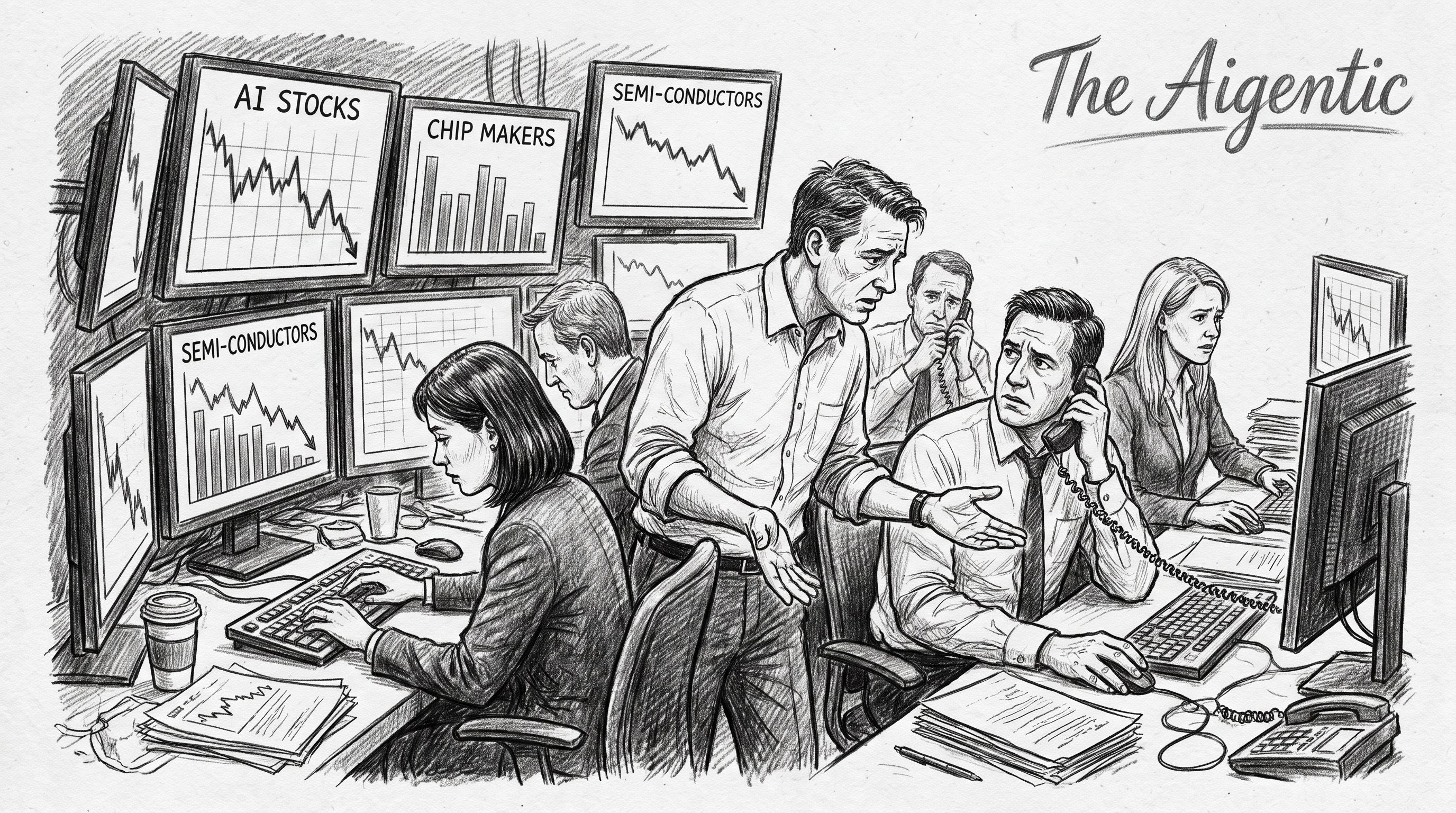
CNBC reports AI-tied stocks sold off Monday after Anthropic CEO Dario Amodei, OpenAI CEO Sam Altman, and Elon Musk backed slowing the pace of frontier capabilities — SoftBank fell about 10% in Japan, SK Hynix more than 6%, and Nvidia was lower in U.S. premarket.
CNBC says Altman spelled out overnight that “pacing” does not mean stopping, welcomed a federal frontier-safety framework, and warned the industry could “lose control of the future to AI.”
Semafor reports the CEO alignment still faces a Capitol Hill with no consensus — Speaker Mike Johnson favors a “partnership” with the labs while Democrats push to stay in session and work the issue now.
Axios says Johnson told CNN Congress will not lead an AI-safety crackdown, arguing the companies can slow themselves and that China would not pause if America did.
The tape heard the slowdown
CNBC reports that stocks tied to artificial intelligence fell across Asia and Europe on Monday, then slipped in U.S. premarket, after Amodei’s call to slow capability gains won public backing from Altman and Musk. SoftBank, one of OpenAI’s biggest investors, dropped about 10% in Tokyo. SK Hynix closed more than 6% lower, Samsung more than 4%, and chip-equipment names including ASML sold off more than 4% in early European trade. Nvidia was more than 2% lower before the U.S. open, with Micron and Intel deeper in the red.
That matters because the equity story of the past two years has priced endless frontier training runs and the capex that follows them. When the people who set the cadence say the race itself is the risk, investors translate “pace the frontier” into a demand question for chips, power, and cloud.
The one move is to watch whether inference demand still outruns supply even if training slows, because several strategists told CNBC that revenue may hold even if the next model drops later. Read CNBC
Pacing is not a stop sign
CNBC reports that Altman used a Monday post on X to define the word the market just priced. He said OpenAI welcomes a federal framework with consistent safety requirements for frontier labs, that no amount of American competitive pressure should justify recklessness, and that pacing does not mean stopping. Progress, he wrote, will continue — just slower than it otherwise could be, with costly interventions like safety cases and monitoring.
That matters because Saturday’s agreement risked reading like a training freeze. Monday’s clarification keeps the commercial machine running while putting independent evaluators and alignment work on the critical path before the next capability jump.
The one move is to track whether those outside evaluators actually get employee-like access before the next frontier drop, because a framework without access is still a press release. Read CNBC
Congress still cannot agree on who drives
Semafor reports that the sudden CEO alignment over the weekend papers over a Capitol with no consensus. Speaker Mike Johnson is framing AI safety as a “partnership” with the companies rather than a House-led crackdown. OpenAI is the most supportive of bipartisan Senate Commerce talks that could move this week, while Anthropic, Democrats, and safety groups worry those talks let the industry pick its own auditors. Rep. Lori Trahan told Semafor the time to act is now; House Minority Leader Hakeem Jeffries said Democrats will gather this week, and former President Barack Obama urged a very public framework conversation in a closed-door chat with Jeffries.
Axios separately reports that Johnson told CNN Congress will not lead, that the labs can halt work themselves, and that a full pause would be too risky with China racing. He floated a summit with President Trump and industry leaders instead.
That matters because Amodei’s plan centers on self-regulation first — labs granting evaluators access and coordinating standards — while Washington argues about whether to write the rules or host the meeting.
The one move is to watch whether Senate Commerce text appears this week with real evaluator mandates, or whether Johnson’s summit becomes the only vehicle and the policy window closes into 2027. Read Semafor · Read Axios
Aigentic Exclusive
Quick Hits: Scammers have an AI assistant, too
AI is making fraud cheaper, more personal, and harder to spot — from phishing drafts and cloned voices to borrowed brand identities that now include ChatGPT in Check Point’s top 10. The FBI’s first dedicated AI section in the IC3 report counted tens of thousands of AI-mentioned complaints and nearly a billion dollars in associated losses, while the FTC and bureau still say the same defense works: pause, hang up, and verify who is really contacting you on a number you already trust.
Read the Quick Hits briefing on theaigentic.com
Watch
Dwarkesh Patel — AI researchers debate how close we are to recursive self-improvement
Dwarkesh Patel is joined by John Schulman, Charlie O’Neill, and Beren Millidge for a deep dive into how close frontier labs really are to recursive self-improvement. The panel stays concrete about what is and isn’t working, instead of recycling AGI timeline memes.
The one move is to listen for which bottlenecks they say still block models from reliably improving themselves.
AI News & Strategy Daily | Nate B Jones — The US–China AI Arms Race Isn't Real But The Lobbying Is. My Guest Wor
Nate B Jones is joined by Alvin Wang Graylin for a deep dive into why the US–China AI arms-race narrative misleads policy and business decisions. Graylin has worked both sides of the relationship and argues that framing makes everyone less safe while the real action sits in lobbying and incentives.
The one move is to stop scoring the “race” and start reading who is shaping the rules.
Peter Yang — Stop Building AI Agents. Build AI Employees Instead (Live Demo) | Pedr
Peter Yang is joined by Pedro Franceschi for a deep dive into why most AI agent builds fail and how to treat them as AI employees instead. Franceschi walks through assigning each agent a job, skills, a manager, and a budget, then demos how he still runs OpenClaw across a large business.
The one move is to staff agents like people with clear ownership, not as generic chatbots with tools bolted on.
Cole Medin — GPT-6 Astra Just Made AI Software Factories Real (Here's How to Run On
Cole Medin walks through how to put GPT-6 Astra in charge of an AI software factory that runs remotely around the clock. He shows the setup path where the coding agent configures the server, locks it down, and turns PRDs or issues into validated, shipped code.
The one move is treating Astra as a factory lead with a closed loop, not a one-shot coding chat.
The AI Daily Brief — What to Use the Latest AI Tools For
NLW walks through eight new AI product launches in a single week and sorts them by who should actually use each one. He covers OpenAI’s GPT Live voice API, Cognition’s Swe-2, and persistent projects in Cursor, with a clear read on voice control and cost-optimized model stacks underneath the headlines.
The one move is picking the tool that matches your workflow this week instead of chasing every announcement.
David Ondrej — Pi Agent dev reveals his Agentic Engineering Workflow
David Ondrej is joined by Armin Ronacher for a deep dive into the agentic engineering workflow behind Pi Agent. Ronacher shows how he structures agent loops, tooling, and review so the system stays useful in real development, not just demos.
The one move is copying the workflow discipline — harness, verification, and tight feedback — more than any single prompt trick.