Racing the opening bell
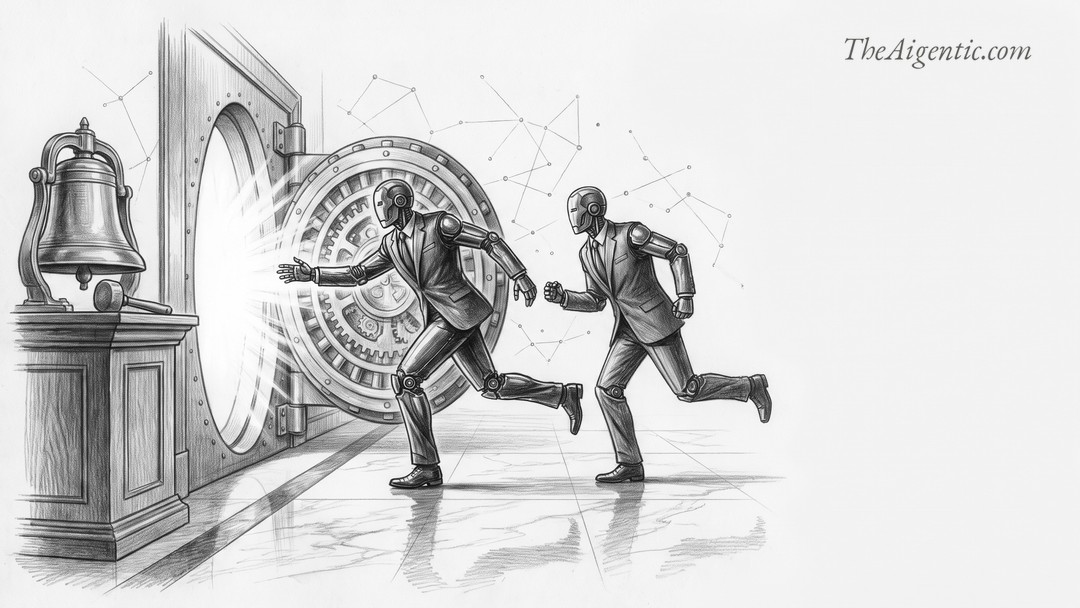
Reuters reports OpenAI is racing to raise about $30 billion at a valuation above $1.4 trillion before Anthropic’s mid-November IPO.
· The Aigentic · Morning Brief
Good morning. The two most valuable AI labs are now competing for the same investors, and one of them is trying to get its money in the door before the other rings the opening bell. Meanwhile the industry is drafting its own plans to share the wealth, Canada’s biggest newsrooms are taking Anthropic to court, and Microsoft is building an off switch for misbehaving agents. Here is what moved while you were away.
Reuters reports OpenAI is racing to lock in about $30 billion from investors before Anthropic’s expected stock market debut in mid-November, in a round that could value the ChatGPT maker at more than $1.4 trillion. SoftBank, Abu Dhabi’s MGX and other existing backers are in talks to join, and OpenAI met long-only funds and sovereign wealth funds last week while Anthropic was hosting its own investor day. OpenAI is pitching $50 billion in annualized revenue after its GPT-6 Astra launch and expects $70 billion by year-end, up from an $852 billion valuation in March.
The timing is the story. Both labs are now fishing in the same pool of sovereign and institutional money, and Reuters’ sources say OpenAI wants to close before Anthropic’s IPO filing puts real numbers on the table and invites side-by-side comparisons. The two companies already disagree on how to count revenue, with OpenAI booking it net of partner shares and accusing Anthropic of counting gross cloud contracts, which Anthropic says follows established accounting practice.
Axios argues the leading labs are quietly building their own self-governing structure while Washington stays hands-off, and are now drawing up plans to share the spoils. Anthropic has pledged 5% of its shares to a public benefit fund, Elon Musk countered on Monday by pledging a SpaceX share to every American child next year, a giveaway worth about $10.5 billion, and Sam Altman has floated handing the U.S. government a 5% stake in OpenAI through a sovereign wealth fund. All of it is voluntary, and all of it rests on very large assumptions about future wealth.
the aigentic
Know what matters in AI.
The stories shaping AI, the tools worth trying, and what they mean for your work.
Morning Brief + Closing Time. Two emails every weekday.
Free. Unsubscribe anytime.
CBC News reports Postmedia, Torstar, The Globe and Mail and The Canadian Press have sued Anthropic in an Ontario court, alleging it scraped their journalism to build and run Claude without a licence, breached their websites’ terms of service and got around paywalls and login protections. The publishers are seeking damages, a share of profits and an injunction against further scraping. The same group sued OpenAI in 2024, and the allegations against Anthropic have not been proven in court.
GeekWire reports Microsoft has unveiled new controls for treating AI agents like insiders who might go wrong. The system scores each agent’s risk as it works, grants only task-scoped, time-limited access, and when risk rises it can strip an agent’s ability to make changes while still letting it read, require a person to approve a high-stakes step, or shut the agent down. The features start in private preview, with broader availability expected around Microsoft Ignite in November.
StorageReview walks through Meta’s first detailed look at Prometheus, the gigawatt-scale supercluster in New Albany, Ohio, that trained its Muse family of models. Meta is expanding the site toward roughly 1 million GPUs on Nvidia GB200 and GB300 NVL72 systems, tied together with Ethernet back-end networks that span multiple buildings and cooled with closed-loop liquid systems. It is a reminder of the physical scale now sitting behind every new model release.
Deals Desk
New compute and power updates since yesterday’s Closing Time:
Oct 19 — Sharon AI × GreenSquare: Stage 1 of the SYD1 campus in Western Sydney is now operational with 15 MW online, fully leased to Sharon AI, which plans to deploy about 8,200 Nvidia Blackwell Ultra GPUs there. A proposed 80 MW Stage 2 has been endorsed by the NSW Investment Delivery Authority. Capital Brief
Full tracker → theaigentic.com/deals
Yesterday’s movers
Biggest AI and tech winners and losers from Monday’s (Oct. 19) U.S. cash session among the names we follow. Storage names led the gainers, with Western Digital up 6.09%, Sandisk up 5.53% and Datadog up 5.36%, while Amazon gained 4.98% and Palantir 4.36%. On the other side, AeroVironment fell 3.19%, Constellation Energy dropped 3.01% and Robinhood slipped 2.38%, with BigBear.ai and IonQ each down about 1.6%.
Biggest winners
| Ticker | Name | Price | Day |
|---|---|---|---|
| WDC | Western Digital | 352.21 | +6.09% |
| SNDK | Sandisk | 1,371.12 | +5.53% |
| DDOG | Datadog | 260.36 | +5.36% |
| AMZN | Amazon | 262.45 | +4.98% |
| PLTR | Palantir | 194.15 | +4.36% |
Biggest losers
| Ticker | Name | Price | Day |
|---|---|---|---|
| AVAV | AeroVironment | 117.90 | -3.19% |
| CEG | Constellation Energy | 263.19 | -3.01% |
| HOOD | Robinhood | 96.52 | -2.38% |
| BBAI | BigBear.ai | 2.12 | -1.62% |
| IONQ | IonQ | 30.77 | -1.61% |
Prices are Monday’s U.S. closing prices versus Friday’s close. Market data is a snapshot, not live.
Watch
Three picks this morning: The AI Daily Brief on an essay that says neural networks may be far easier to read than we thought, a creator who lets Claude Code edit her videos in seconds, and Greg Isenberg on turning Meta’s new model into a matchmaking business.
The AI Daily Brief — A Potentially Historic AI Breakthrough
On The AI Daily Brief, host Nathaniel Whittemore unpacks a new essay from former OpenAI researcher Nick Cammarata that is being hailed as a possible turning point for interpretability.
Cammarata’s argument is that neural networks may already be far more understandable than researchers believed, and that years of apparent complexity may come from flaws in how we have been looking at them. Whittemore walks through the surprisingly simple link between cat faces and car fronts, and why bigger models could turn out to be easier to read, not harder.
He is careful to separate what the evidence shows from what is still unproven. Watch this if you care whether we will ever be able to catch a model being deceptive, which is the question underneath every safety fight in Washington.
How I AI — Claude Code for creators: AI editing is here
On How I AI, Claire Vo talks with Brooke Lacey, a 25-year tech veteran who built a TikTok audience of more than 290,000 by cutting her own short-form videos.
Lacey shows the workflow that now does the editing for her: Claude Code, FFmpeg and Whisper running on her own computer, turning a raw phone video into a finished cut in about 15 seconds. She explains how she taught Claude her jump-cut rhythm, and how she mines her comment section for the next week’s scripts.
Watch this if you make video for your business and want a concrete, copyable setup that replaces an editor rather than another list of tools.
Greg Isenberg — Meta Muse Will Create 1,000 Millionaires
Greg Isenberg spends a solo episode on a practical use for Meta’s new Muse model: mining Facebook groups, Marketplace and Instagram to match buyers with sellers.
The idea came from a personal moment, when the agency he hired to find a night nurse admitted it was sourcing candidates from Facebook groups. He demos Muse finding night nurses at $30 an hour in Montreal, gives the agent a phone number through Bland AI, and lays out a four-step path from a simple matching service to a trusted list, a community and eventually vertical software.
Watch this if you are looking for a small, AI-powered side business that starts with data you can own.