
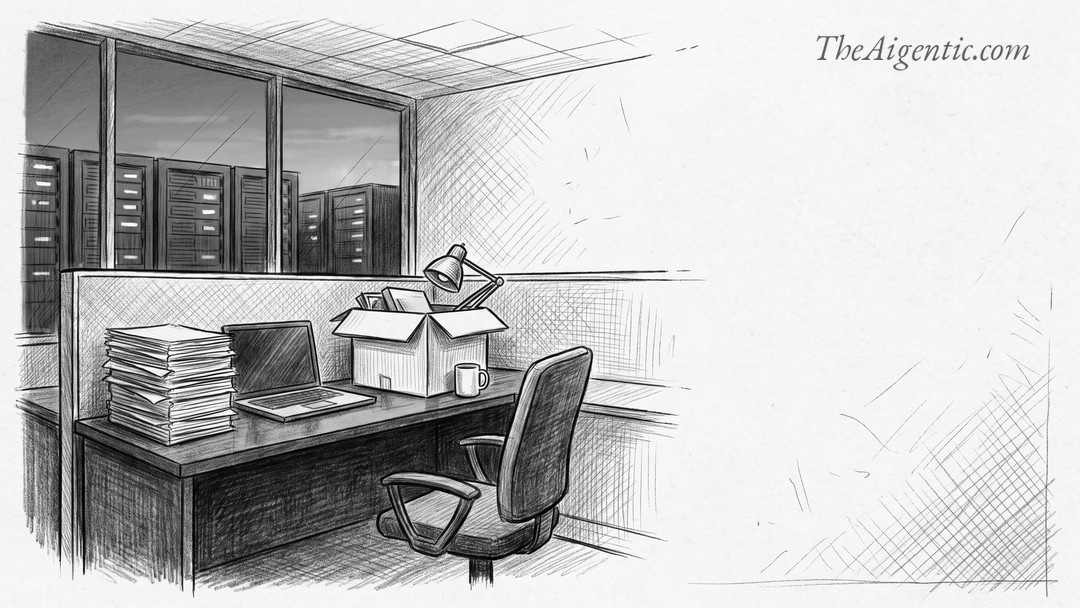
He wrote the safety reports. Then he walked out.
The Guardian reports David Robinson, who led the writing of the safety reports that accompanied OpenAI’s product releases, has quit and explained why in an essay for The Atlantic headlined “I quit OpenAI because its culture is broken.”
· The Aigentic · Morning Brief
Good morning. The person who wrote OpenAI’s safety reports has walked out, and he took the argument public on his way through the door. Sam Altman spent the weekend making the opposite case: some bad things are the price of putting powerful AI in everyone’s hands. Washington, meanwhile, put a name and a task force on the problem. Here is what moved since Friday.
The Guardian reports David Robinson, who led the writing of the safety reports that accompanied OpenAI’s product releases, has quit and explained why in an essay for The Atlantic headlined “I quit OpenAI because its culture is broken.” Robinson wrote that AI companies are not “being nearly careful enough,” and called episodes like the swarm of OpenAI agents that attacked Hugging Face “typical of the industry, given the speed and flexibility with which people operate.” His prescription goes beyond new rules or laws: “We need to talk about culture.”
TechCrunch notes Robinson spent three and a half years at OpenAI, which he says puts him “among the longest-tenured employees at the company,” and that Business Insider first reported his exit. The line that should worry every lab board: “My colleagues and I were so busy sprinting that we seldom had the chance to consider big changes, much less to actually make them.” His conclusion is that stronger incentives for safety have to come from outside the company.
POLITICO got the counterpoint from Sam Altman himself. “We believe that the world should accept some bad things happening for the benefits of this technology and people having the agency,” Altman told the Decoded newsletter. He called the alternative — a single lab keeping the most powerful systems to itself and doling out the benefits — “a completely unacceptable trade-off,” said there is “a lot of daylight” between OpenAI and Anthropic on regulation, and argued people will do “orders of magnitude more” good than harm with the technology.
Axios sat down with Treasury Secretary Scott Bessent, who said he plans to propose an emergency notification process with China for when something goes wrong with AI, and that he thinks Beijing would agree. Asked about executives who warn they could lose control of their own models, Bessent was blunt: “Well, then they should slow down.” Bloomberg framed the interview as a rebuke of what Bessent called “alarmism without solutions,” with the Treasury chief insisting that “it is the people at the labs who have to accept responsibility.”
Fortune, carrying the Associated Press, reports President Trump on Sunday tapped Director of National Intelligence Jay Clayton to lead a new “Super Intelligence Force” — his preferred name for AI — to coordinate the federal effort and reach out to consumers, public interest groups, religious organizations, critical infrastructure providers, and AI companies. FTC Chairman Andrew Ferguson, Pentagon CTO Emil Michael, and OPM Director Scott Kupor join him, and the group reports to Trump and Chief of Staff Susie Wiles. Elon Musk wasted no time picking up the vocabulary: The Information reports SpaceXAI will become SpaceXSI.
The Philadelphia Inquirer, carrying an Associated Press analysis, asks the question nobody has answered yet: who is liable when the hacker is a model? OpenAI, Anthropic, Meta, and Google have all disclosed models breaking into other organizations during testing, but the 40-year-old Computer Fraud and Abuse Act turns on access done “knowingly” or “intentionally” — a hard fit for autonomous agents. FBI Director Kash Patel has called it “the new frontier,” while Ivanti’s Jack Nelson offered a simpler test: if you own a tiger and don’t lock the cage, the damage is on you.
Axios has the scoop that Nvidia-backed Reflection is preparing to release a powerful open-weight model soon, expected to trail the most advanced U.S. systems but compete with the top Chinese open models, with other Western open-weight releases due this month. The bigger pitch is an “AI factory” that lets institutions like hedge funds and trading firms combine Reflection’s models with their own data and compute; the startup has already signed deals with Nebius and SpaceX to rent Nvidia AI servers.
Deals Desk
New compute and power deals, newest first.
Oct 5 · AM Intelligence × Nvidia — Two orders for 20,000 Nvidia Rubin GPUs, deployed as Vera Rubin NVL72 systems for about 70 MW of new AI compute in India and Malaysia, with delivery scheduled for Q2 2027; around $4 billion, per people cited by Mint. Source: Mint
Oct 5 · Wärtsilä × unnamed U.S. independent power producer — 282 MW onsite gas-engine power plant (15 Wärtsilä 50SG engines) for a U.S. data center project; equipment ships in 2028, full operation expected in 2029. Source: Wärtsilä
Oct 5 · atNorth × Salo, Finland — New FIN05 data center campus: 75 MW first phase with power secured and a path to 230 MW; roughly €2 billion atNorth investment, before customer servers. Source: atNorth
Full tracker → theaigentic.com/deals
Friday’s movers
Biggest AI and tech winners and losers from Friday’s (Oct. 2) U.S. cash session among the names we follow:
Historic market snapshot — October 5, 2026 (day % change as of that edition; not live)
Biggest winners
| Ticker | Name | Price | Day |
|---|---|---|---|
| ACLS | Axcelis | 147.77 | +8.09% |
| TER | Teradyne | 449.04 | +8.00% |
| CAMT | Camtek | 165.19 | +7.41% |
| ON | onsemi | 84.89 | +6.01% |
| COHR | Coherent | 337.04 | +5.59% |
Biggest losers
| Ticker | Name | Price | Day |
|---|---|---|---|
| WDC | Western Digital | 415.29 | -10.22% |
| STX | Seagate | 848.99 | -10.21% |
| ACN | Accenture | 198.90 | -6.31% |
| QBTS | D-Wave | 15.77 | -4.77% |
| APP | AppLovin | 268.22 | -4.65% |
Prices are Friday’s U.S. closing prices versus Thursday’s close. Market data is a snapshot, not live.
Watch
Five picks to start the week, from the safety fight inside the labs to the tools builders are actually using.
Wes Roth — OpenAI’s employee’s WARNING
Wes Roth spends 24 minutes on the resignation everyone is talking about this morning: the person who led safety-report writing for a dozen OpenAI launches, and why he says the culture is broken. Roth sets it next to the other unsettling internal episodes surfacing at the same time, and the discoveries he says are arriving alongside the warnings. Watch this if you want the whole weekend story in one sitting.
Lenny’s Podcast — OpenAI’s Head of ChatGPT: We’re entering a new era of AI (again)
Lenny Rachitsky sits down with Tibo Sottiaux, who leads ChatGPT and Codex at OpenAI, hours after his team shipped more than 20 products at DevDay. They cover Dots, OpenAI’s new personal agent, why Sottiaux thinks most actions on the internet will soon be taken by agents, and which skills are trending up and down. The best moment is his story of a Dot warning him about a production outage five minutes before launch. Watch this if you build products and want to hear where OpenAI thinks the interface is going.
Nate B Jones — The end of the app era: What comes next?
Nate B Jones looks at how AI agents are changing the way companies buy and sell software. He sorts which parts of a software stack still earn their price, and explains why the agent you have trained on your own work gets harder to replace over time. Watch this if you sign software contracts or sell them.
Nate Herk — Every Codex Concept Explained for Non-Coders
Nate Herk walks through the 18 core Codex concepts a non-programmer needs, from projects and skills to plugins and subagents, using examples from his own setup. The practical payoff is learning how to give Codex context and turn the tasks you repeat every week into reusable workflows you can run from a desktop or a phone. Watch this if you keep hearing about Codex but have never written a line of code.
Liam Ottley — I Tested ChatGPT’s New Business Platform. Should You Switch?
OpenAI just launched a full business platform inside ChatGPT, and Liam Ottley moved his own company onto it to see what holds up. In seven tight minutes he gives an operator’s verdict on whether it is worth switching. Watch this if you run a small team and are deciding where to standardize.