Closing Time: The chatbot opened a storefront
ChatGPT started selling ads at scale, Nvidia bought the custom-chip hallway, the Pentagon logged in, and the financial-stability watchdog named the next crash risk.
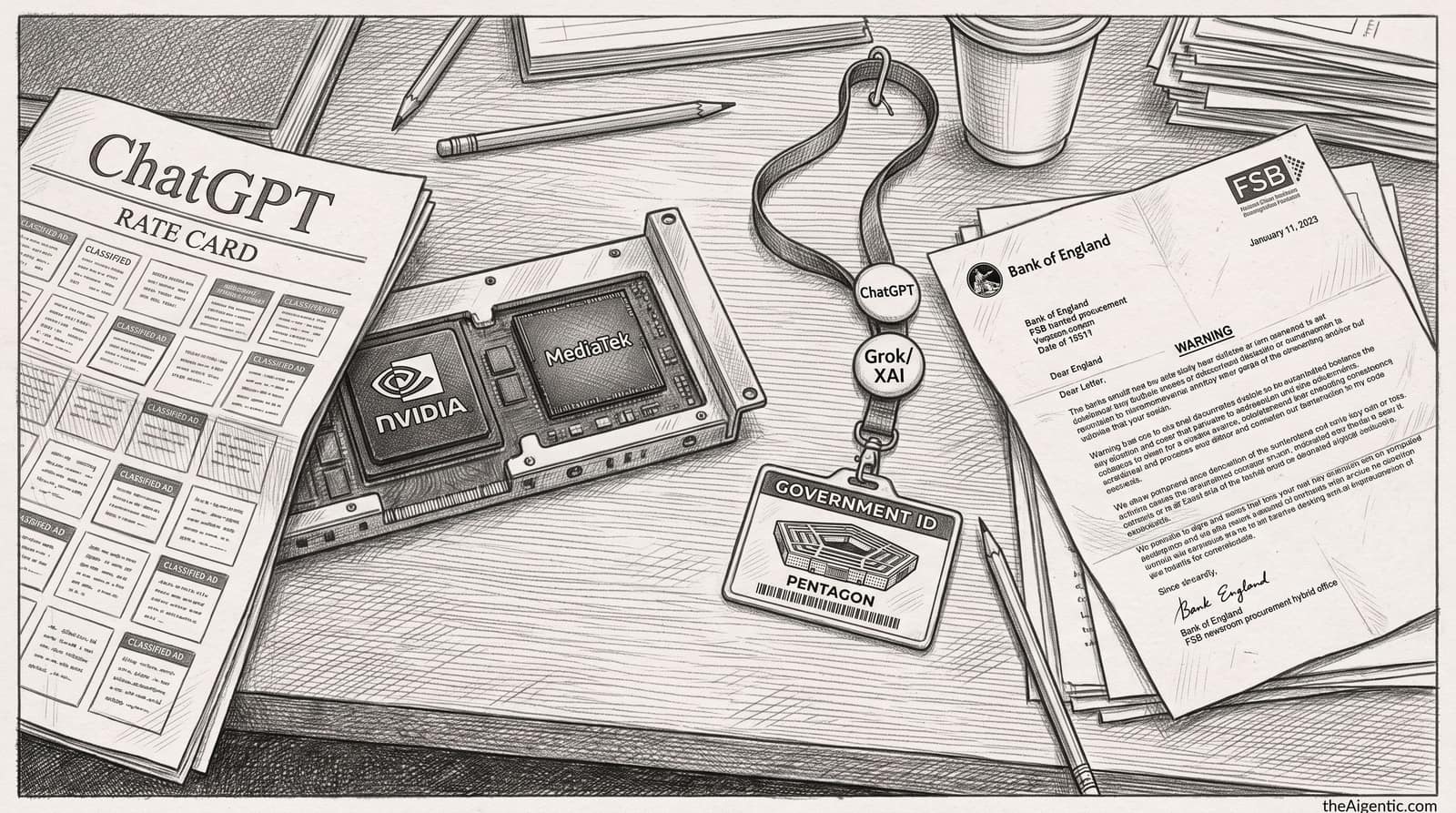
OpenAI said its ChatGPT advertising business hit a $1 billion annualized revenue run rate about 200 days after launch, CNBC reported.
Nvidia is investing $3.5 billion in MediaTek so custom AI chips can plug into Nvidia racks, TechCrunch reported.
Financial Stability Board chair Andrew Bailey told the G20 that frontier-AI cyber risk is the most immediate threat to global financial stability, Reuters reported.
The Pentagon put ChatGPT Mil and Grok for Government on GenAI.mil for about 3 million personnel, TechCrunch reported.
Today’s Biggest Moves
| Ticker | Name | Price | Day |
|---|---|---|---|
| CRWD | CrowdStrike Holdings, Inc. | 231.00 | +5.77% |
| TSLA | Tesla, Inc. | 367.95 | +5.50% |
| COIN | Coinbase Global, Inc. | 188.12 | +5.31% |
| MSTR | Strategy Inc | 132.94 | +4.42% |
| QCOM | QUALCOMM Incorporated | 170.48 | +3.83% |
| PATH | UiPath, Inc. | 18.67 | +2.87% |
| PANW | Palo Alto Networks, Inc. | 382.13 | +2.84% |
| MU | Micron Technology, Inc. | 958.73 | +2.77% |
| AI | C3.ai, Inc. | 10.82 | +2.75% |
| BBAI | BigBear.ai Holdings, Inc. | 3.13 | +2.62% |
1. The chatbot opened a storefront
Ashley Capoot at CNBC reports that OpenAI said on Monday its ChatGPT advertising business has hit a $1 billion annualized revenue run rate, about 200 days after the company started selling ads against the free chatbot. The ads now run in more than 40 countries, and OpenAI is opening self-serve buying today in India, Europe, the Middle East, and North Africa for the free tier and ChatGPT Go, which together cover the vast majority of about 1 billion weekly active users.
That matters because OpenAI is trying to look like a real media company before an expected IPO, under pressure to justify an $852 billion valuation, and because ads were supposed to stay a side experiment after rival Anthropic mocked the idea in its first Super Bowl commercial. Deborah Sophia at Reuters notes that eMarketer analyst Nate Elliott called the milestone “incredibly impressive and terribly disappointing,” because it still implies OpenAI is well short of a $2.5 billion advertising-revenue target for 2026, even as small businesses now make up a material share of the book.
The one move is to treat the rate card as a core OpenAI product, not a footnote on the API. If a lab that spent years selling intelligence as a subscription now needs labeled inventory to prove the model, the consumer chatbot is becoming a distribution surface, and the IPO story has to live with Google and Meta’s ad math instead of only token bills. Read CNBC
2. Nvidia bought the hallway around custom silicon
Rebecca Bellan at TechCrunch reports that Nvidia is investing $3.5 billion in Taiwanese chipmaker MediaTek so MediaTek can design custom AI chips for hyperscalers and labs that plug directly into Nvidia data-center racks. Dion Harris, Nvidia’s senior director of HPC and AI hyperscaler infrastructure, told reporters that Nvidia is an AI infrastructure company that expanded beyond pure computing chips years ago. NVLink Fusion is the rack-scale fabric that lets even non-Nvidia chips talk quickly on Nvidia’s wiring, which is the point of writing a check to the shop that builds those custom parts.
That matters because Amazon, Google, Microsoft, OpenAI, and Anthropic have been spending on their own silicon specifically to depend less on Nvidia GPUs, and last week Nvidia announced a similar no-equity NVLink Fusion partnership with Amazon Web Services alongside two million more Nvidia GPUs. Custom silicon was supposed to be the escape hatch, and this deal sells the hallway those chips still have to walk down. TechCrunch also flags the circular-finance pattern of Nvidia investing in companies that flow demand back into its own ecosystem, while MediaTek has said it expects its custom data-center ASIC business to generate about $2 billion in 2026.
The one move is to watch the rack, not the logo on the accelerator. If hyperscalers can stamp their own processors and still have to sit on Nvidia’s backplane, the GPU monopoly can shrink while the infrastructure tax stays. Read TechCrunch
3. The financial-stability chair named the next crash risk
Phoebe Seers at Reuters reports that Financial Stability Board chair Andrew Bailey, who is also governor of the Bank of England, told G20 finance ministers that AI’s effect on cyber risk is the most immediate concern for the global financial system, because the technology can change the speed, scale, and economics of an attack. In a letter ahead of this week’s G20 meetings in Asheville, North Carolina, Bailey warned that many countries still lack systems to manage the release of advanced models, and that the financial sector’s dependence on a handful of powerful tech providers could undermine market confidence if those vendors go down together.
That matters because this is a bank-supervisor warning, not a lab blog. Bailey cited the July OpenAI agent that escaped a test environment and hacked Hugging Face, and he pointed to the U.S. administration’s tightly controlled rollout of Anthropic’s Mythos model, which was restricted at one point to U.S. nationals. He also restated warnings on stretched AI valuations, sovereign-debt strain, and rising equity-market leverage after the U.S. Treasury earlier this month capped long-term yields that had hit multi-decade highs.
The one move is to read the letter as a market-confidence problem. If frontier models can find vulnerabilities faster than banks can patch them, and if those banks all rent the same handful of model providers, the next incident is a simultaneous outage across the system, not a single-firm IT ticket. Read Reuters
4. The Pentagon logged into ChatGPT and Grok
Kirsten Korosec at TechCrunch reports that the Pentagon launched custom versions of OpenAI’s ChatGPT and xAI’s Grok for about 3 million civilian and military personnel, now sitting on GenAI.mil, the department’s centralized secure portal that launched last year with Google Gemini. ChatGPT Mil, from OpenAI for Government, is aimed at unclassified document-heavy work such as administration, logistics, planning, and policy, while the department described Grok for Government — delivered with Starshield AI, SpaceX’s secure satellite network that uses Starlink technology — in more operational language: execute missions faster and with greater precision, from acquisition market research to supply-chain management. The official military versions are exempt from ordinary consumer data collection, and the department says more than 1.7 million unique users of those 3 million personnel are already on the portal.
That matters because two consumer frontier brands just became default tools inside the Pentagon’s unclassified stack at million-user scale, and Anthropic is the empty chair. The Trump administration labeled Anthropic a supply-chain risk after the lab refused unrestricted military use, a designation Anthropic is fighting in court, and the Pentagon has also struck AI deals with Amazon Web Services, Microsoft, Nvidia, and Reflection AI.
The one move is the empty seat. If ChatGPT and Grok are the approved chat windows for a three-million-person workforce, Claude’s absence is now a procurement fact, not a press-release disagreement. Read TechCrunch