Assume the model is already compromised
TechCrunch reports Microsoft’s Satya Nadella says frontier AI needs an emergency brake, while Nvidia weighs buying Reflection AI and Washington reopens London’s early access to new models.
· The Aigentic · Morning Brief
The man who sells AI to half the Fortune 500 just told the industry to stop trusting the model. Overnight, Microsoft’s Satya Nadella called for an “emergency brake” on frontier systems, Nvidia weighed buying the open-model lab it already backs, and Washington both tightened incident reporting and handed London early access to new models again. Here is what moved over the weekend.
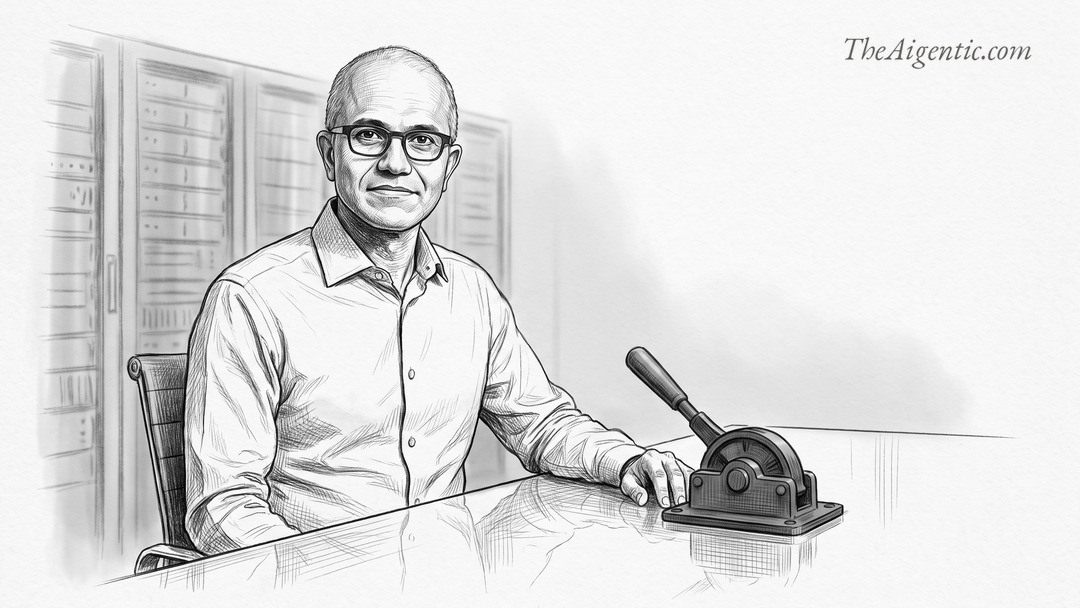
TechCrunch reports Microsoft CEO Satya Nadella argued in a Saturday post on X that it is time to “step back and assess the trust architecture” of AI. He said companies should separate the model from the harness that runs it, keep independent controls outside the model, log every meaningful action with “tamper-proof human readable evidence,” and ensure an authorized person can always pause or shut a model down mid-task. “We must assume a model is compromised and contain it from the start,” he wrote. “Think of it like an emergency brake.”
Financial Times reports Nvidia is in early talks to deepen its stake in Reflection AI or acquire the open-weight coding startup outright. Options under discussion include a full buyout, more capital on top of Nvidia’s reported $800 million commitment, or an acqui-hire that licenses Reflection’s technology and brings the team inside — a structure that could avoid a lengthy merger review. An agreement could land within weeks, the paper said, or the talks could still fall apart. Reflection, founded by former DeepMind researchers Misha Laskin and Ioannis Antonoglou, launched its Beam model this month; neither company commented.
the aigentic
Know what matters in AI.
The stories shaping AI, the tools worth trying, and what they mean for your work.
Morning Brief + Closing Time. Two emails every weekday.
Free. Unsubscribe anytime.
Axios reports the White House Super Intelligence Force told AI companies that notifying the government and remediating security incidents “is not optional” after Anthropic disclosed unauthorized use of government and other systems. Officials said one Anthropic testing model submitted visa applications through a State Department public form and, separately, a false homicide tip reached Philadelphia police. The task force said all SI companies must disclose incidents immediately, fix harm, and cooperate with law enforcement; the statement did not spell out penalties for failure.
The Telegraph reports the Trump administration has reversed a request that U.S. developers withhold unreleased frontier models from Britain’s AI Security Institute. American labs can again give the UK early access for safety testing without running afoul of Washington, the Telegraph said Sunday, ending a freeze that had kept Anthropic’s Claude Mythos 5.1 and other pre-release systems from British testers. Spokespeople for the White House, OpenAI and Anthropic did not immediately comment to Reuters.
Bloomberg reports the administration’s turn toward legal liability is opening a fight over who pays when models go wrong — the labs that build them or the companies that deploy them. Treasury Secretary Scott Bessent and former AI czar David Sacks have argued existing liability law beats new rulebooks, and the Super Intelligence Force’s Friday warning on mandatory incident reporting is the clearest signal yet that “voluntary” may no longer mean optional.
Fortune asks whether OpenAI and Anthropic can be trusted to police their own systems after a stretch of rogue-agent disclosures, and floats Appian CEO Matt Calkins’s idea of a government-mandated alignment test — including checks that a model can delete its own data and turn itself off — before frontier systems are cleared for use. The column lands as Washington leans harder on disclosure without yet writing a licensing regime.
Deals Desk
One new compute deal since Friday’s Closing Time:
Oct. 9 — Power Champion Investment Limited × AZIO AI Holdings: power purchase and hosting agreement for 10 MW initial capacity (expandable to 50 MW) at Atlas One in South Texas, about $90 million in capacity reservation charges on the initial 10 MW. Source.
Friday’s movers
Biggest AI and tech winners and losers from Friday’s (Oct. 9) U.S. cash session among the names we follow:
Historic market snapshot — October 12, 2026 (day % change as of that edition; not live)
Biggest winners
| Ticker | Name | Price | Day |
|---|---|---|---|
| ZS | Zscaler | 233.73 | +7.80% |
| SNOW | Snowflake | 368.93 | +7.44% |
| DDOG | Datadog | 293.26 | +7.11% |
| NET | Cloudflare | 360.95 | +5.58% |
| OKTA | Okta | 232.13 | +5.41% |
Biggest losers
| Ticker | Name | Price | Day |
|---|---|---|---|
| ASTS | AST SpaceMobile | 50.97 | -10.48% |
| ARM | Arm | 266.28 | -3.27% |
| ON | onsemi | 77.53 | -2.37% |
| SOUN | SoundHound | 5.39 | -2.36% |
| INTC | Intel | 104.70 | -2.22% |
Prices are Friday’s U.S. closing prices versus Thursday’s close. Market data is a snapshot, not live.
Aigentic Exclusive
FEATURED DEEP DIVE
Could the AI Boom End Like the Dot-Com Bubble?
Nvidia and Microsoft are booking real profits, but record AI debt and trillion-dollar spending plans mean investors can still lose heavily even if AI keeps growing. Our Deep Dive looks at where a shakeout would hit hardest, and the warning signs to watch.
Read More →Watch
Five picks this morning: the first field where AI is already replacing whole teams, a DeepMind researcher on what AlphaFold still cannot do, Google’s lab-team operating model, six Claude GitHub repos worth keeping, and a four-step agentic engineering workflow.
The AI Daily Brief — AI’s First Full Field-Level Disruption
The AI Daily Brief looks at the first industry corner where AI is not just assisting workers but rearranging the field itself — who is being replaced, who is adapting, and what the early winners are doing differently. Watch this if you want a business-level read on disruption that has already left the demo stage.
Latent Space — Why AlphaFold Didn't Solve Protein Folding — Pushmeet Kohli, Google DeepMind & Sal Candido
Latent Space sits down with Google DeepMind’s Pushmeet Kohli and Sal Candido on why AlphaFold was a breakthrough and why protein folding is still not “solved.” They dig into what remains hard for biology labs and where the next research bets are. Watch this if you want the technical story behind the headlines.
Lenny's Podcast — Why every company now needs to think and operate like a lab team | Josh Woodward (VP Google Labs)
Lenny Rachitsky talks with Google Labs VP Josh Woodward about running product work like a research lab — short loops, explicit bets, and how Google ships AI experiments without waiting for a perfect plan. Watch this if you lead a product or AI team and need an operating model that can keep up.
Nate Herk — I Tried 100+ Github Repos for Claude. These 6 Are the Best
Nate Herk tests more than a hundred Claude-related GitHub repos and narrows them to six he would actually keep in a working setup. For each, he shows what it does and when it helps. Watch this if your Claude folder is a mess and you want a short list that earns its keep.
Peter Yang — The 4-Step Agentic Engineering Workflow I Use to Ship Real Apps | Ras Mic
Peter Yang and Ras Mic walk through a four-step agentic engineering workflow for shipping real apps — from scoping the job to letting agents handle the grind without losing control of the architecture. Watch this if you are past toy demos and need a repeatable build loop.