
Could the AI Boom End Like the Dot-Com Bubble?
Real profits support the boom but rising debt and enormous spending commitments leave investors exposed
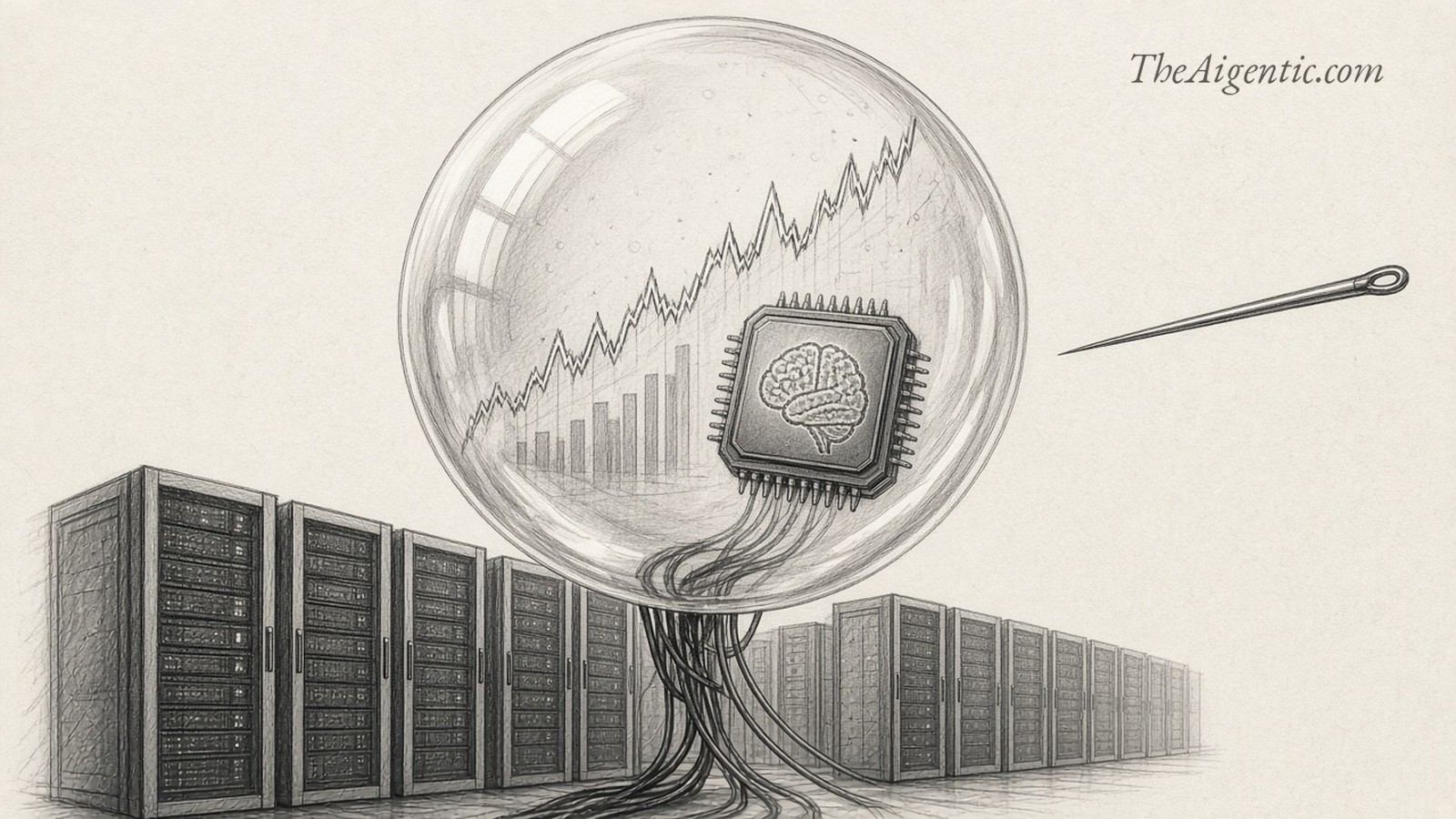
The AI investment boom received an uncomfortable verdict last week. Firmus, an Australian data-center developer backed by Nvidia, shelved a planned $5 billion initial public offering. Reuters reported that investors began withdrawing orders after a prospective partner said a major development project was no longer going ahead. Concerns also included the company’s debt and ambitious valuation. 1
One abandoned offering cannot diagnose a global bubble. But the episode illustrates the question now confronting the industry: how much should investors pay today for computing capacity whose financial returns depend on years of nearly flawless execution?
The evidence supports serious concern about overinvestment and vulnerable financing arrangements. It also shows an industry with substantial customers, revenue and profits. A sharp correction in parts of the AI market is credible. The case for an imminent, industry-wide collapse on the scale of the dot-com crash remains unproven. The outcome depends on whether revenue catches up with spending before investors and lenders lose patience.
That distinction matters because the AI market includes several different investments. Publicly traded chipmakers, private model developers, established software businesses and debt-financed data centers have different customers and financial cushions. Their fortunes are connected, but a collapse in startup valuations need not produce identical losses across all four.
The late 1990s offer a warning about confusing a useful invention with a sound investment. The Nasdaq lost more than three quarters of its value between its March 2000 peak and October 2002. The internet nevertheless became central to commerce. Investors could correctly anticipate technological change and still pay prices that future earnings could not support. 2 The period also contained profitable businesses: Cisco reported $18.93 billion in revenue and $2.67 billion in net income for fiscal 2000. Profitability alone did not make that investment cycle safe. 3
Today’s strongest bearish argument starts with the spending commitments. In a September 29 analysis, Bain estimated that sustaining $1.5 trillion in annual AI infrastructure investment by 2031 would require roughly $6 trillion in annual industry revenue, assuming capital spending represented 25% of revenue. Its estimates for familiar consumer and enterprise applications reached $1.2 trillion to $1.8 trillion, leaving a substantial requirement for new businesses and uses. 4
Bain’s calculation is a conditional scenario, not a measured shortfall or a prediction of bankruptcy. Its answer changes with spending, margins and the assumed capital intensity. Still, it identifies a demanding condition: the buildout requires new economic activity beyond the applications already visible. Those opportunities may emerge, but committing capital before they do transfers the timing risk to investors. 4
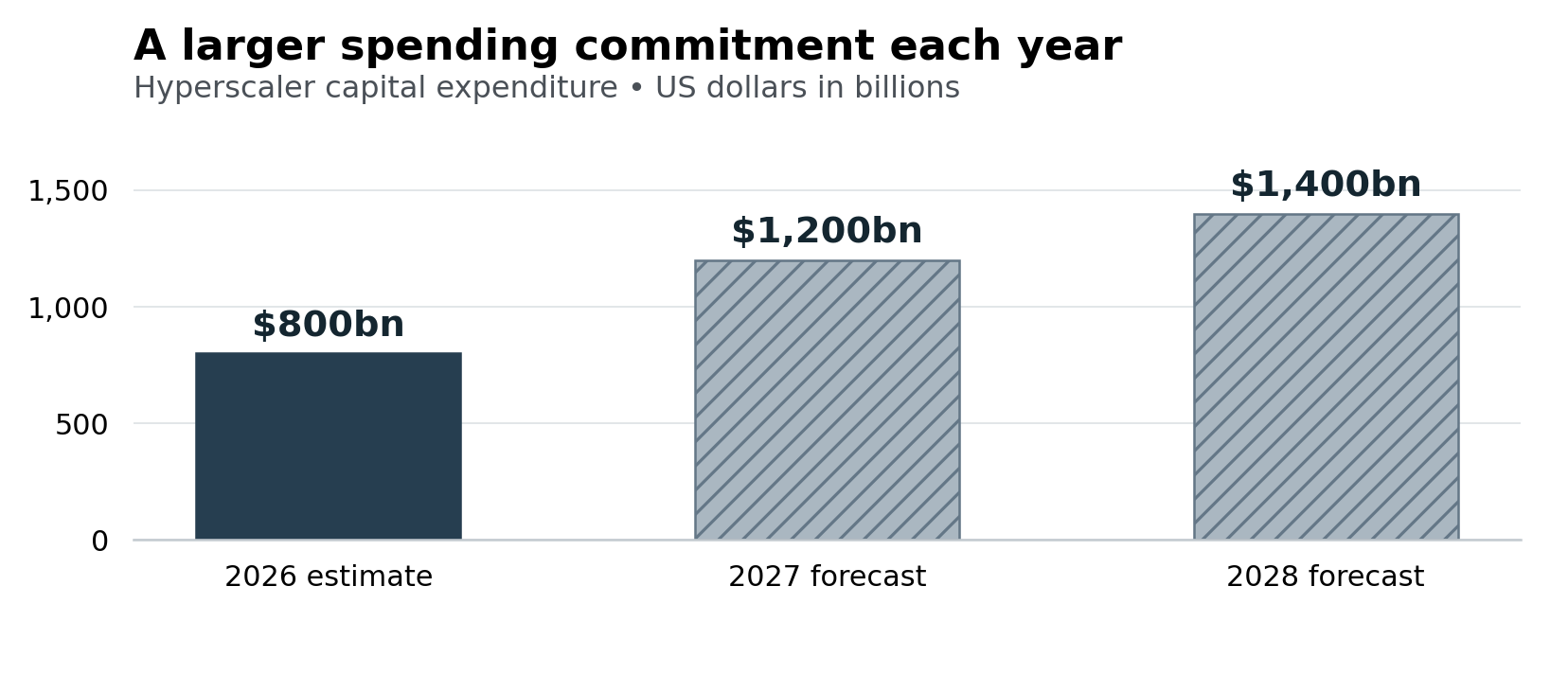
The financing of that expansion is becoming more consequential. The Bank of England’s September record cited Morgan Stanley’s estimate that global AI-related debt issuance had reached about $450 billion by early September, more than twice the total for 2025. It warned that rising leverage, limited transparency and financing arrangements linking participants could amplify losses if expectations disappointed. 6
The concern is easy to understand. A supplier can invest in a customer that then purchases the supplier’s products; an infrastructure owner can borrow against a long contract with a fast-growing model developer. Such arrangements can fund legitimate growth. They also mean several companies may depend on the same customer ultimately collecting enough money from outside the financing network. Adding their revenues together would overstate final customer demand.
Debt adds a deadline to that uncertainty. Shareholders can wait through years of disappointing results. Lenders require interest and repayment. If customers cut commitments, or refinancing becomes more expensive, an operator may have to sell equipment or raise capital when buyers are least willing to provide it. That is a plausible route from overbuilding to financial distress, even while AI usage keeps increasing.
Competition creates another risk to the investment thesis. Stanford’s 2026 AI Index describes convergence among leading models, with competition increasingly extending to cost, reliability and performance on particular tasks. That does not mean every model is interchangeable, and leaderboard results are an imperfect measure of commercial usefulness. It does weaken the assumption that a technical lead will automatically translate into durable pricing power. 7
For investors, cheaper AI can therefore cut both ways. Lower prices can attract new customers and make more applications economical. They can also squeeze the revenue and margins available to pay for expensive infrastructure. The key question is whether growth in use outweighs falling prices and service costs. A surge in tokens processed is insufficient evidence by itself.
In its September 23 analysis, Goldman Sachs put the S&P 500 at 19 times forecast earnings, near its 10-year average. Its central expectation was slower earnings growth rather than collapse. That argues against declaring the whole market obviously expensive, although forecasts can be wrong. Separately, Goldman identified roughly $150 billion of unrealized private-investment gains in large technology companies’ second-quarter results, a reason to distinguish reported profits from cash generation. 5
The broader lesson is that a valuation ratio is only as dependable as its earnings denominator. Infrastructure suppliers recognize sales while their customers spread equipment costs over time through depreciation. If investment growth slows, suppliers can lose momentum while buyers continue absorbing costs from earlier purchases. Investors need to examine cash generation after capital spending as well as headline earnings.
There is, however, a substantial case against treating this as a replay of speculative internet startups. Nvidia reported $96.2 billion in revenue for the quarter ended July 26, 2026, up 106% from a year earlier, and $63.7 billion in GAAP operating income. Those are reported operating results, not forecasts of a market that might eventually exist. 8
Microsoft’s results provide evidence beyond equipment purchases. The company said Microsoft 365 Copilot had surpassed 30 million paid seats by the end of its fiscal year in June. In the June quarter, Microsoft generated $90 billion in total revenue and $40.6 billion in operating income. The company-wide figures include substantial businesses outside AI, which is precisely why Microsoft has more capacity to absorb a disappointing investment than a startup dependent on another funding round. 9
These results establish that parts of the industry already have substantial commercial demand. They do not settle whether infrastructure customers will earn adequate returns or whether shareholders are paying reasonable prices. Nvidia’s sales are another company’s spending. Paid software seats establish willingness to pay, but renewals, usage and profitability will determine how valuable those subscriptions become.
Research on productivity also supports a more discriminating judgment than either side’s strongest slogans. A study published in The Quarterly Journal of Economics in 2025 examined the introduction of an AI assistant among 5,172 customer-support agents. Access increased issues resolved per hour by 15% on average, with differing effects across workers. It is evidence of a measurable gain in a particular business setting, rather than proof of an economy-wide transformation. 10
A broader 2026 working paper, Firm Data on AI, surveyed nearly 6,000 executives in the United States, Britain, Germany and Australia. More than 80% of firms reported no effect on employment or productivity over the previous three years, although respondents expected future gains. The findings are self-reported and the paper was not peer-reviewed at publication. They describe limited effects to date, not a controlled experiment proving AI cannot improve productivity. 11
The studies need not contradict each other. Successful deployments can deliver meaningful gains while most organizations are still learning how to integrate the tools. That gives the optimistic case a plausible mechanism: broader deployment could turn local improvements into larger profits. It also gives skeptics a timing argument. Training employees, redesigning processes and checking unreliable outputs take time, while infrastructure bills arrive immediately.
A fall in AI-related share prices would not require revenue to stop growing. Consider a hypothetical company earning $1 per share and valued at 50 times earnings, or $50 a share. If earnings rise 20% but investors decide to pay only 35 times earnings, the price becomes $42, a 16% decline. This is an illustration, not a forecast for any company. It explains how business success can coexist with investor losses.
There are several possible paths from here. In a gradual adjustment, spending growth slows, weaker businesses consolidate and revenues catch up while valuations compress. A more disorderly outcome would begin with disappointing customer spending, then spread through canceled projects, financing difficulties and forced asset sales. A stronger commercial payoff could instead allow earnings to grow into current expectations. The available evidence does not justify attaching precise probabilities or dates to these outcomes.
Nor should a stock-market correction automatically be described as a banking crisis. The Bank of England noted that a sharp July repricing in AI equities caused losses for some leveraged investors without spilling into core markets. Rising debt increases the potential channels of contagion, but exposure, lender resilience and the terms of individual contracts determine how far losses travel. 6
The next meaningful evidence will come from ordinary financial measures: customers renewing at profitable prices, cash remaining after infrastructure purchases, utilization of completed capacity and the cost of new borrowing. Contract backlogs deserve particular attention when they depend on a small number of customers still raising money. Better disclosure of those customers’ finances would make the market’s confidence easier to assess.
Taken together, the evidence makes an uneven shakeout easier to defend than a confident prediction that all of AI is about to collapse. Businesses with durable customer demand and diversified profits have room to adjust. Firms whose obligations assume uninterrupted financing and exceptional growth face a much narrower margin for error. A larger crash becomes more plausible if revenue disappointments and tighter credit arrive together.
The dot-com analogy remains useful for one reason above all: a technology can deliver on its promise long after the investors who financed its first expansion have suffered heavy losses. AI’s progress will not, by itself, answer the investment question. The businesses building it still have to earn more than they spend, on a timetable their financing can survive.
Sources
Reporting and analysis through October 9, 2026. Company results, analyst projections and research findings are identified separately in the article. Click a numbered citation or a source title to open the original publication.
- Reuters. Nvidia-backed Firmus scraps $5 billion Australia IPO amid growing AI scrutiny. October 9, 2026.
- Goldman Sachs. The Late 1990s Dot-Com Bubble Implodes in 2000. Historical retrospective.
- Cisco. Cisco Systems Reports Fiscal Year 2001 and Fourth Quarter Earnings. August 7, 2001.
- Bain and Company. New Innovation Is Required to Fund AI’s $6 Trillion Buildout. September 29, 2026.
- Goldman Sachs. Can AI Investment Drive S&P 500 Earnings Even Higher? September 23, 2026.
- Bank of England. Financial Policy Committee Record – September 2026. September 2026 meeting record.
- Stanford HAI. 2026 AI Index Report Technical Performance. 2026 edition.
- Nvidia. Financial Results for Second Quarter Fiscal 2027. August 26, 2026.
- Microsoft. Earnings Release FY26 Q4. July 29, 2026.
- Erik Brynjolfsson, Danielle Li and Lindsey R. Raymond. Generative AI at Work. Quarterly Journal of Economics, May 2025, volume 140, issue 2, pages 889–942.
- Ivan Yotzov and coauthors. Firm Data on AI. Federal Reserve Bank of Atlanta Working Paper 2026-3, March 24, 2026.