
TIME left Jensen Huang off its AI 100. Credibility check?
TIME’s 2026 TIME100 AI list skips Nvidia CEO Jensen Huang after three straight years on it. Paris Hilton and Bernie Sanders made the cut. Has the list lost the plot?
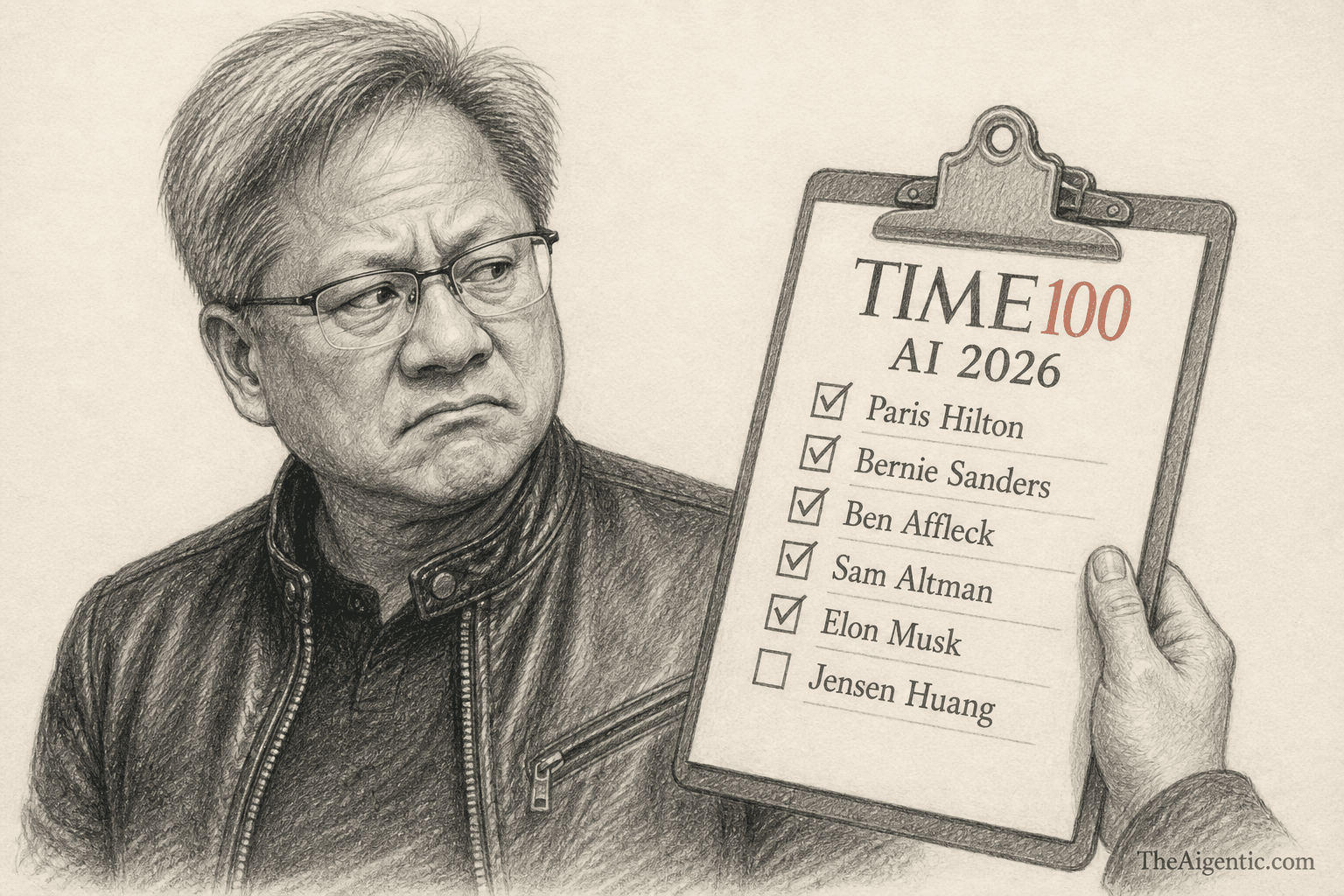
TIME’s 2026 TIME100 AI is out: one hundred “most influential people in artificial intelligence,” sorted into Leaders, Innovators, Shapers, and Thinkers. Sam Altman, Greg Brockman, Elon Musk, and the Amodeis are on it. Nvidia CEO Jensen Huang is not.
This is not a trivia miss or a trivial miss. Huang was on TIME100 AI in 2023, 2024, and 2025. TIME also bundled him into its 2025 “Architects of AI” / Person of the Year framing. Nvidia’s GPUs still sit under almost every serious training and inference stack. One fair reading of influence puts him in the top ten. A harder reading puts him in the top five. Leaving him off a hundred-person AI list is the kind of editorial choice that asks whether the magazine is measuring power or programming a vibe.
What TIME put on the board instead
The list still has plenty of lab and infrastructure names. It also has culture and politics entries that drove the online reaction: Paris Hilton (deepfake advocacy), Bernie Sanders (AI jobs, data-center, and superintelligence warnings), and Ben Affleck (AI film tooling via InterPositive). Gizmodo put the contrast cleanly: the picks-and-shovels CEOs are the real power brokers, even when a magazine would rather spotlight pop culture.
Huang is not the only heavy absence. Reporting across LavX, Tom’s Hardware, and Times of India also flags Lisa Su, and notes other prior fixtures (Zuckerberg, Hassabis, and more) cycling off as TIME refreshes the roster. Nvidia’s presence, in some accounts, shrinks to infrastructure and sustainability voices rather than the CEO who productized the AI accelerator era.
TIME’s own framing, via editor-in-chief Sam Jacobs and senior editor Ayesha Javed, is that the list captures “the year’s key storylines,” not a permanent Hall of Fame. Fine. Storyline curation is still a credibility test when the year’s most obvious industrial fact is that nothing scales without Nvidia silicon.
What people are saying on X
The snub did not need a press release to travel. Here are a few of the posts that set the tone.
Nina Schick put the hierarchy problem in one punch: Sanders made the list, Huang did not, and data-center politics apparently outranked the hardware layer.
Investor-side accounts treated it as comedy. FIRED Up Wealth posted the omission with clown-face energy and a reminder that Huang had been on the prior three editions.
Brand and culture voices asked how Hilton lands on the same board as Musk and OpenAI leadership while Huang is gone.
Replies to @TIME made the same point; smaller accounts sharpened the absurdity further (miloctseng). Polymarket threads filled with people asking Grok to confirm the omission was real. It was. The debate was not “did TIME forget a spelling.” It was “what does influential mean if the GPU monopoly’s founder is optional.”
So: has TIME lost all credibility?
Not all. A magazine can decide that 2026’s AI story is governance, labor, deepfakes, and new faces. Refreshing a list is legitimate. Crediting Hilton for deepfake advocacy or Sanders for forcing a political fight about data centers is coherent as politics and culture coverage.
What fails the credibility test is pretending that framing is interchangeable with a ranking of who actually moves AI. Influence that ships FLOPS is still influence. Huang’s company is the clearinghouse for training compute; export controls treat its chips as strategic; hyperscalers plan CapEx around its roadmaps. If that person is outside your top 100 in AI, you are no longer describing the industry. You are describing the newsroom’s preferred cast list.
Call the list what it is: an annual narrative package. Do not confuse it with a map of who holds the stack.