
How Dartmouth Became the Birthplace of AI
A modest grant and an ambitious summer gathering helped establish a field whose hardest questions remain unsettled seventy years later
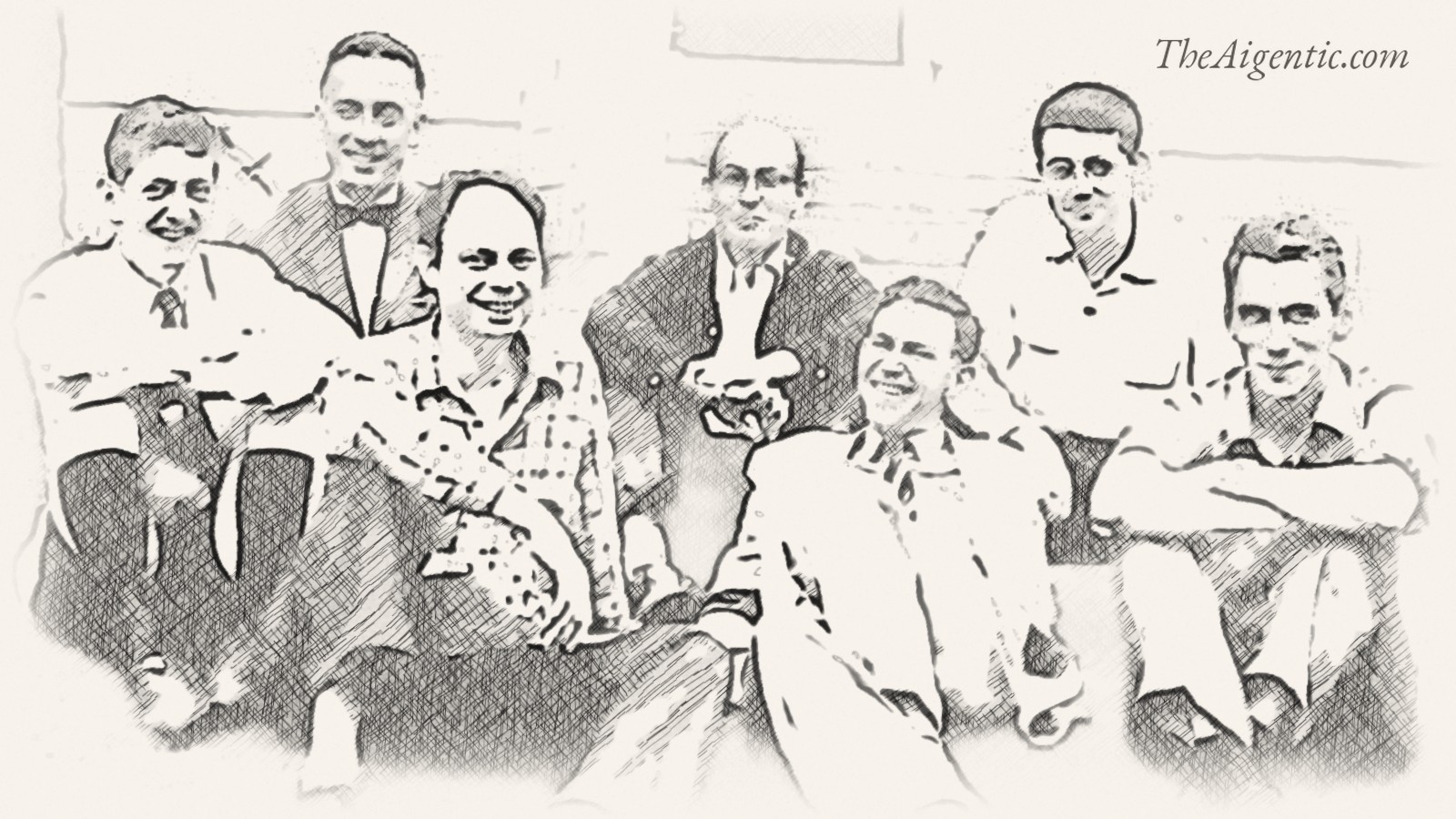
The research proposal that helped launch artificial intelligence included money for railway fares, rent and a secretary.
In 1955, John McCarthy and three colleagues asked the Rockefeller Foundation for $13,500 to bring researchers to Dartmouth College the following summer. The foundation offered $7,500. Robert Morison, the foundation official handling the request, described the undertaking as a “modest gamble” and explained that the possibilities were still difficult to grasp.
Seventy years after that gathering in Hanover, New Hampshire, Dartmouth’s claim to be the birthplace of AI has become an enduring part of the technology’s history. It is a reasonable claim, provided we understand what was born there: a research field organized around the possibility of machine intelligence. The ideas had earlier roots, and the meeting itself was considerably messier than its reputation suggests.
That untidiness makes the story more useful. The researchers shared an extraordinary ambition, disagreed about how to pursue it and underestimated the work ahead. Their experience offers a way to think about AI’s progress without assuming either that every promise will come true or that every disappointment disproves the enterprise.
McCarthy, a Dartmouth mathematics professor, organized the project with Harvard’s Marvin Minsky, IBM’s Nathaniel Rochester and Claude Shannon of Bell Telephone Laboratories. The college supplied the setting for an effort that crossed institutional boundaries.
Their proposal, dated August 31, 1955, gave the project its name: the Dartmouth Summer Research Project on Artificial Intelligence. It called for ten researchers to work for two months on the premise that learning and other features of intelligence could be described precisely enough for a machine to reproduce them.
The distinction between the dates matters. McCarthy introduced the term in the proposal in 1955; the gathering followed in 1956. In a later recollection, he explained that the name was chosen to “nail the flag to the mast.” He wanted to focus attention on making machines behave intelligently, a subject he felt had received too little attention in a collection of papers he had coedited with Shannon.
Naming the field gave its advocates a clear position to defend. They were proposing that activities associated with the human mind could become subjects of experimental engineering. A sufficiently precise account of intelligence might allow someone to build it. That was an expansive research commitment, with no guarantee that the proposed methods would deliver.
By then, several researchers had already supplied reasons to take the possibility seriously. In 1943, Warren McCulloch and Walter Pitts published a mathematical account of simplified nerve cells and the logical operations networks of them could perform. Their work connected reasoning with a model of the nervous system more than a decade before the Dartmouth meeting.
Alan Turing approached the problem from another direction. His 1950 paper, “Computing Machinery and Intelligence,” described an imitation game in which a questioner would try to distinguish a computer from a person through written exchanges. The proposal shifted attention toward behavior that could be tested: what answers could a machine produce, and could a person tell the difference?
Those earlier contributions complicate any account of AI as an invention made at one place and time. Neural models, mathematical logic and questions about machine behavior were already in circulation. Dartmouth helped draw such work into an identifiable field. Its historical importance comes from that organizing role, alongside the technical work presented there.
The summer did not unfold as McCarthy had hoped. Participants arrived at different times and stayed for different periods. Many continued pursuing their own projects. In his account of the fiftieth-anniversary conference in 2006, Dartmouth philosopher James Moor reported that the original gathering had produced no agreement on a general theory of intelligence or learning.
In Dartmouth Hall, the participants were still working out what a successful approach would look like. Their common ground was the belief that computers could perform intelligent tasks. Even the terminology was unsettled: Moor recorded that participant Trenchard More disliked both “artificial” and “intelligence” as names for the field.
There were, nevertheless, specific ideas worth carrying away. Allen Newell and Herbert Simon visited for a few days to present the Logic Theory Machine, work developed with Cliff Shaw. McCarthy later called Newell and Simon the “stars of the show.” Their presentation included a way to represent information in lists, an idea that caught his attention.
The Logic Theory Machine explored whether a computer could find proofs in symbolic logic. As Newell and Simon described it in their 1956 RAND paper, the system used heuristics: methods for choosing promising steps without exhaustively trying every possibility. This was an attempt to turn a recognizable form of human problem-solving into a procedure a computer could follow.
It also shows why the birthplace metaphor needs care. Researchers brought developing work to Dartmouth from elsewhere. Their exchanges mattered, but those projects had their own origins. The meeting helped establish a community around such efforts; it did not make one institution the source of every advance that followed.
The original research agenda is strikingly familiar. The organizers wanted computers to handle language and concepts, and considered how machines might improve themselves. Neural networks were explicitly included. They identified several problems associated with today’s AI while working with a fraction of today’s computing resources.
That continuity can be misleading, however. Recognizing a problem is a different achievement from finding a practical way to solve it. An early proposal about machine language does not amount to a design for a modern language model. Between the aspiration and the working system lie choices about representation, training, computing resources and how to measure success.
Deep learning illustrates how much the methods changed. In their 2015 review in Nature, Yann LeCun, Yoshua Bengio and Geoffrey Hinton described systems that learn representations through multiple layers of processing. Training adjusts the systems’ internal parameters using data. They documented major gains in areas including speech recognition and image recognition.
That approach lets a system learn useful features from examples instead of requiring a programmer to specify every feature in advance. It provides one answer to a question the Dartmouth group had left open: how a machine might extract useful structure from the information it receives. It does not, by itself, settle every question about intelligence.
Another advance came in 2017, when Ashish Vaswani and seven co-authors introduced the Transformer in “Attention Is All You Need.” Their paper demonstrated a new neural-network architecture on translation tasks, with advantages in quality and training efficiency. The work supplied a concrete method that the Dartmouth proposal, written more than six decades earlier, could not have specified.
Seen in this light, Dartmouth’s place in AI history is compatible with giving full credit to later discoveries. The 1956 gathering established an ambition broad enough to survive substantial changes in technique. Progress depended on researchers finding better ways to pursue it, including approaches that differed from the preferences of some of the founders.
The timetable was another matter. Looking back in 2006, McCarthy joked that when people asked how optimistic he had been in 1956, he could often answer that he had hoped for human-level AI before they were born. He then made a more sober observation: estimates of how long a task will take depend on which obstacles have been recognized. Some obstacles had been overcome, others remained, and still others had yet to be identified.
That observation is a useful test for claims about what AI will do next. A demonstration can establish that a system performs a particular task under particular conditions. Predicting how soon it will work reliably across unfamiliar situations requires understanding the obstacles that the demonstration may never encounter. A successful example and a dependable forecast ask different things of the evidence.
The same history offers a reason to take ambitious research seriously. The Rockefeller Foundation could not know what its grant would eventually help establish. It supported a bounded investigation of a difficult question. Its caution left room for work whose value would take much longer to become clear.
For readers trying to make sense of AI now, Dartmouth’s most useful legacy may be permission to hold two judgments at once. A technical result can be impressive on its own terms, while the larger claim attached to it remains unproven. Recognizing that distinction allows enthusiasm to follow the evidence without making every advance a verdict on the future of human intelligence.
At the 2006 anniversary gathering, Minsky offered a practical standard for the field he had helped establish. As Moor recounted, he argued that AI could become a science only if researchers published what failed as well as what succeeded. Seventy years after Dartmouth, that remains a demanding measure of progress.
Reporting sources
Primary documents and historical accounts used in the article
- The original Dartmouth research proposal
John McCarthy, Marvin Minsky, Nathaniel Rochester and Claude Shannon, August 31, 1955. The project’s aims, proposed participants, agenda and budget. - Rockefeller Archive Center on the Dartmouth grant
Barbara Shubinski, “A Roomful of Brains.” Includes the requested and awarded funding and Robert Morison’s November 30, 1955 letter. - Dartmouth on the founding of the field
Dartmouth College, “Artificial Intelligence (AI) Coined at Dartmouth.” Institutional account of the 1956 gathering. - McCarthy on what happened at the workshop
John McCarthy, “The Dartmouth Workshop—as planned and as it happened,” 2006. A participant’s retrospective on the name, attendance and presentations. - McCulloch and Pitts on neural models
Warren S. McCulloch and Walter Pitts, “A logical calculus of the ideas immanent in nervous activity,” 1943. - Turing on machine intelligence
Alan Turing, “Computing Machinery and Intelligence,” 1950. Reprinted in The Essential Turing; Oxford Academic’s introduction explains the imitation game. - The fiftieth anniversary and the founders’ recollections
James Moor, “The Dartmouth College Artificial Intelligence Conference: The Next Fifty Years,” AI Magazine, 2006, pp. 87–91. - The Logic Theory Machine
Allen Newell and Herbert A. Simon, RAND paper P-868, 1956. Describes the system’s approach to finding proofs. - How deep learning learns from data
Yann LeCun, Yoshua Bengio and Geoffrey Hinton, “Deep learning,” Nature, 2015. Abstract available through PubMed. - The Transformer paper
Ashish Vaswani and co-authors, “Attention Is All You Need,” 2017. Google Research publication page. - McCarthy on optimism and unrecognized obstacles
John McCarthy, “50 Years and Counting,” 2006.