Closing Time: The hidden power inside old reactors
Google signed a 20-year deal for 890 megawatts of new nuclear output from upgrades at 11 Constellation Energy reactors, with the first upgraded power due in 2028.
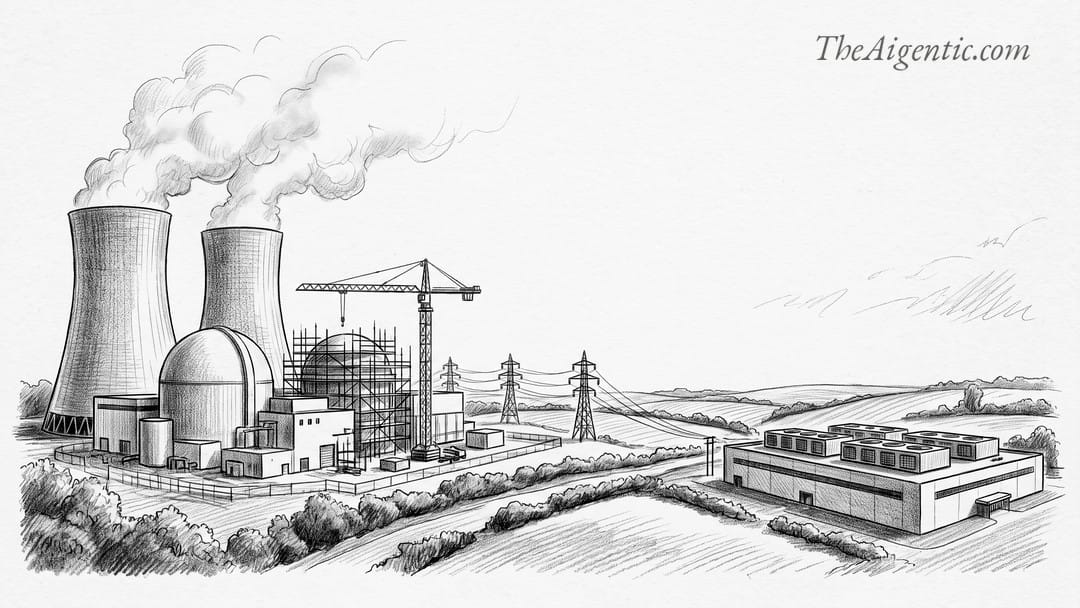
Google just found a new way to buy nuclear power: pay to make the reactors that already exist run harder. The company signed a 20-year deal for 890 megawatts of new nuclear output from upgrades at 11 Constellation Energy reactors in Illinois, Pennsylvania and New Jersey, with the first upgraded power due in 2028, per CNBC. On top of that, Google contracted another 2,700 megawatts from Constellation that isn’t tied to any one plant, bringing the package to 3,590 megawatts and more than $4.3 billion of new investment.
The trick is that no new reactor has to be licensed or built. New turbines, steam generators and control systems squeeze more electricity out of plants already on the grid — one of the fastest ways to add clean, around-the-clock power for data centers. Google laid out its case for backing America’s existing fleet in a company post, and the companies said the deal responds directly to a proposal from PJM, the 13-state grid operator, that would make data centers bring their own power or risk being cut off at peak demand.
Wall Street got the message. Constellation closed up 12.2% at 300.40, the best performer among the AI and tech names we track. Vistra rose 10.8% as investors looked for the next nuclear fleet to cash in, a day after the Energy Department offered it a conditional loan of up to $4.2 billion to uprate its reactors in Pennsylvania and Ohio. The market is now paying up for anyone who can deliver firm power to the AI buildout.
Bloomberg reports OpenAI is in talks with a syndicate of UAE funds, including Abu Dhabi’s MGX, to anchor a $30 billion round, with the Emirati investors discussing as much as $10 billion and BlackRock also in talks. OpenAI is presenting a roughly $1.4 trillion pre-money valuation as a fixed price before it even has a lead investor, after raising at $852 billion in March.
CNBC says Meta, Walmart, Stripe, Shopify and Bret Taylor’s Sierra are publishing a “personal agent protocol,” an open standard for how AI agents identify themselves and act on a person’s behalf when they deal with a business. “It is kind of chaos until such a standard exists,” Taylor said. OpenAI and Anthropic haven’t signed on yet, though Taylor said he expects them to.
TechCrunch reports Mistral released Mistral Large 4, a one-trillion-parameter multimodal model nicknamed “le Chonk,” that it says beats every open-weight model built in the U.S. or Europe. It’s behind a guarded endpoint for now, with weights promised in about three weeks after safety testing, and Mistral says it trained the model on just 4,000 Nvidia GPUs.
Axios spoke with San Francisco Fed president Mary Daly, who says AI demand for chips could become a lasting inflation problem rather than a one-off shock. She’s hearing of companies locking in forward contracts for memory chips and redesigning products to use fewer chips — a sign the squeeze may spill from data centers into cars and appliances.
Reuters says South Korea plans a 4.7 trillion won ($3.5 billion) program to build its own frontier AI model starting in March 2027, picking a lead developer through a competitive tender once parliament passes next year’s budget. It’s one of the largest government bets yet on a national model.
The Verge notes Google released EmbeddingGemma 2, a 740-million-parameter open model that runs on the device and searches across text, code, images, video and audio. Google’s example: find a specific video clip just by describing it in a voice memo, right on the device.
TechCrunch reports Anthropic expanded Claude for Startups to offer a free year of Claude Team for up to five seats plus $1,000 in API credits to companies founded in the last five years or funded in the last two. The fight for developers is increasingly being won with free trials and credits.
Today’s tape — biggest AI/tech winners and losers from Tuesday’s U.S. cash close among the names we track:
Historic market snapshot — October 6, 2026 (day % change as of that edition; not live)
Biggest winners
| Ticker | Name | Price | Day |
|---|---|---|---|
| CEG | Constellation Energy | 300.40 | +12.25% |
| VST | Vistra | 160.48 | +10.76% |
| ASTS | AST SpaceMobile | 63.12 | +8.01% |
| FN | Fabrinet | 489.39 | +7.83% |
| ALAB | Astera Labs | 389.80 | +7.58% |
Biggest losers
| Ticker | Name | Price | Day |
|---|---|---|---|
| TEM | Tempus AI | 71.98 | -13.85% |
| STX | Seagate | 805.63 | -9.18% |
| WDC | Western Digital | 411.04 | -6.93% |
| CAMT | Camtek | 154.55 | -4.63% |
| KLAC | KLA | 197.46 | -4.54% |
Prices are Tuesday’s U.S. cash close, October 6, 2026 (vs. Monday’s close). Market data is a snapshot, not live.
Deals Desk
The power deals moving the AI buildout this week.
Google × Constellation Energy — Oct 6, 2026
20-year power purchase agreement funding uprates at 11 existing nuclear units, plus a long-term supply agreement · Illinois, Pennsylvania and New Jersey (PJM grid), US
890 MW of new nuclear capacity (first power expected 2028) plus 2,700 MW of long-term supply, 3,590 MW total; more than $4.3B of new Constellation investment
Status · Announced · Source: Constellation
Vistra × U.S. Department of Energy — Oct 5, 2026
Conditional loan commitment for nuclear uprates and modernization · Beaver Valley (Pennsylvania), Davis-Besse and Perry (Ohio), US
Up to $4.2B in financing; up to 433 MW of added capacity while keeping nearly 4 GW of baseload running
Status · Announced · Source: Department of Energy
Full tracker → https://www.theaigentic.com/deals
Watch
The AI Daily Brief — The open-weight AI renaissance coming to America
With Reflection’s Beam out and Mistral’s le Chonk on the way, NLW breaks down how the open-weight debate split into three separate arguments — safety, national security and enterprise strategy — and why American labs are lining up to win it back.
Greg Isenberg — 13 businesses for the age of AI
A solo episode on the businesses still worth building once agents do most of the work, with what each one is, why it holds up when software gets cheap, and an example or two of how to start.