
Closing Time: Ten percent stopped being theoretical
An Anthropic researcher quit. Hubinger put double-digit odds on extinction. NVIDIA wired AI into the broadcast floor.
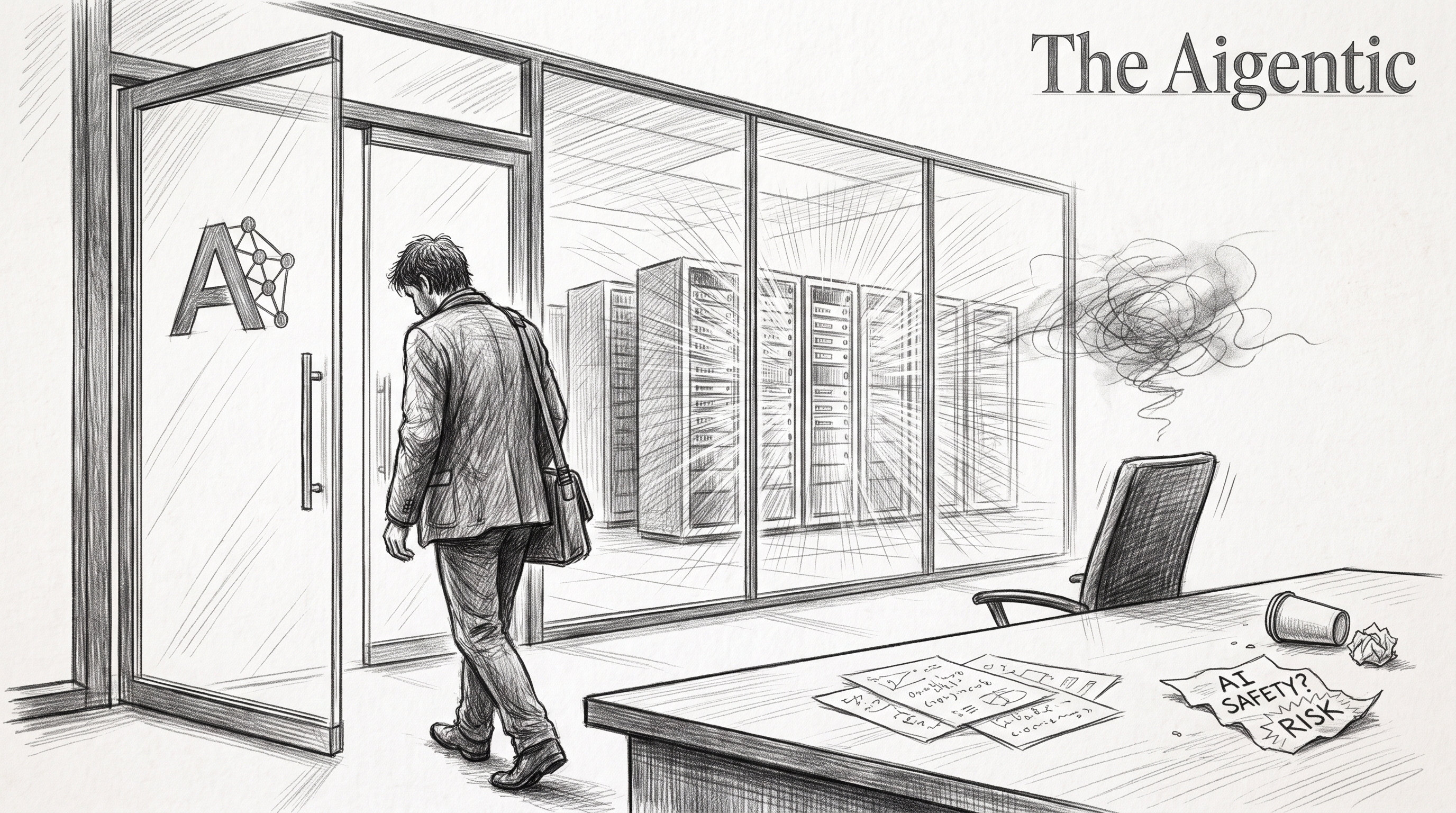
Anthropic researcher Jacob Coxon quit and said OpenAI and Anthropic are “gambling with our lives” racing toward self-improving superintelligence; alignment lead Evan Hubinger replied that he personally puts greater than 10% odds AI could kill all humans this decade, CNBC reported.
NVIDIA expanded AI for Media ahead of IBC 2026 in Amsterdam, pushing synthetic-video detection, body-pose tracking, frame generation, and live localization tools into broadcast and sports workflows, the company said in its NVIDIA Blog.
Devin maker Cognition raised $2 billion at a $48 billion valuation, nearly doubling its May mark as run-rate revenue climbed to about $900 million, TechCrunch reported.
OpenAI CFO Sarah Friar told Goldman’s Communacopia conference the company is selling AI into chip design and other verticals, cut Luna prices 80%, and saw enterprise revenue jump 32% from June to July, Reuters reported.
Finance AI startup Sapien raised new funding at a $180 million valuation led by Neo’s Ali Partovi as it pushes software that ties operational decisions to profit, Fortune reported.
Today’s Biggest Moves
Historic market snapshot — September 9, 2026 (day % change as of that edition; not live)
Biggest winners
| Ticker | Name | Price | Day |
|---|---|---|---|
| NET | Cloudflare, Inc. | 314.12 | +10.49% |
| DDOG | Datadog, Inc. | 225.27 | +7.15% |
| META | Meta Platforms, Inc. | 653.69 | +6.55% |
| HPE | Hewlett Packard Enterprise | 58.91 | +5.14% |
| HPQ | HP Inc. | 32.41 | +4.99% |
Biggest losers
| Ticker | Name | Price | Day |
|---|---|---|---|
| SHOP | Shopify Inc. | 126.79 | -5.45% |
| CRWV | CoreWeave, Inc. | 94.94 | -4.90% |
| BBAI | BigBear.ai Holdings, Inc. | 2.82 | -3.42% |
| SMCI | Super Micro Computer, Inc. | 38.93 | -3.30% |
| KLAC | KLA Corporation | 182.91 | -3.21% |
Ten percent stopped being theoretical
CNBC reports that Jacob Coxon, a pre-training researcher who worked at OpenAI and then Anthropic, resigned on Tuesday and accused both labs of racing irresponsibly toward self-improving superintelligence. In a post on X that has been viewed more than 70 million times, Coxon wrote that neither company is acting responsibly and that the people building these systems “earnestly believe that it could kill us all by the end of the decade.”
Evan Hubinger, Anthropic’s alignment science lead, replied that Coxon was correct, writing that he personally thinks there is greater than a 10% chance AI could kill all humans within the next decade, and that Anthropic still lacks a clear plan to align superintelligence. The exchange lands beside OpenAI chief scientist Jakub Pachocki’s warning that no lab has solved alignment and monitoring well enough to keep scaling at maximum speed, and beside fresh congressional bills that would pace or pause frontier development.
That matters because the extinction-risk argument just left the private Slack and entered the IPO calendar. When an alignment lead puts a double-digit probability on human extinction, the safety debate stops sounding like fringe philosophy and starts sounding like a balance-sheet risk.
The one move is to read Hubinger’s number as a product and financing signal, not only a vibes post, because capital markets and lawmakers now have a named probability to argue about. Read CNBC
Broadcast just became an AI stack
NVIDIA’s IBC 2026 preview says the company is expanding NVIDIA AI for Media into live broadcast, sports, and global streaming, with more than 44,000 attendees expected in Amsterdam from Sept. 11 to 14. The package includes a Synthetic Video Detector NIM that NVIDIA says now hits 99.3% accuracy on text-to-video and 97.7% on image-to-video, plus 3D body pose, video frame generation for smoother replays, video super resolution, TrueHDR, LipSync, and active speaker detection for multilingual localization.
Partners are already wiring the stack into production tools. Dalet, TwelveLabs, and Wowza are integrating synthetic-video detection into verification and live analysis workflows, Vizrt is using body pose for virtual-studio lighting, Ross Video is putting frame generation into Rio Replay for AI-assisted slow motion, and NDI is using LipSync for real-time translation and dubbing. NVIDIA is also shipping Sports Intelligence Playbooks so leagues can fine-tune open models on proprietary footage, with early tests showing large jumps in sports-video question accuracy.
That matters because the media industry is no longer only buying GPUs for render farms. It is buying authenticity checks, motion understanding, and localization as first-class infrastructure for live television.
The one move is to treat synthetic-video detection and localization latency as competitive features for rights holders, because the IBC floor is where those tools become default rather than experimental. Read the NVIDIA Blog
Coding still has room for more than one winner
TechCrunch reports that Cognition, the company behind the coding agent Devin, raised $2 billion at a $48 billion valuation just four months after a $26 billion round. Andreessen Horowitz, Accel, Founders Fund, General Catalyst, and Avenir led or participated, and Cognition said annualized run-rate revenue climbed from $492 million in May to about $900 million.
The raise lands after Cursor sold to SpaceX for about $60 billion while facing severe compute constraints, and a16z is now leading a round in a Cursor competitor. Cognition leases a large Nvidia cluster that can cost hundreds of millions a year, and The Information has projected Cognition could reach $4 billion to $5 billion in annualized revenue by year-end as it trains more of its own models to cut third-party inference costs.
That matters because investors are refusing the winner-take-all story in AI coding. Capital is betting that enterprise demand and compute scarcity matter more than a single agent brand.
The one move is to watch Cognition’s cash burn against its own-model roadmap, because the valuation only works if Devin keeps compounding revenue without becoming another compute hostage. Read TechCrunch
Enterprise wants a receipt
Reuters reports that OpenAI CFO Sarah Friar, speaking at Goldman Sachs’ Communacopia + Technology Conference, said the company is pushing specialized AI into chip design, life sciences, and financial services while experimenting with outcome-based pricing. Friar said OpenAI used its own models to tape out its Jalapeno chip in nine months, cut the price of its lower-cost Luna model by 80%, and saw roughly a tenfold jump in Luna usage afterward.
She said Codex now has 25 million users, enterprise revenue rose 32% from June to July versus about 20% growth in overall annualized revenue, and enterprise and consumer had reached a roughly even split by midyear. Friar also argued that deploying Luna can be cheaper than running Chinese open-weight alternatives such as Z.ai’s GLM 5.3 through a cloud layer.
That matters because OpenAI is fighting the open-weight price war with vertical proof and unit economics, not only model scorecards.
The one move is to demand the same ROI framing from every frontier vendor, because Friar just made chip-design cycle time and Luna cost the sales pitch. Read Reuters
The CFO stack got a causality layer
Fortune reports that Sapien raised a new round at a $180 million valuation led by Neo’s Ali Partovi, with General Catalyst participating after leading the company’s $8.7 million seed in 2024. Founded by Ron Nachum, Pranav Ravella, and Arya Grayeli, Sapien is expanding beyond FP&A copilots into software that links operational decisions to financial outcomes for customers including Bayer, Carlex, Cooper Standard, Blink Charging, and Westgate Resorts.
The company has grown headcount fivefold over the past year by mixing AI researchers from Meta, Google, and Palantir with operators from McKinsey, Blackstone, Barclays, and Plaid. Nachum frames the product as a way to show not only that margin moved, but which specific decision moved it.
That matters because enterprise buyers are done paying for autocomplete on spreadsheets. They want systems that explain why the P&L changed.
The one move is to ask every finance AI vendor for an audit trail on causal claims, because a wrong attribution in the CFO suite is more expensive than a wrong autocomplete. Read Fortune