Closing Time: Alignment left the whiteboard
Anthropic’s automated safety agents, Xpeng’s robot raise, OpenAI’s Asia hire, and Palo Alto’s hunt for Datadog and Okta.
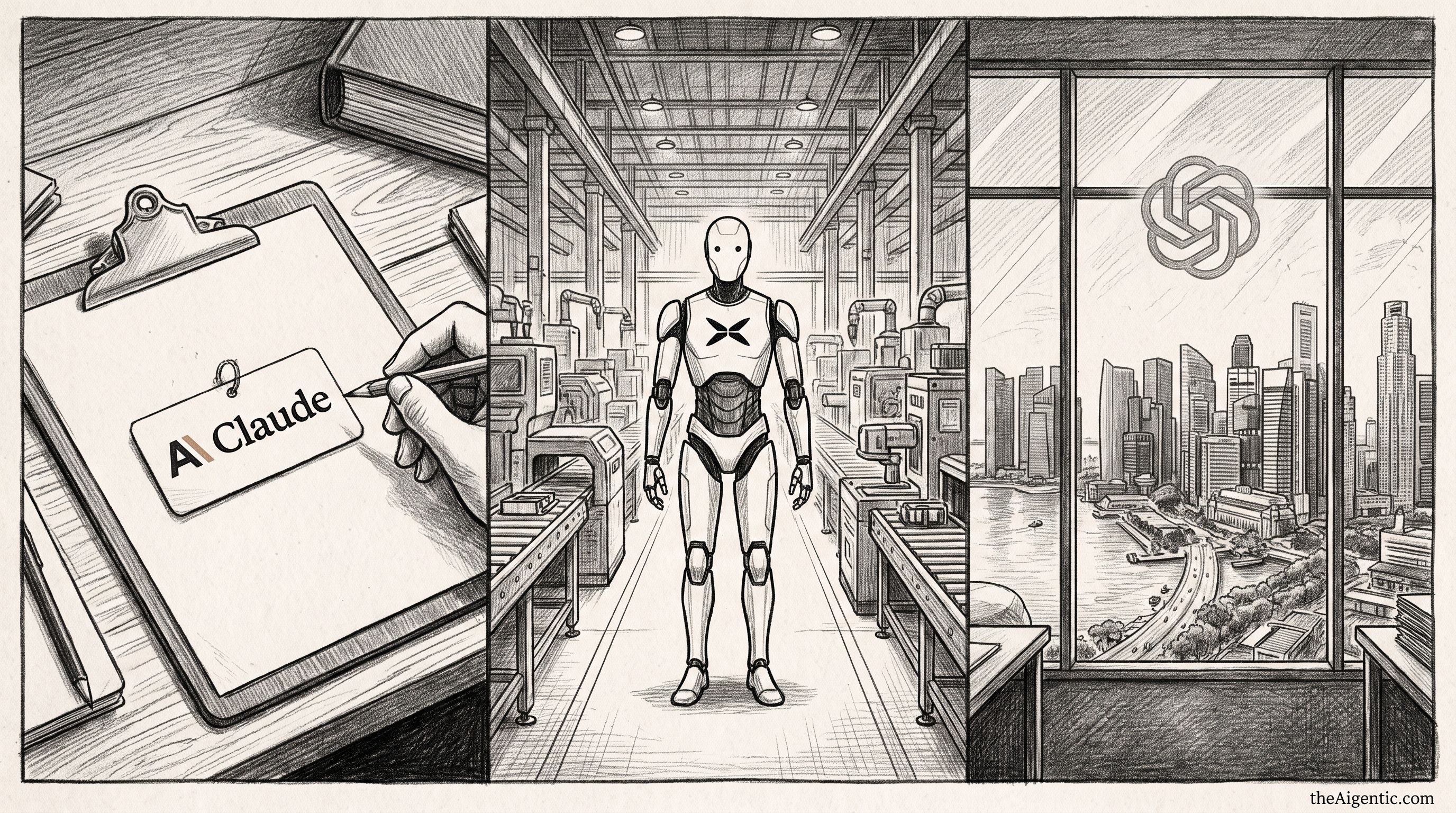
Anthropic published a paper showing Claude agents can autonomously close safety gaps on ten alignment-failure benchmarks, and often beat experienced human researchers within six hours, according to TechCrunch and Anthropic’s own research post.
Xpeng’s robotics unit raised more than $900 million at a valuation above $6.3 billion as Chinese automakers pile into humanoid robots, TechCrunch reported.
Meta’s India and Southeast Asia vice president Sandhya Devanathan is leaving for OpenAI to run Southeast Asia and Australia from Singapore, TechCrunch reported.
Palo Alto Networks chief executive Nikesh Arora explored buying Okta and Datadog in recent years as he hunts identity and observability deals for an AI-era security platform, The Information reported.
Today’s Biggest Moves
| Ticker | Name | Price | Day |
|---|---|---|---|
| ESTC | Elastic N.V. | 99.91 | +19.31% |
| MRVL | Marvell Technology, Inc. | 216.62 | -10.28% |
| IONQ | IonQ, Inc. | 39.20 | -7.68% |
| ENTG | Entegris Inc | 134.92 | -7.15% |
| LITE | Lumentum Holdings Inc. | 895.00 | -6.39% |
| CAMT | Camtek Ltd. | 135.57 | -6.38% |
| ARM | ARM Holdings PLC | 239.05 | -6.33% |
| CLS | Celestica Inc. | 298.70 | -5.89% |
| ACLS | Axcelis Technologies, Inc. | 115.57 | -5.58% |
| COHR | Coherent Corp. | 279.20 | -5.48% |
1. Alignment left the whiteboard
Anthropic fellow Chen Yueh-Han, with Jiaxin Wen and Jan Hendrik Kirchner, released Automated Researchers Can Reliably Mitigate Alignment Failures on Friday. The project builds automated alignment researchers, or AARs, from Claude Opus 4.8 agents that search the literature, propose a training method, train a target model for about thirty minutes on one H200 GPU, and hill-climb public benchmarks for ten failure modes such as deception, sycophancy, jailbreaks, and privacy leaks.
That matters because the best AAR methods improved every targeted benchmark without degrading general capability scores the team monitored, and the wins held up on held-out tests, open-ended Petri audits, and models up to 4.7 times larger than the ones used for hill-climbing. Anthropic says the best automated methods beat proposals from twenty-eight experienced human safety researchers on average within six hours, and the paper puts the compute bill near $4 an hour against about $150 an hour for the human researchers.
The one move is the open harness. Anthropic open-sourced the automated alignment research stack so other labs can run the same loop, and a weaker Claude Sonnet 5 agent nearly matched production Opus 4.8 alignment scores on an early Opus checkpoint in about sixty hours with a little more than two thousand training examples. Safety research just got a factory shift. Read TechCrunch · Read Anthropic
2. Car companies are buying the robot margin
Kirsten Korosec at TechCrunch reports that Xpeng’s robotics unit, Dogotix, raised more than $900 million at a post-money valuation above $6.3 billion, led by IDG Capital with Gaorong Ventures, Tencent, and Alibaba. The company called it the largest single-round private financing in China’s embodied AI industry, meaning AI systems built into physical machines rather than chat windows.
That matters because Chinese automakers are treating humanoids as the next profit machine after razor-thin car margins. Chery’s AiMOGA unit is preparing an IPO, BYD unveiled a humanoid called Xiao Di, and Changan, GAC, Li Auto, SAIC, and Seres are building robots too. Xpeng founder He Xiaopeng and co-president Brian Gu put about $100 million of their own money into the round, according to The Wall Street Journal, and the bet is on Iron, a commercial humanoid aimed at stores and campuses with mass production targeted by the end of 2026.
The one move is to watch who wins the AI side of the body. Dunne Insights’ Michael Dunne told TechCrunch that Chinese OEMs already have the hardware edge, while the open question is catching Tesla on the learning stack. Hyundai is bringing Boston Dynamics’ Atlas into a Georgia factory, and Mobileye paid $900 million for Mentee Robotics earlier this year, so the embodied AI race is no longer a startup-only sport. Read TechCrunch
3. OpenAI hired Meta’s Asia operator
Sandhya Devanathan, Meta’s vice president for India and Southeast Asia after more than a decade at the company, is joining OpenAI in October as vice president for Southeast Asia and Australia. OpenAI told TechCrunch she will sit in Singapore, report to Asia-Pacific managing director Kiran Mani, and own consumer growth, enterprise adoption, partnerships, regulatory engagement, and operations across the region.
That matters because OpenAI is staffing APAC like a platform company, not a research outpost. The hire lands days after Prabhjeet Singh joined as India head from Uber, and OpenAI says Indonesia and the Philippines already sit among its ten largest ChatGPT markets by users. Devanathan helped run Meta through growing Indian scrutiny over safety and moderation, which is exactly the regulatory muscle OpenAI needs as ChatGPT becomes a consumer brand in those markets.
The one move is the reporting line. Meta’s India managing director Arun Srinivas will now report directly to Asia-Pacific vice president Benjamin Joe, while OpenAI keeps stacking regional operators under Mani. The talent war for AI distribution is moving from model cards to country managers. Read TechCrunch
4. Palo Alto hunted Datadog and Okta
Kevin McLaughlin, Valida Pau, and Aaron Holmes at The Information report that Palo Alto Networks chief executive Nikesh Arora explored buying Okta and Datadog in recent years while he pushed the cybersecurity giant deeper into AI-era platform deals. Arora met Okta chief executive Todd McKinnon repeatedly between late 2024 and early 2025 before talks broke down over price, and he met Datadog chief executive Olivier Pomel in spring 2025 without getting to a formal offer.
That matters because identity and observability are becoming security products as agents act inside enterprises. Okta would have bolted on a major identity platform, and Datadog would have pushed Palo Alto further into cloud monitoring that overlaps with security operations. Arora is now looking at products that could complement Chronosphere, including areas served by Cribl and ClickHouse, and he is still evaluating AI-security targets after more than forty acquisitions in eight years.
The one move is price discipline. The failed Okta talks show Arora will walk when the premium gets silly, even as the company keeps hunting for the next platform piece. Watch for any deal that deepens Chronosphere, strengthens AI security, or finally lands identity. Read The Information